The Hundred Poets, Part II
|
|
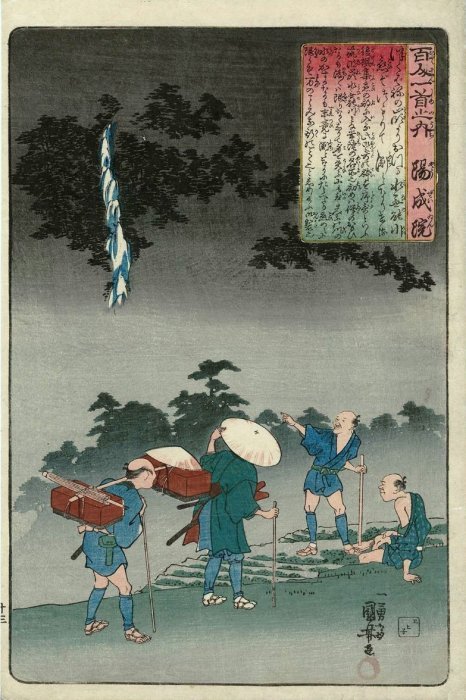
Number: 13 Poet: Emperor Yôzei-in (陽成院) Scene: Two travelers
viewing the Mina Waterfall pointed out to them by two peasants Robinson: S19.13 The poem translates: From Tsukuba’s peak Falling waters have
become Mina’s still, full flow: So
my love has grown to be Like the river’s quiet
deeps. |
|
|
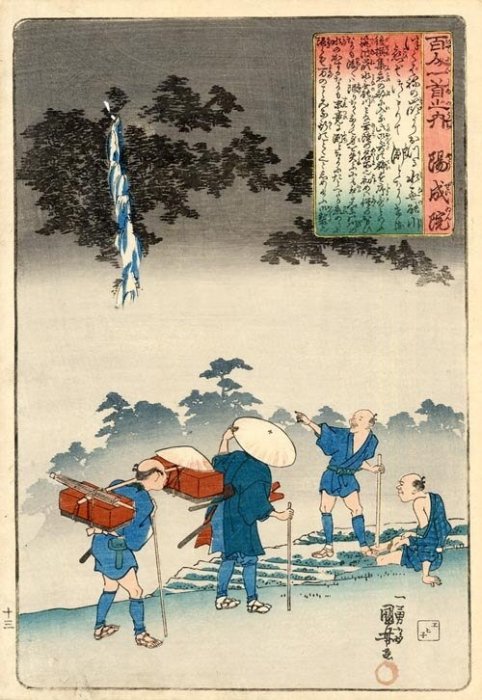
This is another version of the above print. A careful comparison of some detail, such
as the script, will demonstrate that they are identical proving that they
were printed from the same woodblocks. |
|
|
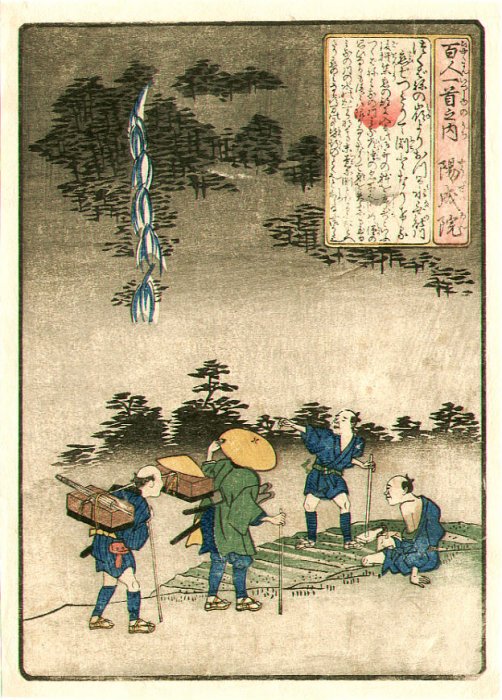
This is another unsigned copy printed with newly carved
woodblocks. |
|
|
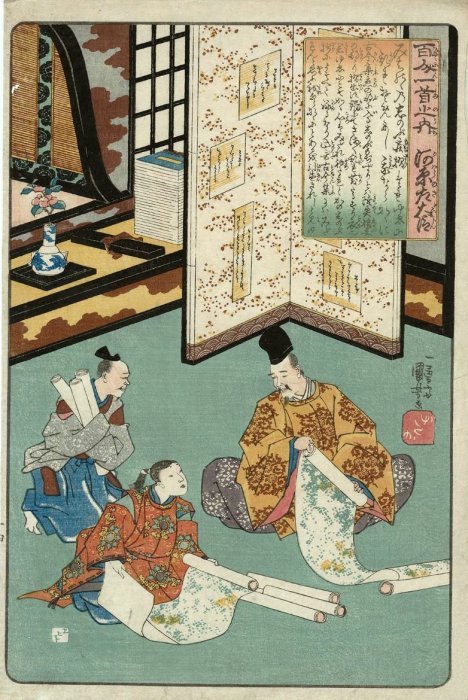
Number: 14 Poet: Kawara no Sadaijin (河原左大臣), also known
as Minamoto no Toru Scene: Kawara no Sadaijin with a court page and an attendant examining
roles of Michinoku flower-printed cloth Robinson: S19.14 The poem translates: Like Michinoku prints Of the tangled leaves of
ferns, It is because of you That I have become
confused; But my love for you
remains.
|
|
|
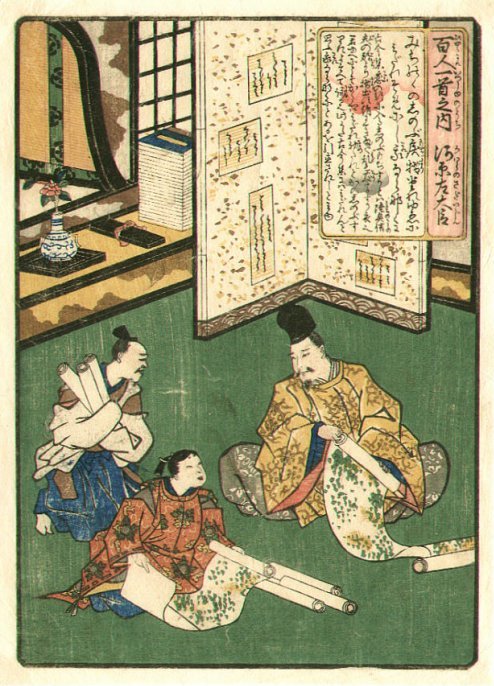
This is another unsigned copy printed with newly carved
woodblocks. |
|
|
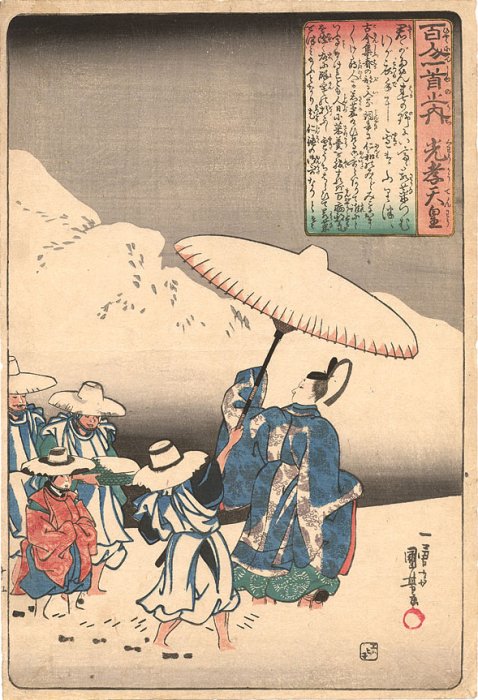
Number: 15 Poet: Emperor Kôkô Tennô (光孝天皇) Scene: Emperor Kôkô Tennô walking in the snow with
four attendants, one of whom is holding an umbrella Robinson: S19.15 The poem translates: It is for your sake That I walk the fields
in spring, Gathering green herbs, While my garment’s
hanging sleeves Are speckled with
falling snow. |
|
|
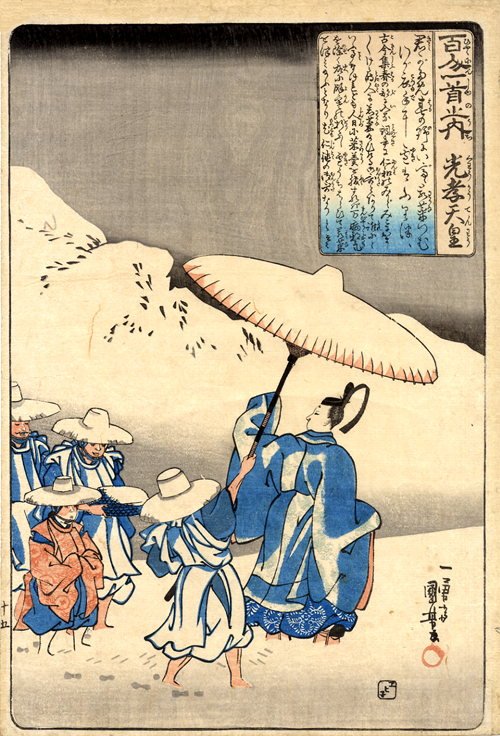
This is another state of the above print in which green was
replaced with a dark blue. |
|
|
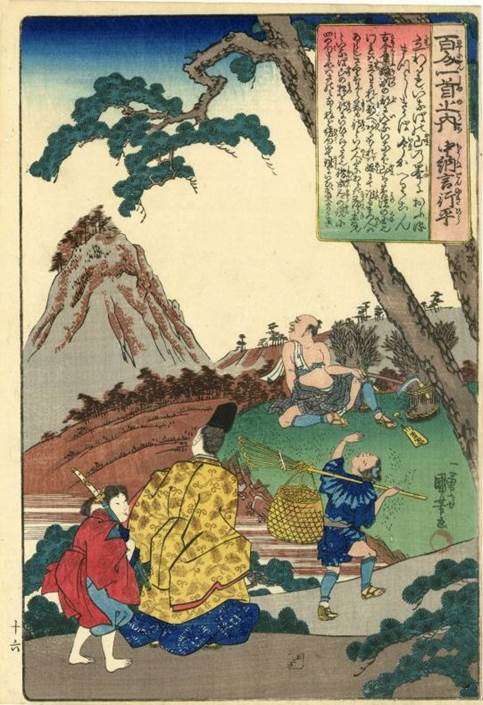
Number: 16 Poet: Chûnagon Yukihira (中納言行平) also known as
Ariwara no Yukihira Scene: Chûnagon Yukihira with his page looking across a valley
towards Mount Inaba, as does a woodcutter with his boy Robinson: S19.16 The poem translates: Though we are parted, If on Mount Inaba’s peak I should hear the sound Of the pine trees
growing there, I’ll come back again to
you. |
|
|
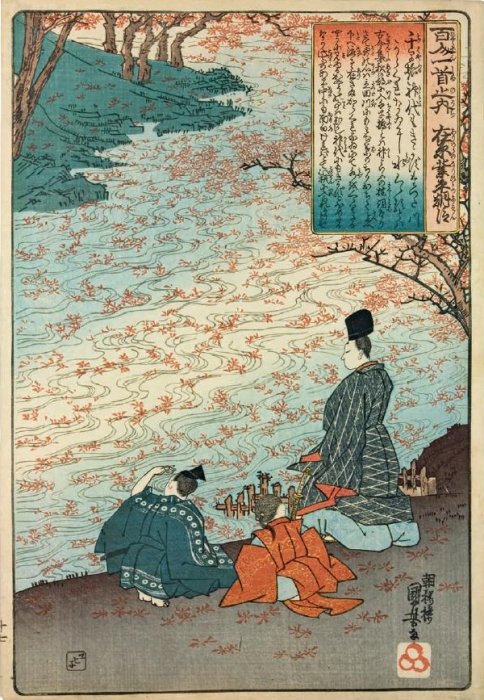
Number: 17 Poet: Ariwara no Narihira Ason (在原業平朝臣) Scene: Ariwara no Narihira Ason with a
page and an attendant on the banks of the Robinson: S19.17 The poem translates: Even when the gods Held sway in the ancient
days, I have never heard That water gleamed with
autumn red As it does in Tatta’s
stream NOTE: This print is
generally considered the masterpiece of the series and one of Kuniyoshi’s
greatest works. |
|
|
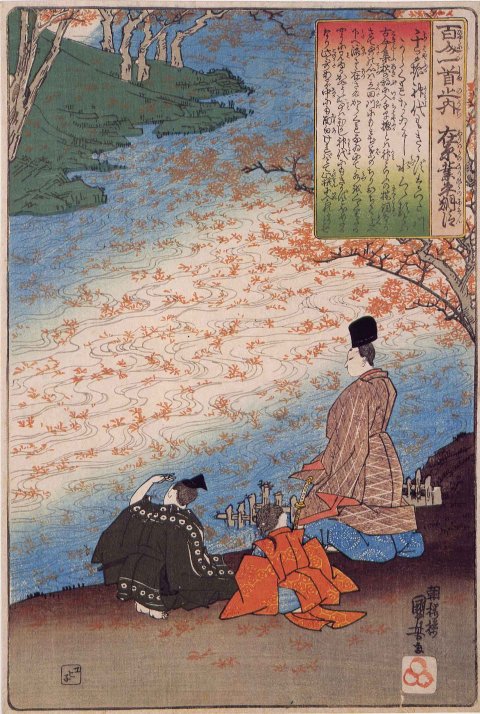
Another state of the above design |
|
|
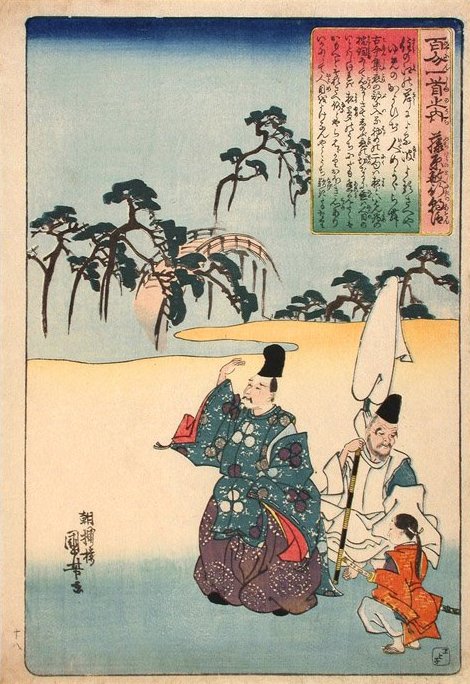
Number: 18 Poet: Fujiwara no
Toshiyuki Ason (藤原敏行朝臣) Scene: Fujiwara no
Toshiyuki Ason with a page and an attendant viewing the drum-bridge of Robinson: S19.18 The poem translates: The waves are gathered On the shore of And in the gathered
night, When in dreams I go to
you, I hide from people’s
eyes. |
|
|
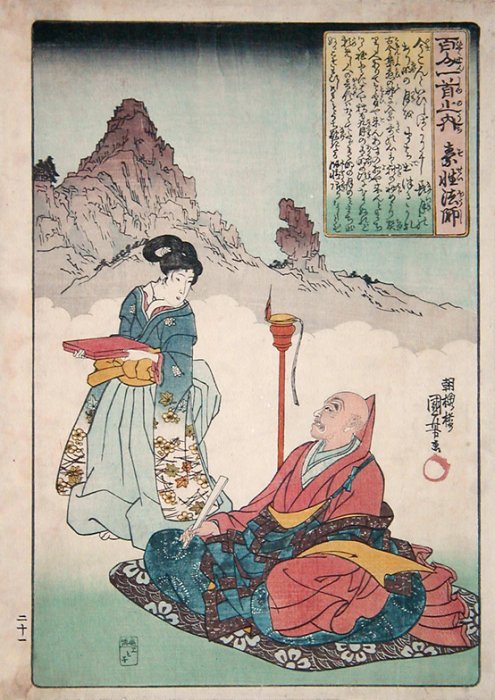
Number: 21 Poet: Sosei-hôshi (The Monk Sosei, 素性法師) Scene: Sosei-hôshi seated on mat addressing his page with a
rocky mountain in the background Robinson: S19.21 The poem translates: Just because she said, “In a moment I will
come,” I’ve awaited her Until the moon of
daybreak, In the long month, has
appeared.
|
|
|
Another state of the above design |
|
|
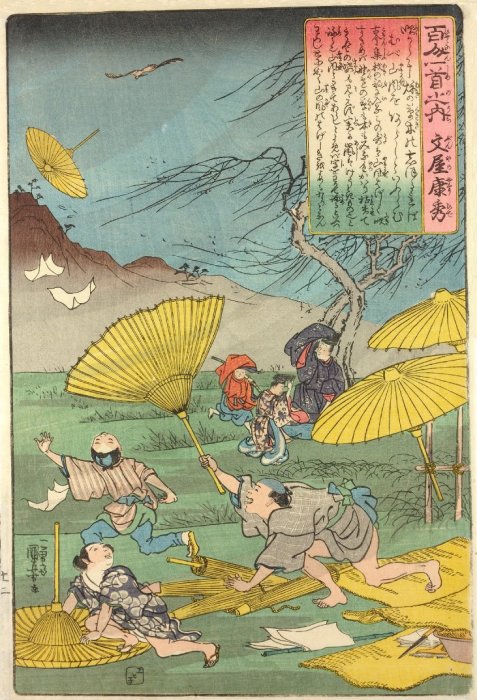
Number: 22 Poet: Bunya
(Fumiya) no Yasuhide (文屋康秀) Scene: Bunya no Yasuhide with a page and attendant under a willow tree
with an umbrella seller’s stock being scattered by the wind Robinson: S19.22 The poem translates: It is by its breath That autumn’s leaves of
trees and grass Are wasted and driven. So they call this
mountain wind The wild one, the
destroyer. |
|
|
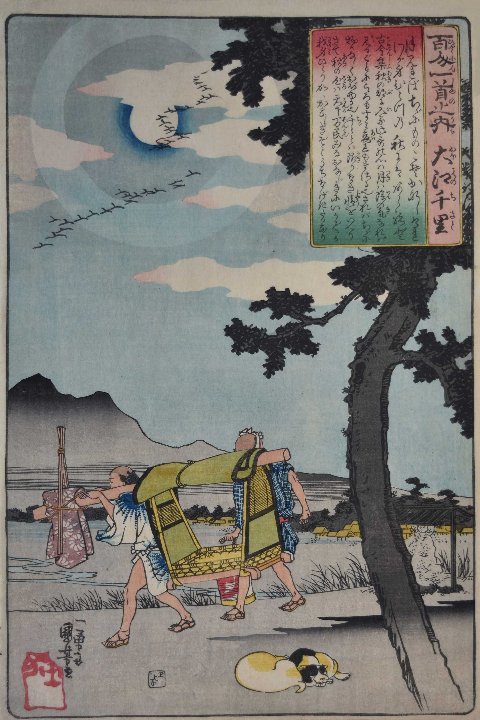
Number: 23 Poet: Ôe no Chisato (大江千里) Scene: Two bearers
on the road with an empty palanquin and a full moon with halo above Robinson: S19.23 The poem translates: As I view the moon, Many things come into my
mind, And my thoughts are sad; Yet it’s not for me
alone, That the autumn time has
come. |
|
|
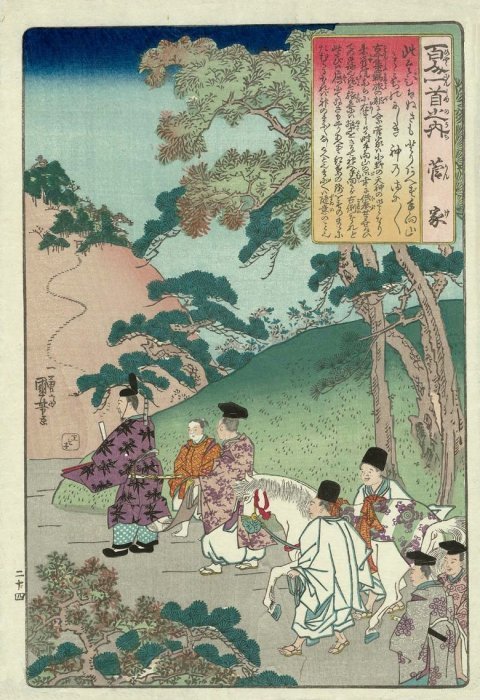
Number: 24 Poet: Kanke (管家) also known as
Sugawara no Michizane Scene: Kanke leading
a procession of courtiers and attendants escorting a white horse to a Shinto
shrine on a hill Robinson: S19.24 The poem translates: At the present time, Since I could bring no
offering, See Here are brocades of red
leaves, As a tribute to the
gods. |
|
|
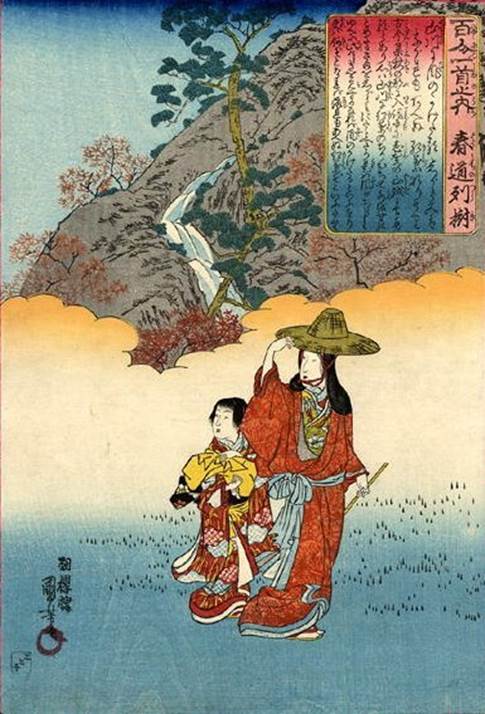
Number: 32 Poet: Harumichi no Tsuraki (春道列樹) Scene: Female
pilgrim walking with her little maid.
A waterfall is seen beyond the mist Robinson: S19.32 The poem translates: In a mountain stream There is a wattled
barrier Built by the busy wind. Yet it’s only maple
leaves, Powerless to flow away. |
|
|
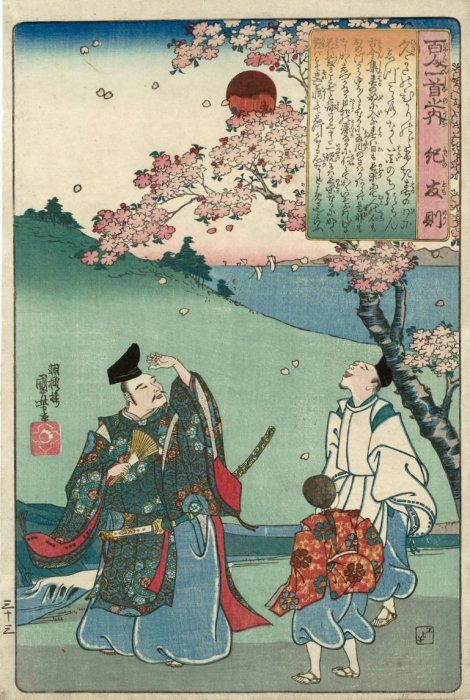
Number: 33 Poet: Ki no
Tomonori (紀友則) Scene: Ki no
Tomonori with a page and attendant watching falling cherry blossoms with the
sea in the background Robinson: S19.33 The poem translates: In the peaceful light Of the ever-shining sun In the days of spring, Why do the cherry’s
new-blown blooms Scatter like restless
thoughts? |
|
|
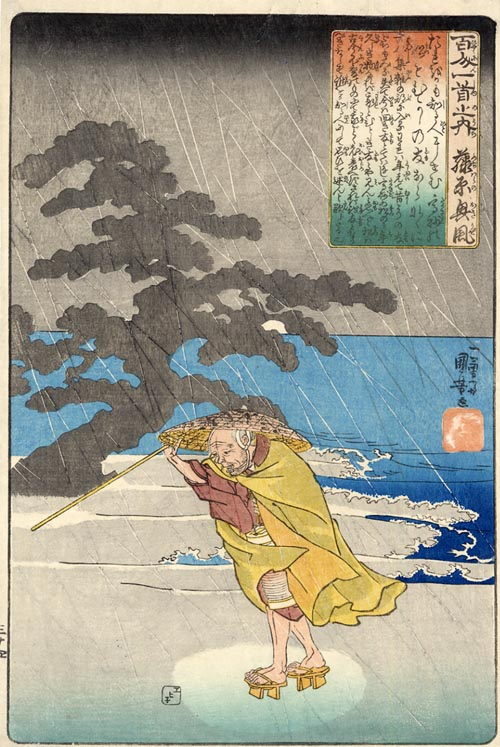
Number: 34 Poet: Fujiwara no Okikaze (藤原興風) Scene: Fujiwara no Okikaze walking along shore on rainy night by the ancient
pine tree of Takasago Robinson: S19.34 The poem translates: Who is still alive When I have grown so old That I can call my
friends? Even Takasago’s pines No longer offer comfort.
|
|
|
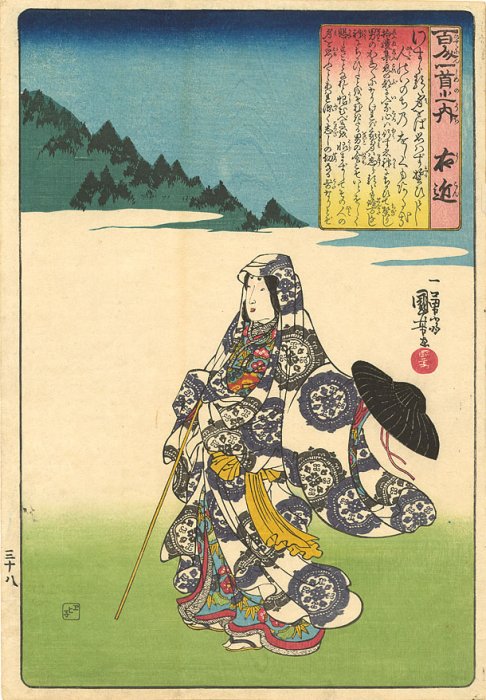
Number: 38 Poet: Lady Ukon (右近) Scene: The poetess
carrying a wide-brimmed black hat with a wooded hill beyond the mist Robinson: S19.38 The poem translates: Though he forsook me, For myself I do not
care: He made a promise, And his life, who is
forsworn, Oh how pitiful that is. |
|
|
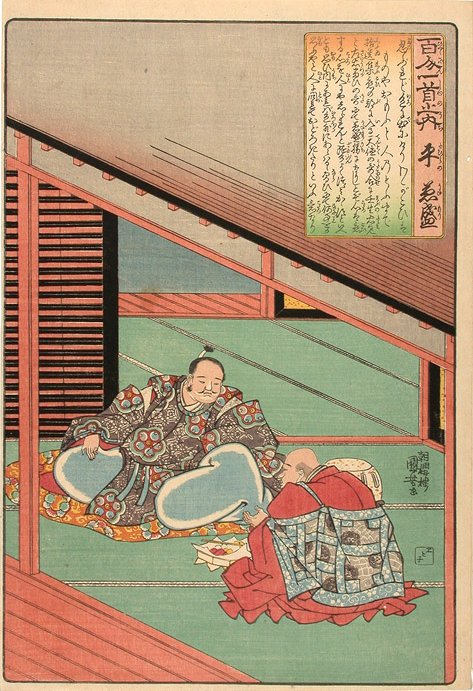
Number: 40 Poet: Taira no Kanemori (平兼盛) Scene: Taira no Kanemori dining with a priest inside a palace Robinson: S19.40 The poem translates: Though I would hide it, In my face it still
appears– My fond, secret love. And now he questions me: “Is something bothering
you?” |
|
|
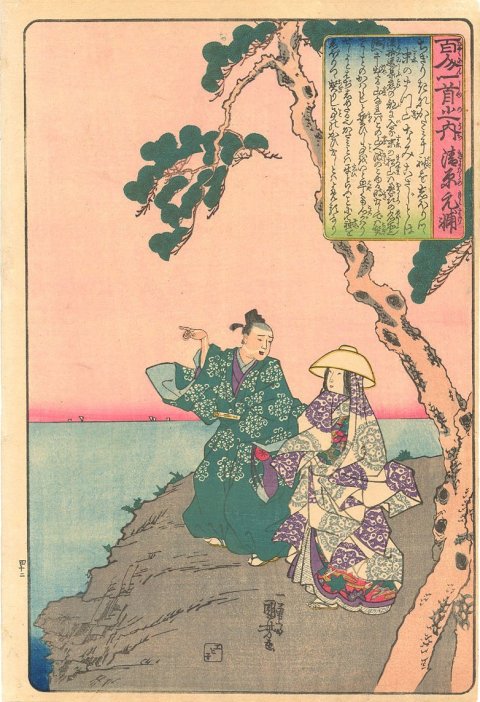
Number: 42 Poet: Kiyowara no Motosuke (清原元輔) Scene: Kiyowara no Motosuke with his
lady on a cliff pointing out over the sea Robinson: S19.42 The poem translates: Our sleeves were wet
with tears As pledges that our
love– Will last until Over Sue’s Mount of
Pines Ocean waves are
breaking. |
|
|
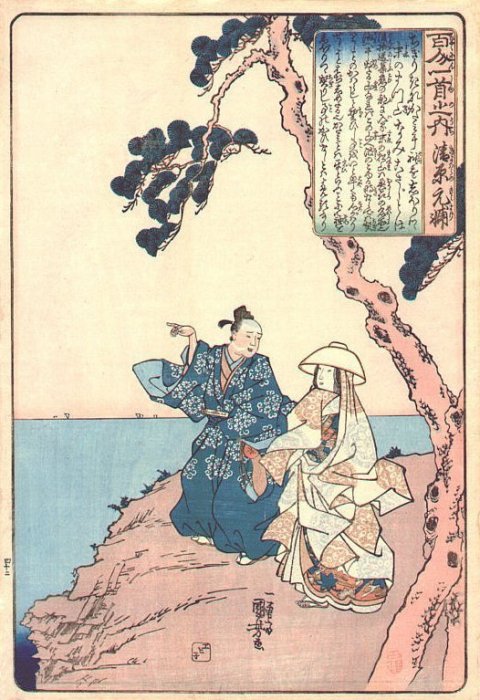
Another state of the above design |

|
“Robinson” refers to listing in Kuniyoshi: The Warrior-Prints by Basil William Robinson (Cornell University Press, Ithaca, NY, 1982) and its privately published supplement.
|