The Hundred Poets, Part
|
|
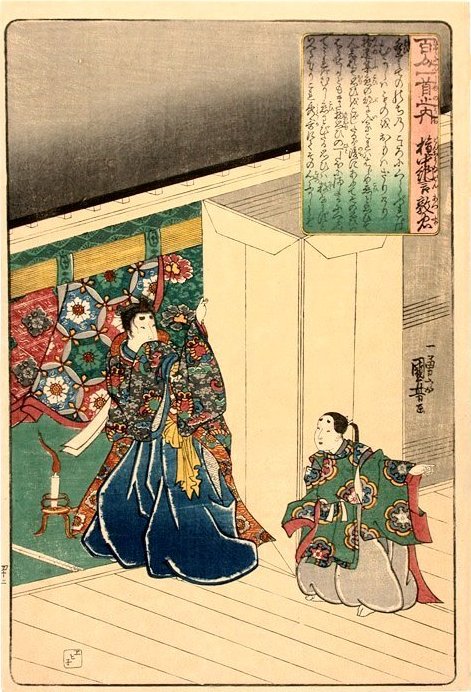
Number: 43 Poet: Gonchûnagon Atsutada (権中納言敦忠), who is also
known as Fujiwara no Atsutada Scene: Gonchûnagon Atsutada standing
by a screen receiving a message from a page Robinson: S19.43 The poem translates: I have met my love. When I compare this
present With feelings of the
past, My passion is now as if I have never loved
before. |
|
|
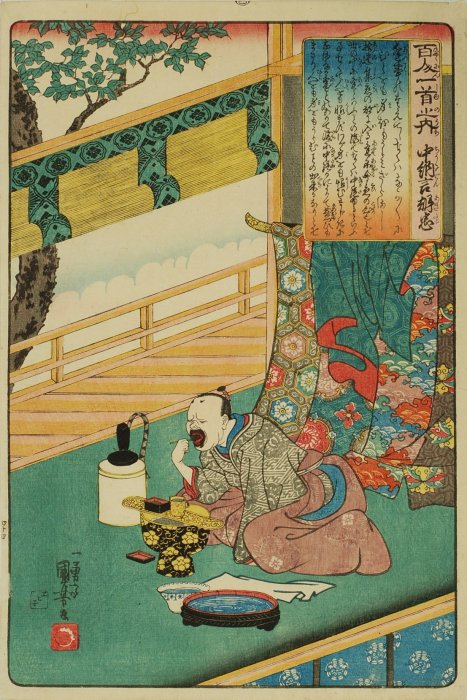
Number: 44 Poet: Chûnagon Asatada (中納言朝忠), who is also known as Fujiwara
no Asatada Scene: Chûnagon Asatada kneeling on
the veranda of a palace while painting his teeth black Robinson: S19.44 The poem translates: If it should happen That we never met again, I would not complain; And I doubt that she or
I Would feel that we were
left alone. Image courtesy of Marie de Strycker |
|
|
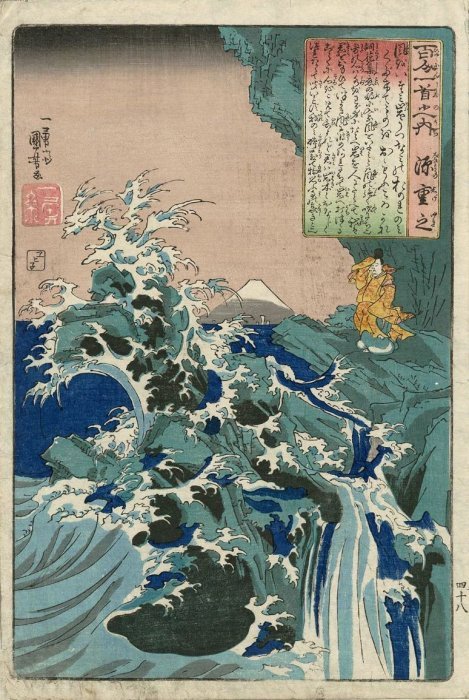
Number: 48 Poet: Minamoto no
Shigeyuki (源重之) Scene: Minamoto no Shigeyuki standing
on a rocky promontory watching the raging waves below with Mount Fuji in the
distance Robinson: S19.48 The poem translates: Like a driven wave, Dashed by fierce winds
on a rock, So am I: alone And crushed upon the
shore, Remembering what has
been.
|
|
|
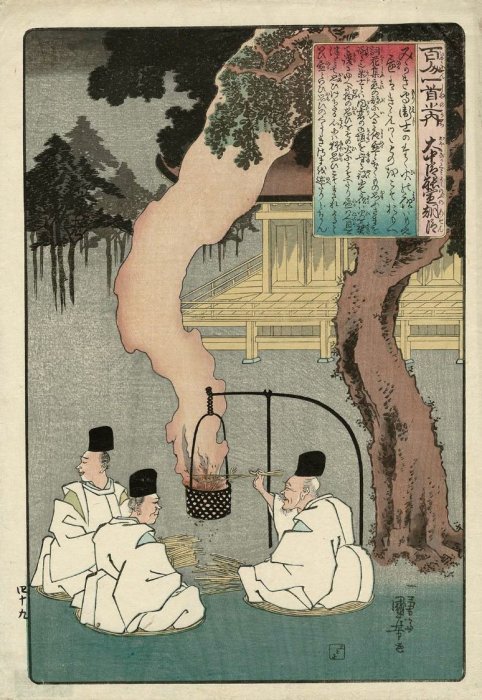
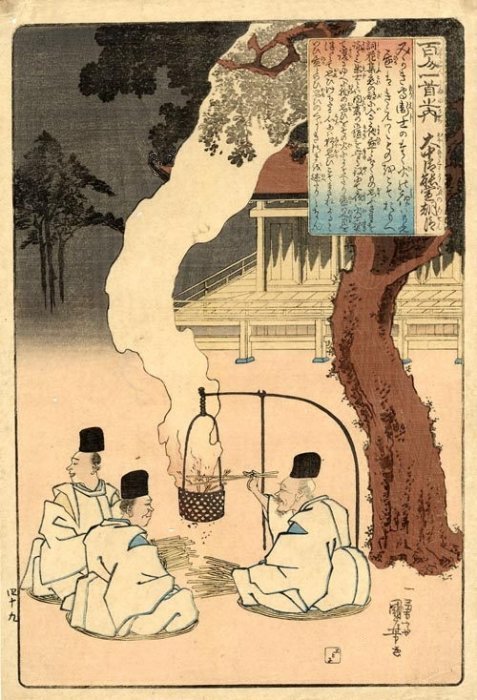
Number: 49 Poet: Ônakatomi no Yoshinobu Ason (大中臣能宣朝臣) Scene: Three palace
guards sitting around a fire at night Robinson: S19.49 The poem translates: Like the guard’s fires Kept at the imperial
gateway– Burning through the
night, Dull in ashes through
the day– Is the love aglow in me? |
|
|
This is a later and less labor intensive edition of the above
print |
|
|
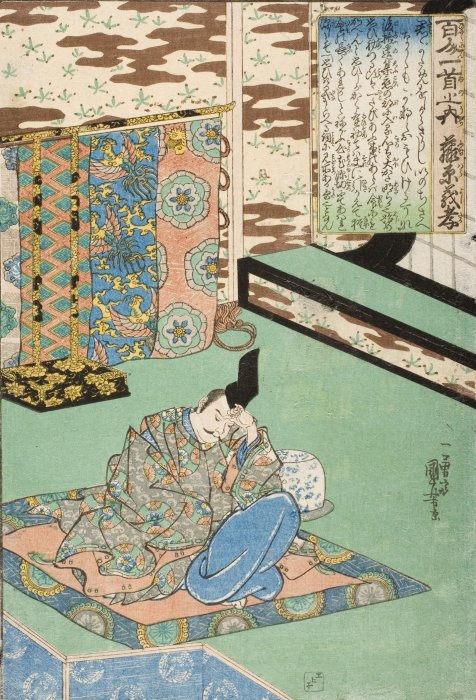
Number: 50 Poet: Fujiwara no
Yoshitaka (藤原義孝) Scene: Fujiwara no Yoshitaka
seated in reverie in a palace with his hand on his forehead Robinson: S19.50 The poem translates: For your precious sake, Once my eager life
itself Was not dear to me. But now it is my heart’s
desire It may long, long years
endure. |
|
|
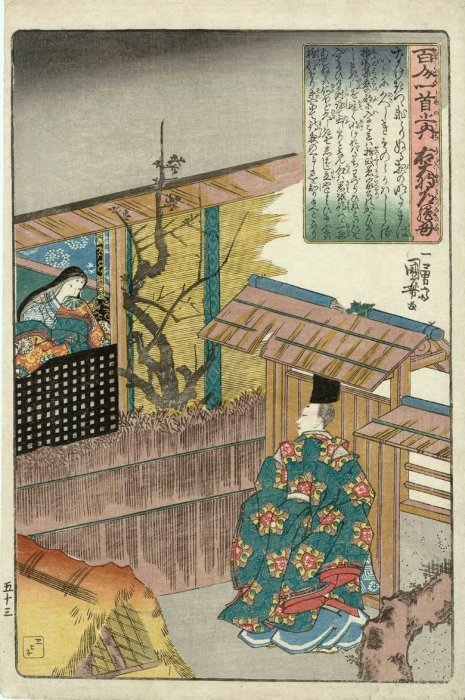
Number: 53 Poet: The mother of
Udaishô Michitsuna (右大将道綱の母) Scene: The poetess
looking out from her window as a noble gentleman-caller comes to her gate Robinson: S19.53 The poem translates: Lying all alone, Through the hours of the
night, Till the daylight comes: Can you realize at all The emptiness of that
night? |
|
|
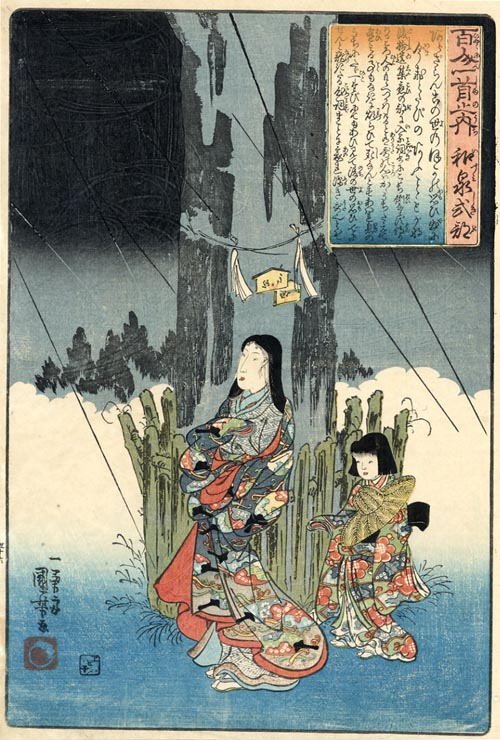
Number: 56 Poet: Lady Izumi-shikibu (和泉式部) Scene: The poetess
and her maid walking in the rain past an enormous pine tree Robinson: S19.56 The poem translates: Soon my life will close. When I am beyond this
world And have forgotten it, Let me remember only
this: One final meeting with
you. |
|
|
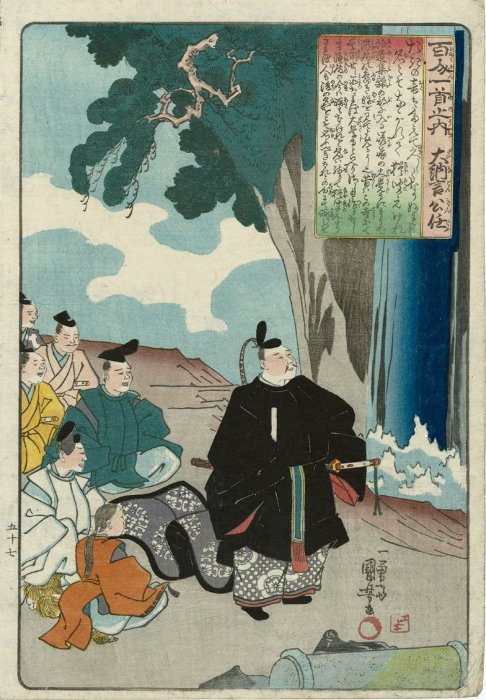
Number: 57 Poet: Dainagon Kintô (大納言公任), who is also
known as Fujiwara no Kintô Scene: Dainagon Kintô with a page and
five attendants viewing a waterfall with an overhanging pine tree Robinson: S19.57 NOTE: Although this
print is clearly numbered 57 in the left margin, Dainagon
Kintô is usually assigned number 55. The poem translates: Though the waterfall Ceased its flowing long
ago, And its sound is
stilled, Yet, in name it ever
flows, And in fame may yet be
heard. |
|
|
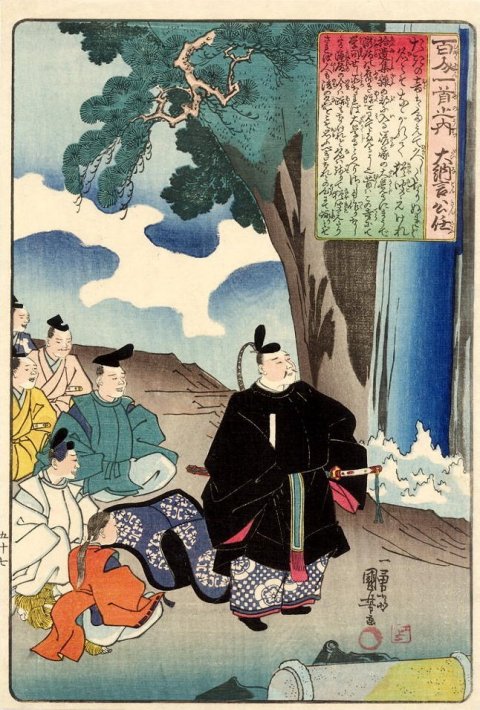
Another state of the above design |
|
|
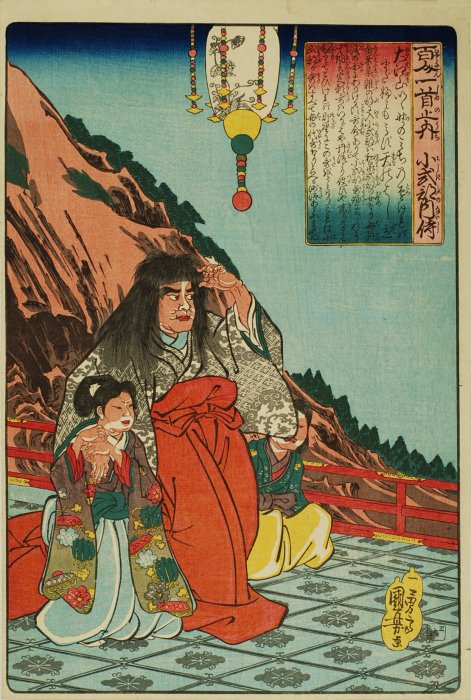
Number: 60 Poet: Lady Koshikibu-no-naishi (小式部内侍) Scene: The Shuten-dôji on a terrace by the wooded mountainside of Ôyeyama Robinson: S19.60 NOTE: The Shuten-dôji was a red-skinned demon eventually killed by Raikô The poem translates: By Oe Mountain The road to Ikuno Is far away, And neither have I
beheld Nor crossed its bridge
of heaven. Image courtesy of Marie de Strycker |
|
|
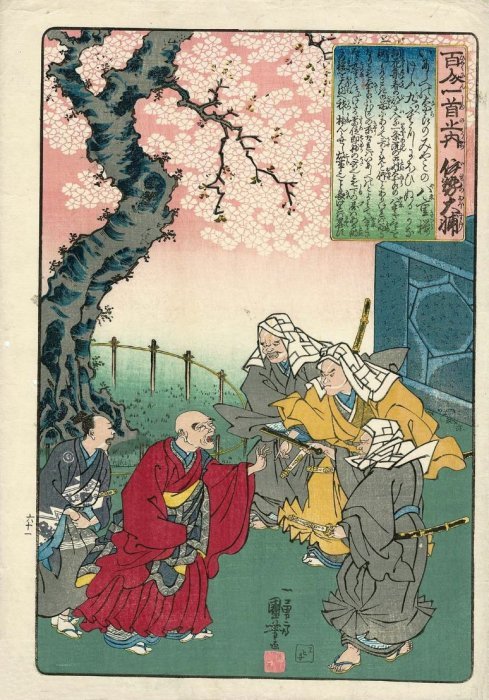
Number: 61 Poet: Lady Ise-no-ôsuke (or Ise-no-tayû, 伊勢大輔) Scene: A priest and
his attendant waylaid under a blossoming cherry tree by three yamabushi
(ascetic warrior-priests) Robinson: S19.61 The poem translates: Eight-fold cherry
flowers That at Nara–ancient seat Of our state–have
bloomed, In our nine-fold palace
court Shed their sweet perfume
today. |
|
|
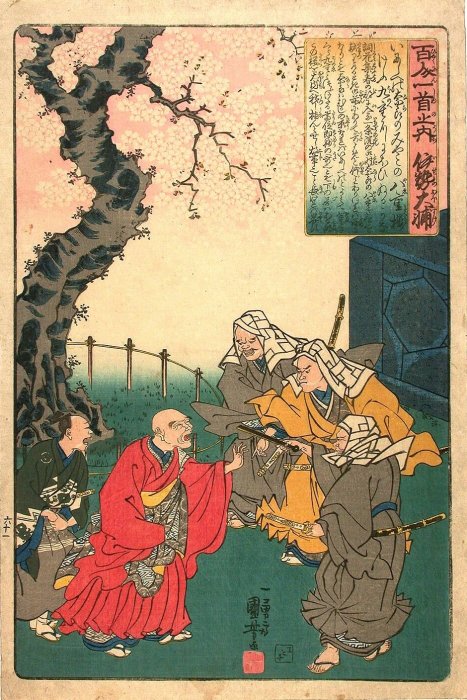
This alternate state of the above design has slightly different
colors. (Note the yellow in the large
cartouche.) Both states were printed
from the same woodblocks. |
|
|
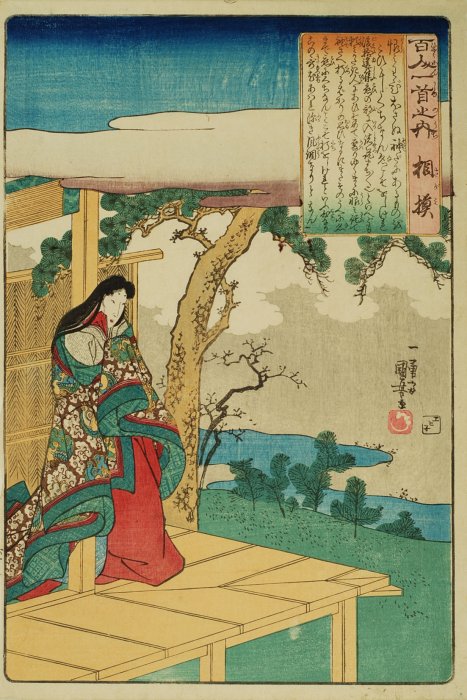
Number: 62 Poet: Lady Sagami (相模) Scene: The poetess
on her veranda in the evening looking out over a river in the mist Robinson: S19.62 NOTE: Although this
print is numbered 62, Lady Sagami is usually assigned number 65. The poem translates:
Even when your hate
Makes me stain my sleeves with tears
In cold misery,
Worse than hate and misery Is the loss of my good
name. Image courtesy of Marie de Strycker |
|
|
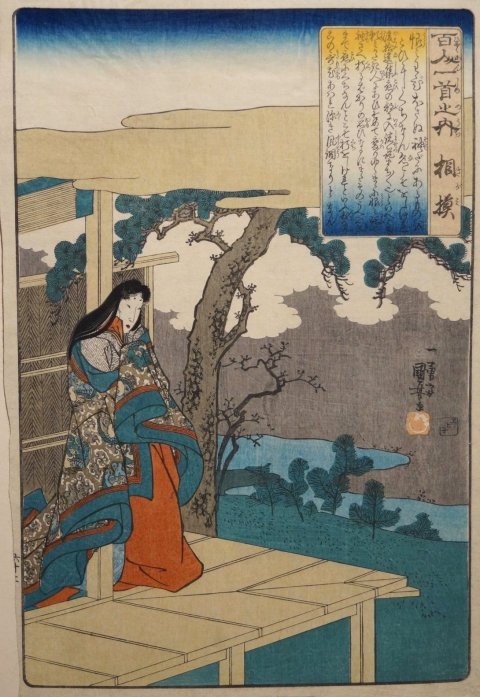
Another state of the above design |
|
|
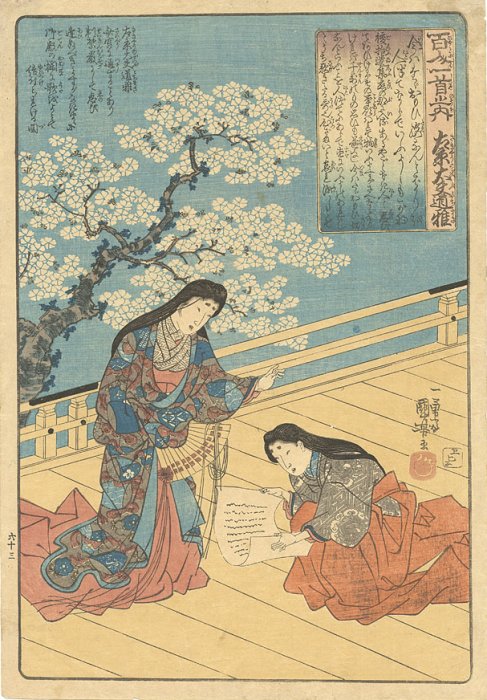
Number: 63 Poet: Sakyô-no-daibu Michimasa (左京大夫道雅) also known as
Fujiwara no Michimasa Scene: Two court
ladies examining a scroll on a veranda with blossoming cherry trees behind Robinson: S19.63 The poem translates: Is there any way Except by a messenger To send these words to
you? If I could, I’d come to
you To say goodbye forever. |
|
|
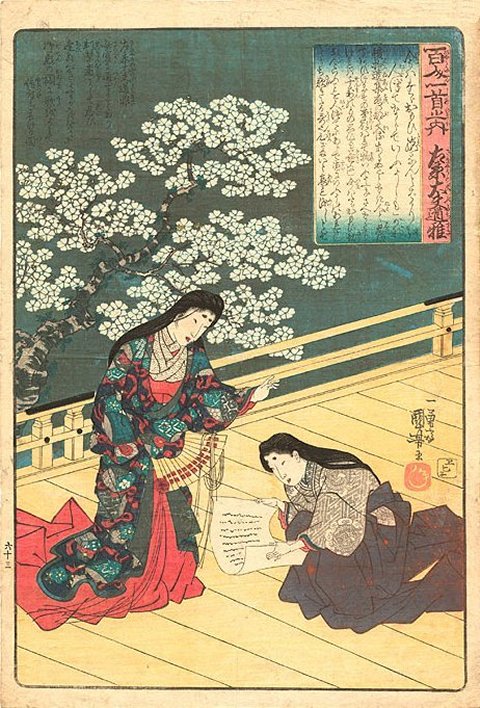
Another state of the above design |
|
|
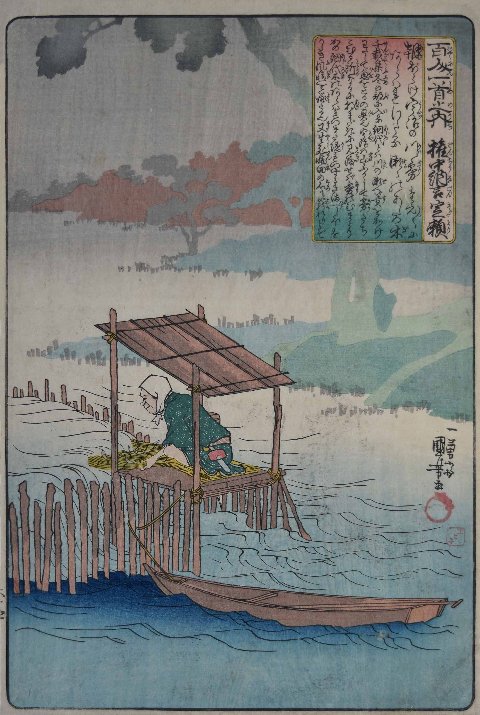
Number: 64 Poet: Gonchûnagon Sadayori (権中納言定頼) also known as
Fujiwara no Sadayori Scene: A peasant
operating a fish trap on the Uji River at dawn Robinson: S19.64 The poem translates: In the early dawn When the mists on Slowly lift and clear, From the shallows to the
deep, The stakes of fishing
nets appear. |
|
|
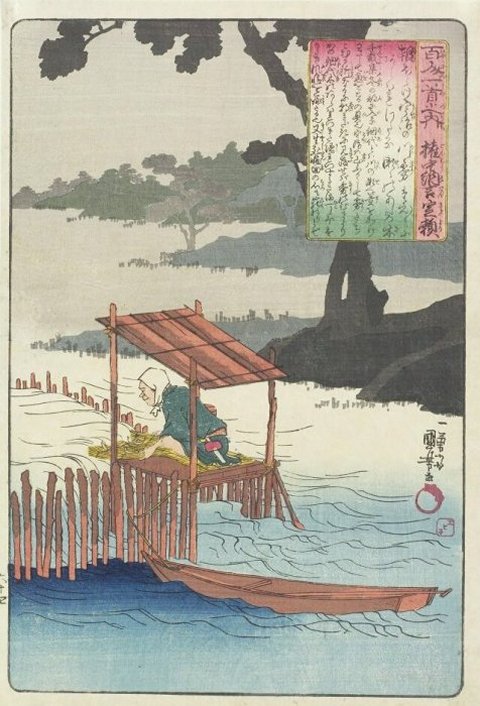
Another state of the above design |
|
“Robinson” refers to listing in Kuniyoshi: The Warrior-Prints by Basil William Robinson (Cornell University Press, Ithaca, NY, 1982) and its privately published supplement.
|