The Hundred Poets, Part I
(Hyaku-nin isshu, 百人一首内)
Publisher: Ebisu-ya Shokichi
c. 1840-1842
|
Hyaku-nin isshu is an
anthology of 100 poems by 100 different poets compiled by the thirteenth-century
critic and poet Fujiwara no Sadaie (also known as Teika). The poems
are all five-line poems of 31 syllables arranged as 5, 7, 5, 7 and 7. This form was known as waka and is now known as tanka. The 100 poets are in approximately chronological
order from the seventh through the thirteenth centuries. The number associated with each poet
appears in the margin of most of the prints, with a few incorrectly
numbered. Some of the prints portray
the poets, and some show scenes associated with their lives or poetry. The poem and some descriptive text appear
on each print. Robinson described 58
prints in this series, and it is unlikely that any more exist. The poems were
translated by Clay MacCauley in his book “Single
Songs of a Hundred Poets” (1917, Kelly and Walsh, |
|
|
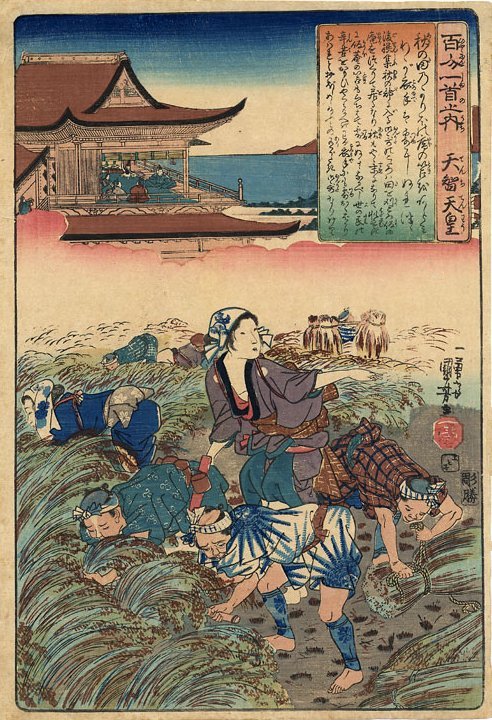
Number: 1 Poet: Emperor Tenchi Tennô (天智天皇) Scene: Peasants
harvesting grain in the foreground with a palace overlooking the sea in the
distance Robinson: S19.1 The poem translates: Coarse the rush-mat roof Sheltering the
harvest-hut Of the autumn
rice-field; And my sleeves are
growing wet With the moisture
dripping through. |
|
|
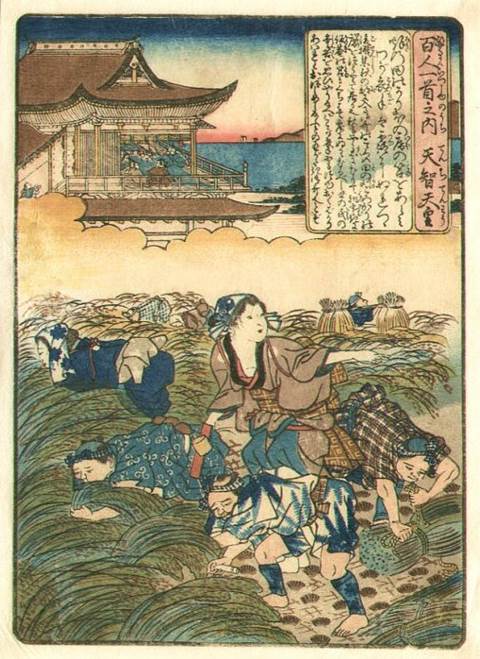
This print superficially resembles the above print. However, it is lacking Kuniyoshi’s
signature, his personal red seal (below his signature), the publisher’s
square seal below that, and the carver’s signature-seal (below and just to
the right of the publisher’s seal). A
careful comparison of corresponding parts of the two prints will reveal
slight differences. This print was
copied from the above using newly carved woodblocks. No matter how skilled the carver, it is
never possible to perfectly duplicate the original. |
|
|
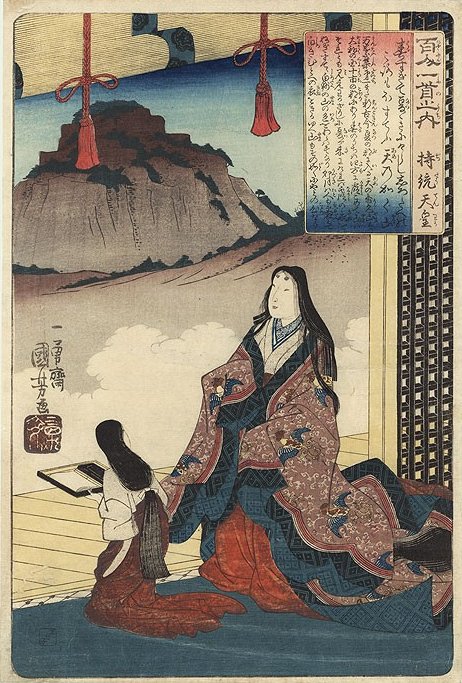
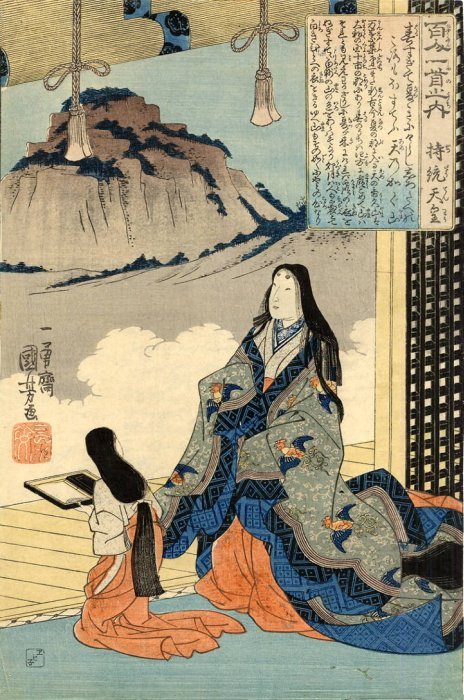
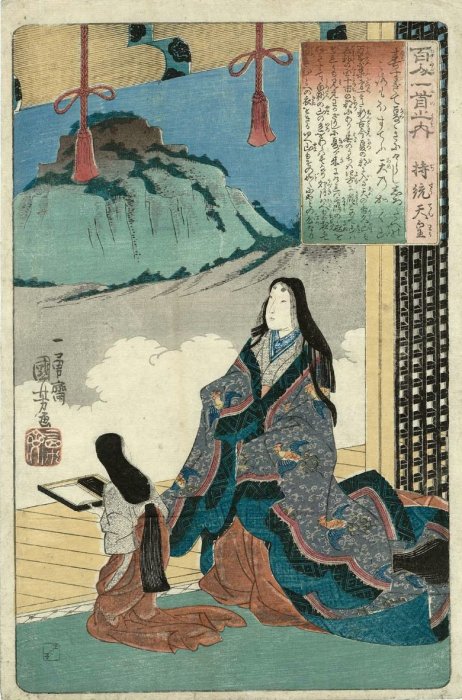
Number: 2 Poet: Empress Jitô Tennô (持統天皇) Scene: Empress Jitô Tennô at a palace door
looking out at the wooded mountains of Kaguyama Robinson: S19.2 The poem translates: The spring has passed And the summer come
again; For the silk-white
robes, So they say, are spread
to dry On the "Mount of
Heaven’s Perfume." |
|
|
This is another version of the above design. It is a less labor intensive printing than the above, which almost invariably means a later edition. In this print, the shading (bokashi) in the sky was omitted. Bokashi was achieved by hand-applying a gradation of ink to the wooden printing block rather than inking the block uniformly. This hand-application had to be repeated for each sheet of paper that was printed. |
|
|
Yet another state with green added |
|
|
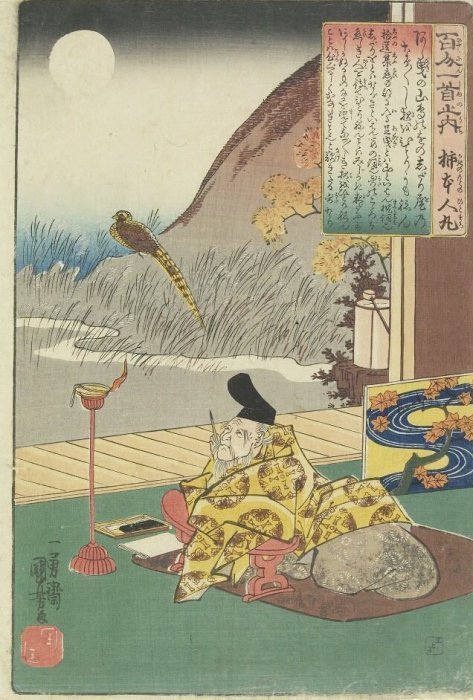
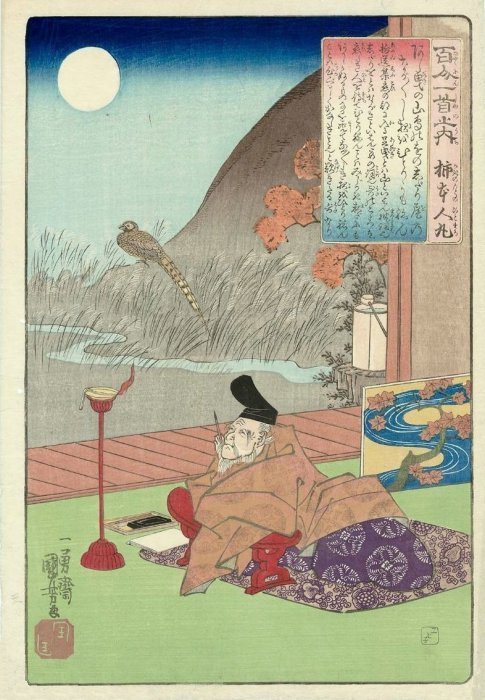
Number: 3 Poet: Kakinomoto no Hitomaro (柿本人麿) Scene: The aged poet
holding his brush and watching a pheasant with writing materials before him Robinson: S19.3 The poem translates: Oh, the foot-drawn trail Of the
mountain-pheasant’s tail Drooped like down-curved
branch! Through this long,
long-dragging night Must I lie in bed alone? |
|
|
Another state of the above design |
|
|
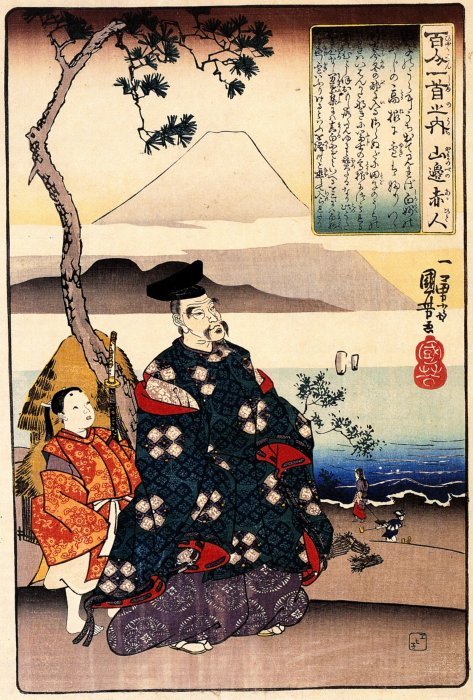
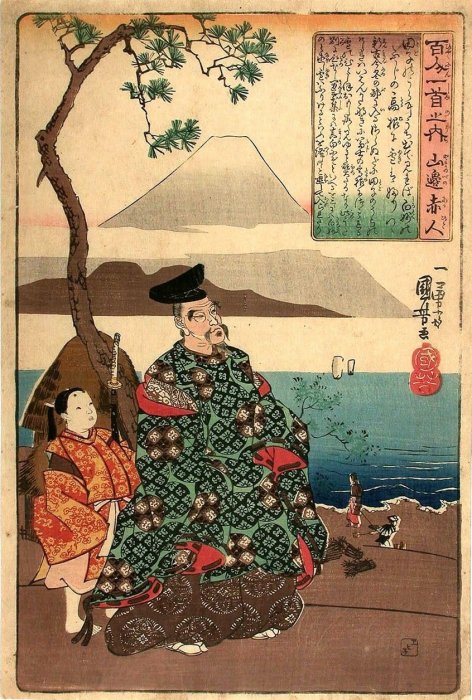
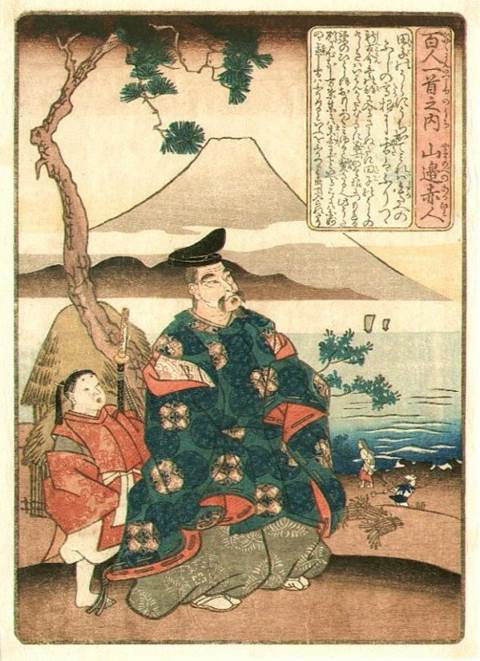
Number: 4 Poet: Yamabe no Akahito (山辺赤人) Scene: Yamabe no Akahito with a page
on a hill overlooking the Robinson: S19.4 The poem translates: When I take the path To Tago’s
coast, I see Perfect whiteness laid On Mount By the drift of falling
snow. |
|
|
Another state of the above design courtesy of Stuart Varnam-Atkin |
|
|
This is another unsigned copy printed with newly carved
woodblocks. |
|
|
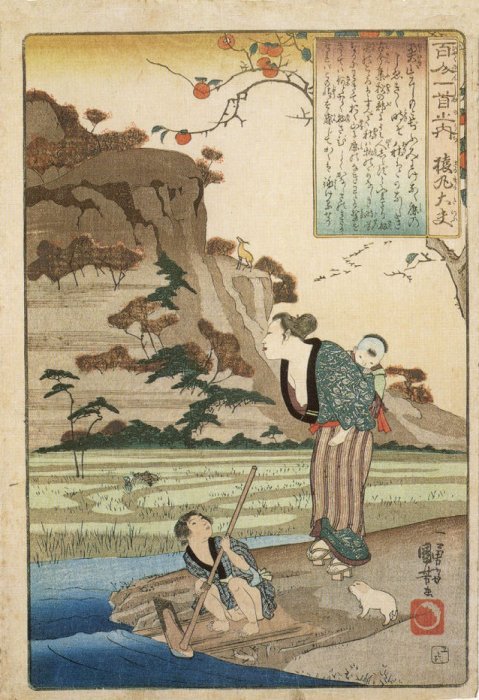
Number: 5 Poet: Sarumaru-dayû (猿丸太夫) Scene: A peasant
woman with two children looking over a river and rice paddies at a hill on
which are deer and autumn maple trees Robinson: S19.5 The poem translates: In the mountain depths, Treading through the
crimson leaves, The wandering stag
calls. When I hear the lonely
cry, Sad–how sad!–the autumn
is. |
|
|
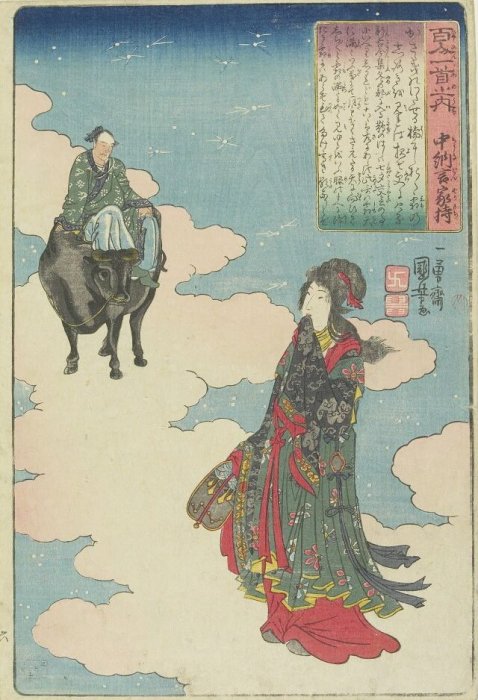
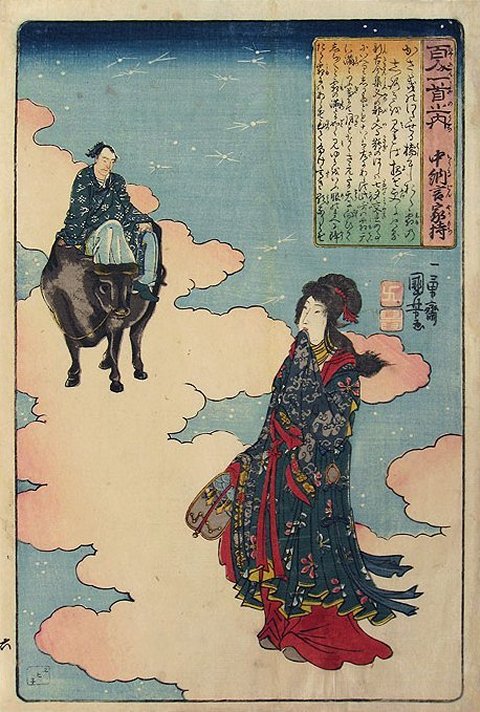
Number: 6 Poet: Chûnagon Yakamochi (中納言家持) also known as
Otomo no Yakamochi Scene: Ori-hime, the weaving princess, and her husband mounted on an
ox among clouds and stars Robinson: S19.6 The poem translates: If I see that bridge That is spanned by
flights of magpies Across the arc of heaven Made white with a
deep-laid frost, Then the night is almost
past.
|
|
|
Another state of the above design |
|
|
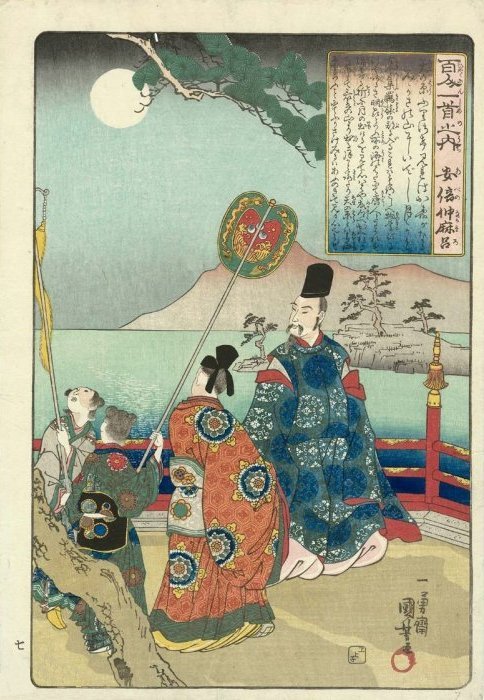
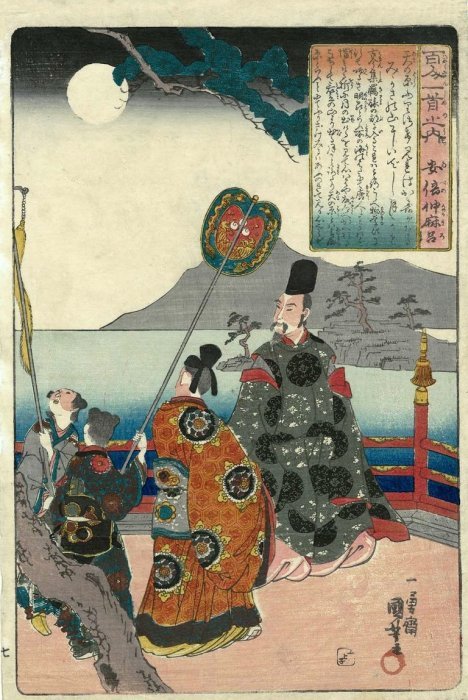
Number: 7 Poet: Abe-no Nakamaro (安倍仲麿) Scene: Abe-no Nakamaro in Robinson: S19.7 The poem translates: When I look up at The wide-stretched plain
of heaven, Is the moon the same That rose on In the |
|
|
This is another version of the above print. It is a less labor-intensive printing than
the above, which almost invariably means a later edition. In this print, the shading (bokashi) above the horizon and on the
distant mountains has been eliminated.
Bokashi was achieved by
hand-applying a gradation of ink to the wooden printing block rather than
inking the block uniformly. This
hand-application had to be repeated for each sheet of paper that was printed. The woodblock used to print shadows in the
foreground has also been eliminated. |
|
|
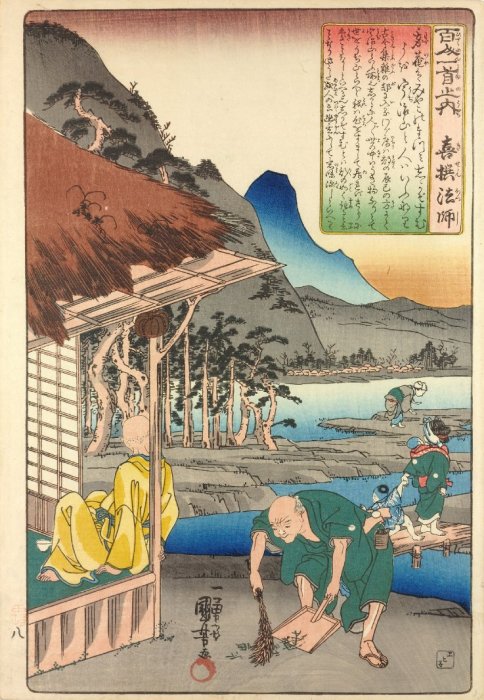
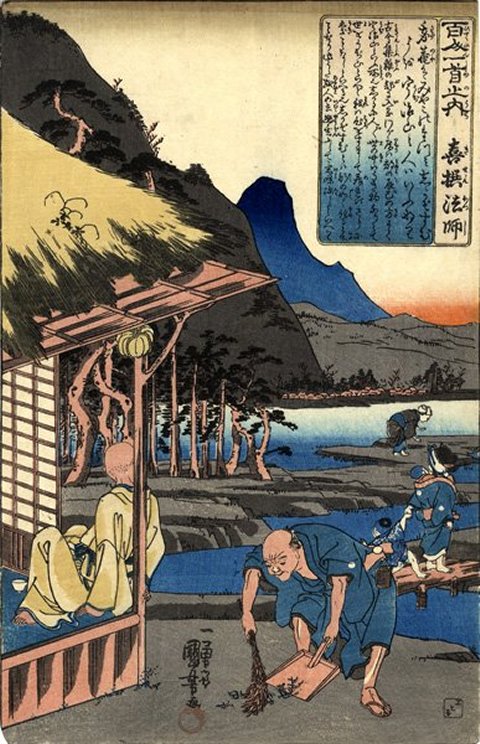
Number: 8 Poet: Kisen-hôshi (The Monk Kisen, 喜撰法師) Scene: Kisen-hôshi seated in a hut overlooking a lake an a mountain with a servant sweeping-up fallen leaves Robinson: S19.8 The poem translates: My lowly hut is Southeast from the
capital. Thus I choose to live. And the world in which I
live Men have named a
"Mount of Gloom." |
|
|
Another state of the above design |
|
|
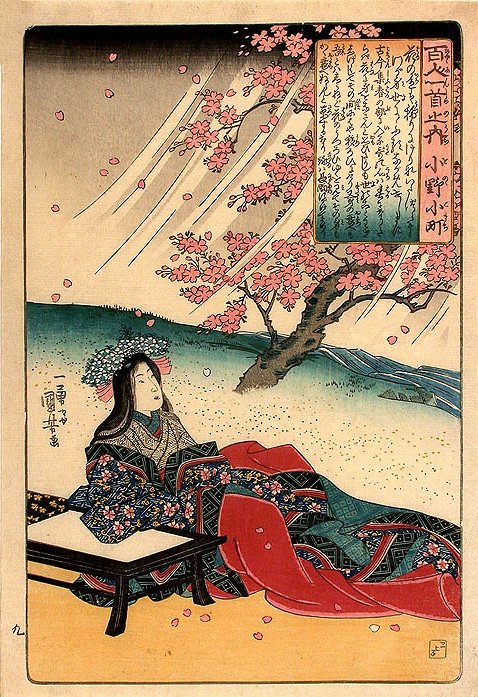
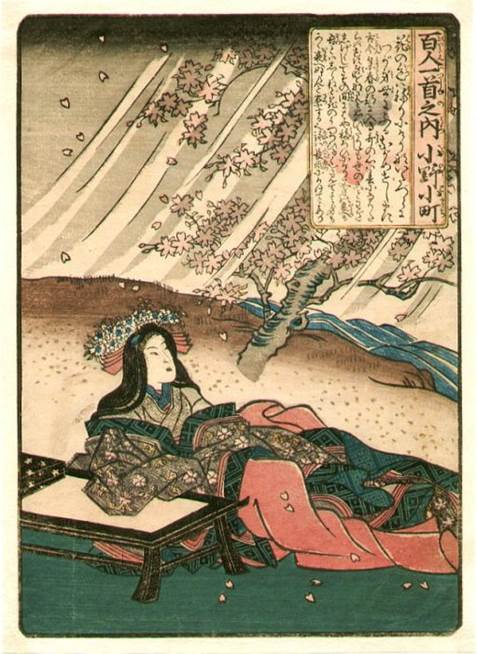
Number: 9 Poet: Ono no
Komachi (小野小町) Scene: Ono no Komachi
seated at a writing table watching falling cherry blossoms in the wind Robinson: S19.9 The poem translates: Color of the flower Has already faded away, While in idle thoughts My life passes vainly
by, As I watch the long
rains fall. |
|
|
This is another copy printed with newly carved woodblocks. It lacks both Kuniyoshi’s signature and the
publisher’s seal in the right lower corner. |
|
|
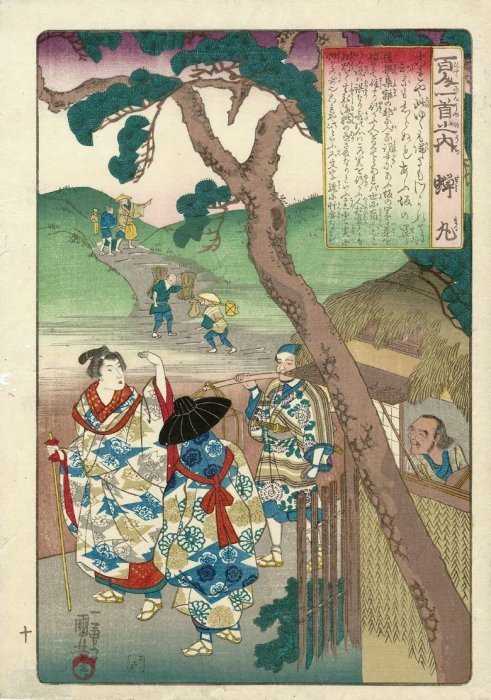
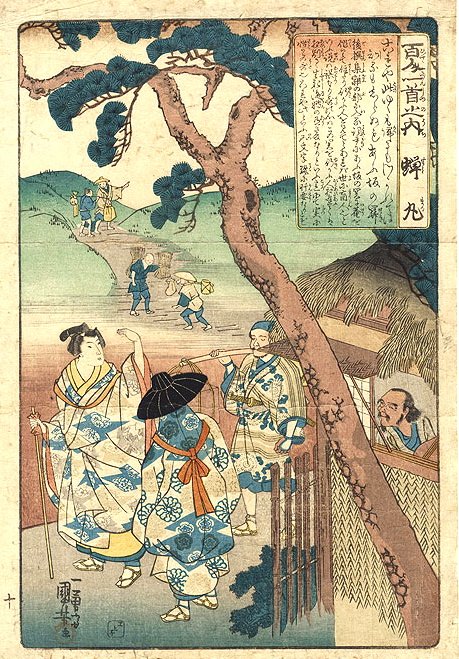
Number: 10 Poet: Semimaru (蝉丸) Scene: The blind Semimaru at the window of his hut listening to travelers
on the road outside Robinson: S19.10 The poem translates: Truly, this is where Travelers who go or come Over parting ways– Friends or strangers–all
must meet: The gate of
"Meeting Hill." |
|
|
Another state of the above design courtesy of Stuart Varnam-Atkin |
|
|
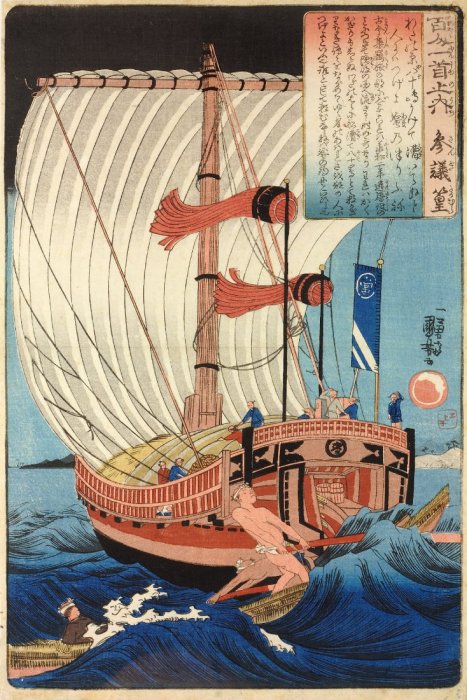
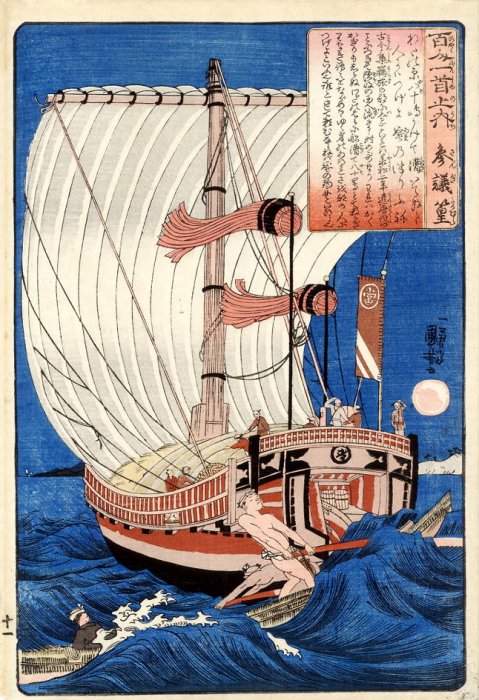
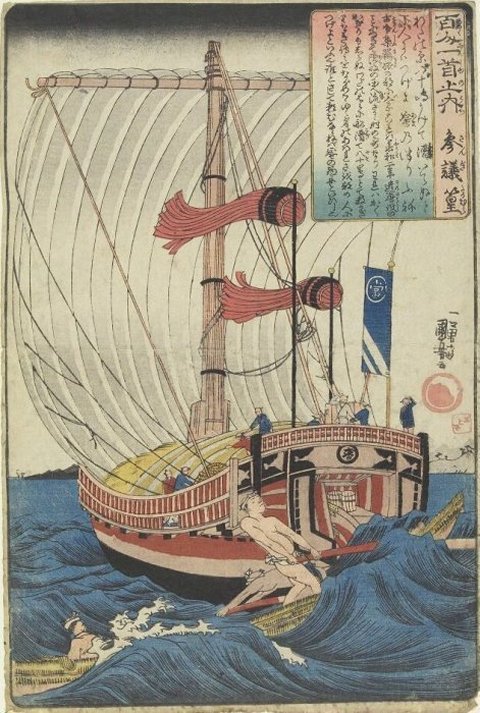
Number: 11 Poet: Sangi Takamura (参議篁) also known as
Ono no Takamura Scene: Stern view of
a large junk with a rowboat in the foreground Robinson: S19.11 The poem translates: Over the wide sea Towards its many distant
isles My ship sets sail. Will the fishing boats
thronged here Proclaim my journey to
the world? |
|
|
This is another version of the above print. It is a less labor intensive printing than
the above, which almost invariably means a later edition. |
|
|
Another state of the above design |
|
|
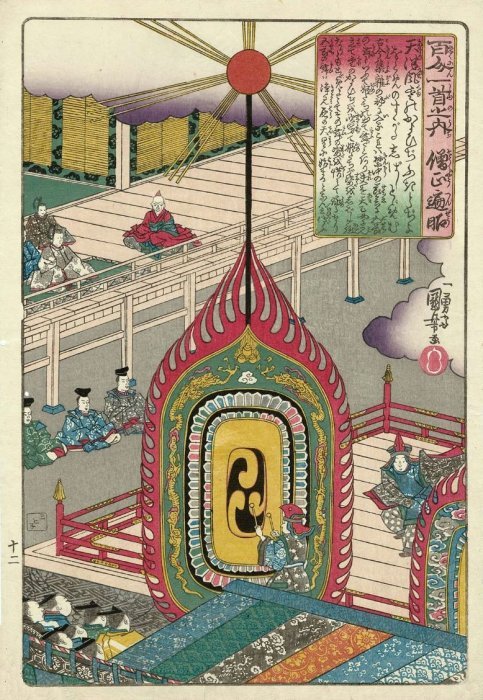
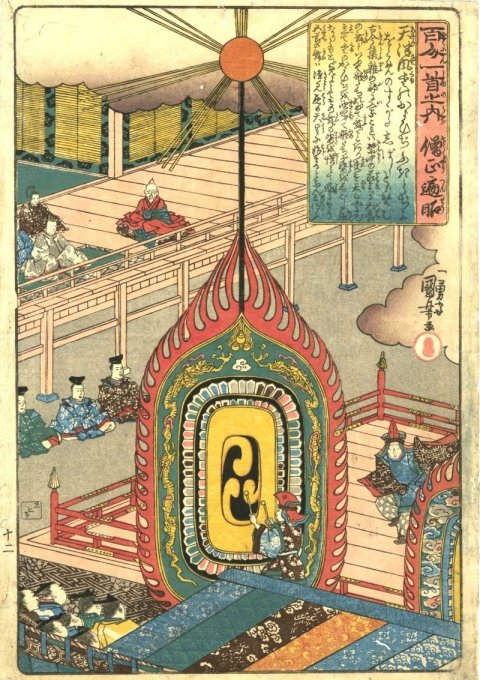
Number: 12 Poet: Sôjô Henjô (The Monk Henjô, 僧正遍昭) Scene: A Bugaku
performance before an audience of noblemen and the poet with a large drum in
the foreground Robinson: S19.12 The poem translates: Let the winds of heaven Blow through the paths
among the clouds And close their gates. Then for a while I could
detain These messengers in
maiden form. |
|
|
Another state of the above design |
|
“Robinson” refers to listing in Kuniyoshi: The Warrior-Prints by Basil William Robinson (Cornell University Press, Ithaca, NY, 1982) and its privately published supplement.
|