The 108 Heroes of the Popular Suikoden,
Part II
|
|
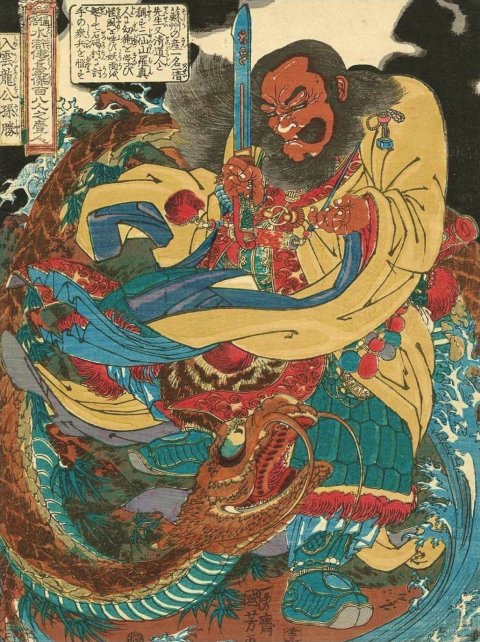
Japanese name: Ju-unryû (or Nyûunryû) Kôsonshô (入雲龍公孫勝) Chinese name: Gongsun Sheng Scene: Ju-unryû Kôsonshô holding up a short
sword and making a magical gesture with his other hand; a dragon surrounds
the rock on which he stands Robinson: S2.26 Klompmakers: 10 |
||||
|
|
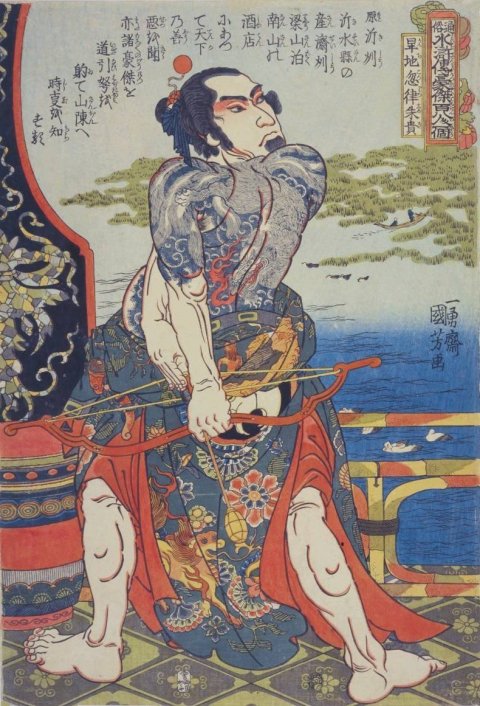
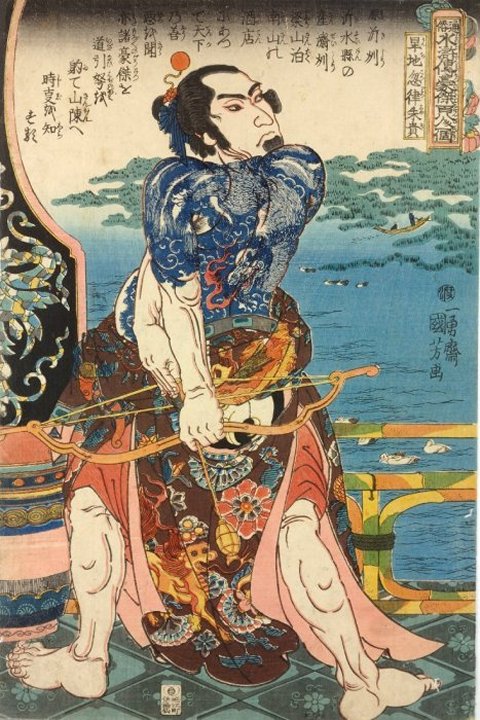
Japanese name: Kanchikotsuritsu Shuki (旱地忽律朱貴) Chinese name: Zhu Gui Scene: Kanchikotsuritsu Shuki,
bare-chested and tattooed, on a balcony overlooking a wide river, fitting to
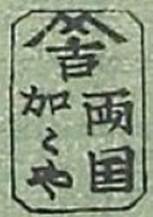
his bow a humming-bulb arrow containing a concealed message Robinson: S2.27 Klompmakers: 7 NOTE: The seal on
the bottom of the print is that of the publisher Kaga-ya
Kichiemon |
||||
|
|
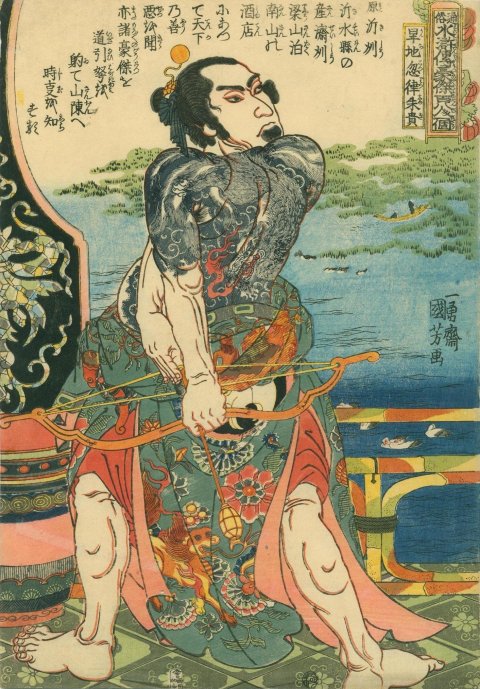
I am grateful to Nathan Oliver for this image showing a different
state of the above design published by Kaga-ya Kichiemon |
||||
|
|
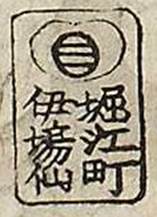
This later printing from 1842-1846 (censor Watanabe Shôemon) was published by Iba-ya
Sensaburô
|
||||
|
|
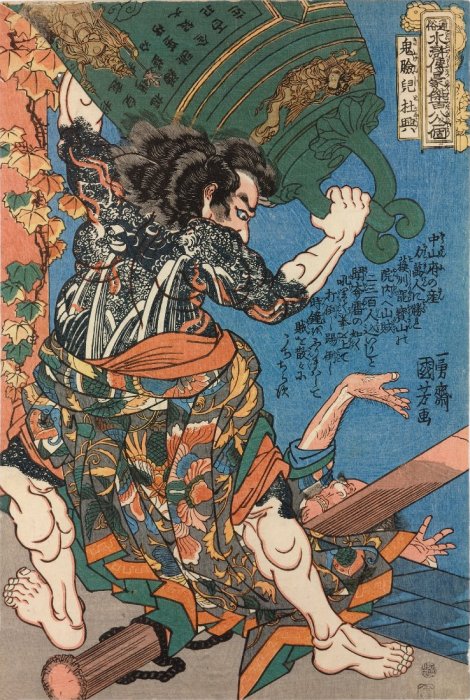
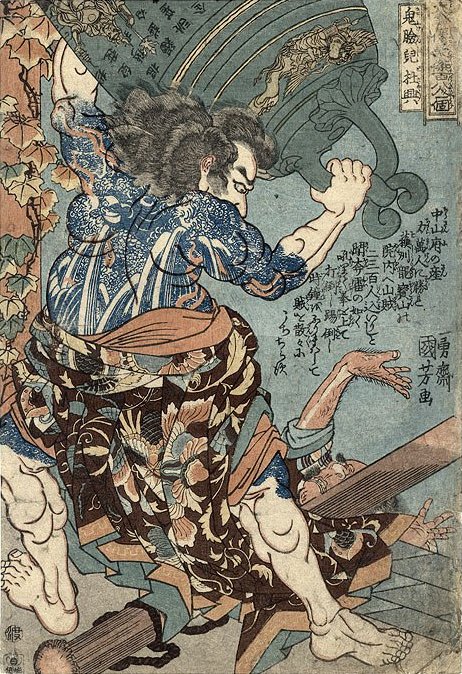
Japanese name: Kikenji Tokyô (or Kirenji Tokô, 鬼膾児杜興) Chinese name: Du Xing Scene: Kikenji Tokyô, bare-chested and
tattooed, lifting a huge
temple bell above a cowering foe Robinson: S2.28 Klompmakers: 36 |
||||
|
|
A later edition of the above print with the seal of the publisher
Iba-ya Sensaburô in the
bottom left corner |
||||
|
|
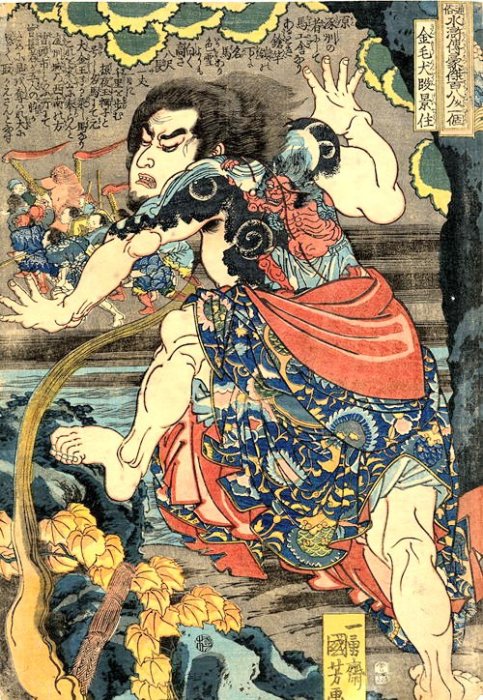
Japanese name: Kimmôken Dankeijû (金毛犬段景住) Chinese name: Duan Jingzhu Scene: Kimmôken Dankeijû, bare-chested
and tattooed, watches the departure of an armed gang of horse thieves with a
flaming torch at his feet Robinson: S2.29 Klompmakers: 46 |
||||
|
|
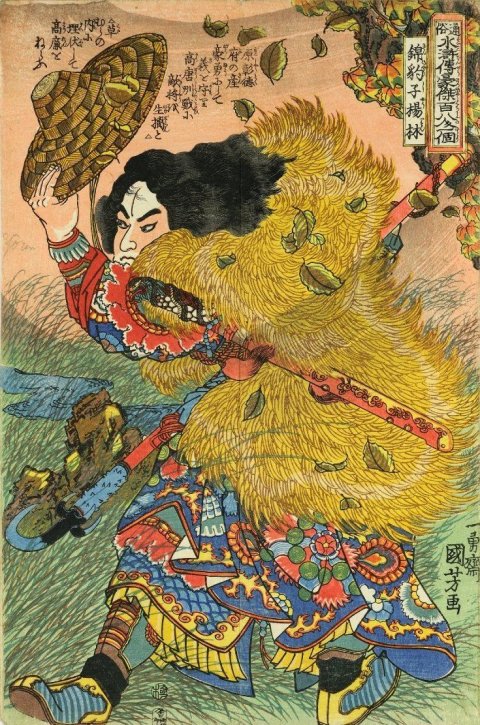
Japanese name: Kimpyôshi (or Kinhyôshi) Yôrin (錦豹子揚林) Chinese name: Yang Lin Scene: Kimpyôshi Yôrin after the
battle of Kôtôshû, in a straw cloak on a windy day,
carrying a barbed and hooked pole-arm Robinson: S2.30 Klompmakers: 28 I am grateful to Nathan Oliver for this image. |
||||
|
|
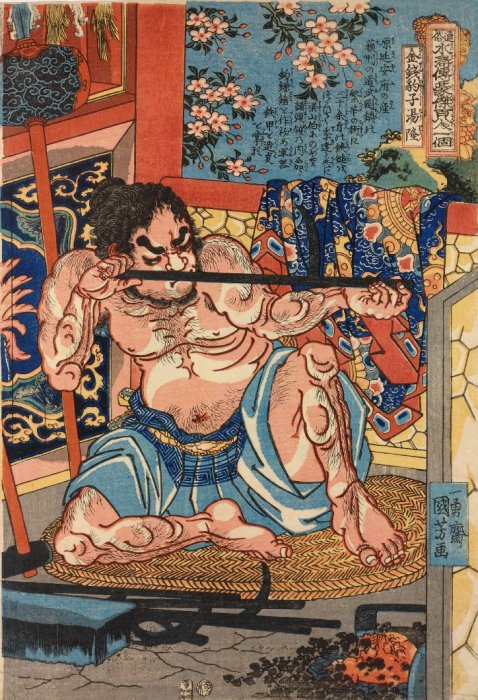
Japanese name: Kinsempyôshi Tôryû (金銭豹子湯隆) Chinese name: Tang Long Scene: Kinsempyôshi Tôryû the smith,
bare-chested and seated on a mat by his fire and anvil, tests the
straightness of an iron bar Robinson: S2.31 Klompmakers: 29 |
||||
|
|
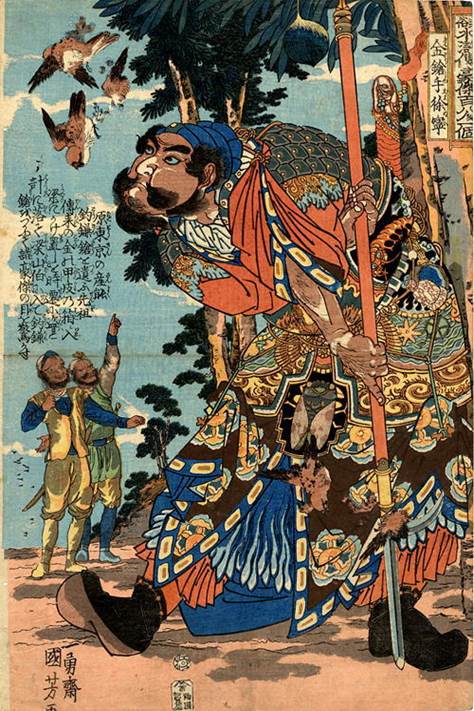
Japanese name: Kinsôshu Jonei (金槍手徐寧) Chinese name: Xu Ning Scene: Kinsôshu Jonei cutting down sparrows
in flight with his hooked spear; two spectators of distinctly western
appearance Robinson: S2.32 Klompmakers: 33 |
||||
|
|
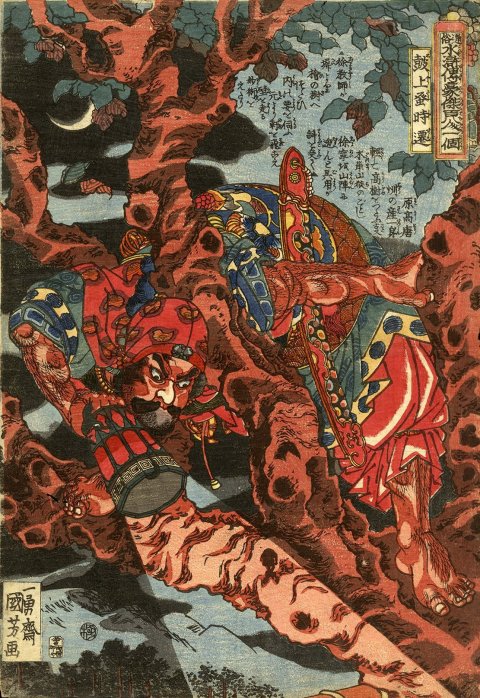
Japanese name: Kojôsô Jisen (鼓上蚤時遷) Chinese name: Shi Qian Scene: Kojôsô Jisen in a tree by moonlight,
shining his lantern towards the ground Robinson: S2.33 Klompmakers: 32 |
||||
|
|
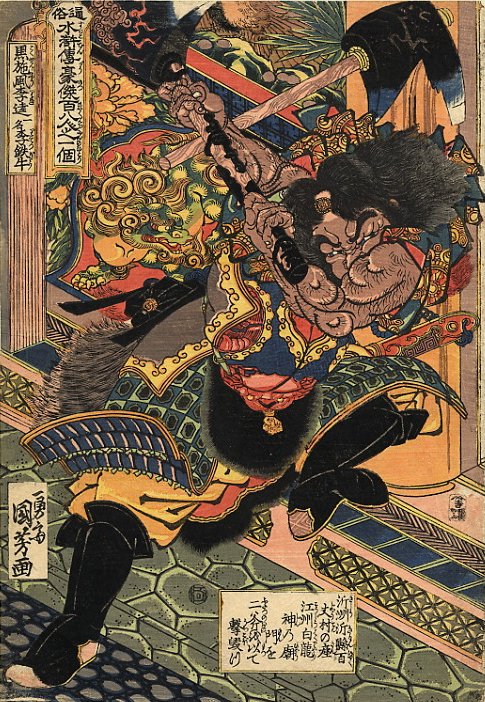
Japanese name: Kokusempû Riki, the black
whirlwind, also called Iron Ox Li (黒旋風李逵 一名李鉄牛) Chinese name: Li Kui Scene: Kokusempû Riki in a drunken
fury attacking the gate of the Robinson: S2.34 Klompmakers: 22 |
||||
|
|
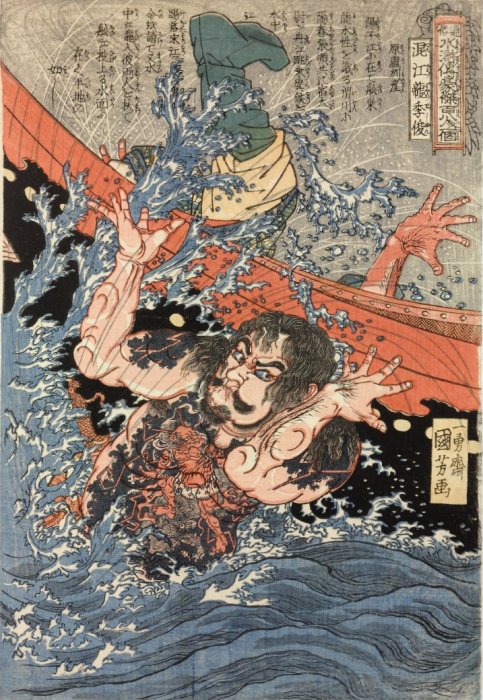
Japanese name: Konkôryû Rishun (混江龍李俊) Chinese name: Li Jun Scene: Konkôryû Rishun bare-chested in
the water capsizing an enemy boat Robinson: S2.35 Klompmakers: 35 NOTE: This print
has neither the seal of a publisher nor of a censor. |
||||
|
|
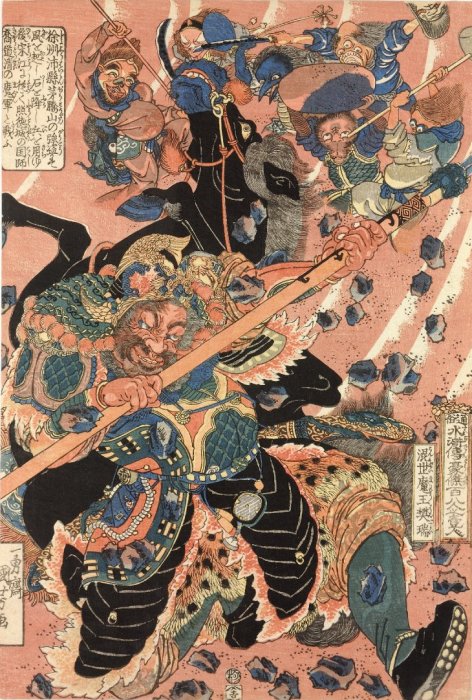
Japanese name: Konseimaô Hanzui (混世魔王樊瑞) Chinese name: Fan Rui Scene: Konseimaô Hanzui, spear in hand
and his rearing black horse behind him, recoils from a shower of stones and
an apparition of demons Robinson: S2.36 Klompmakers: 54 |
||||
|
|
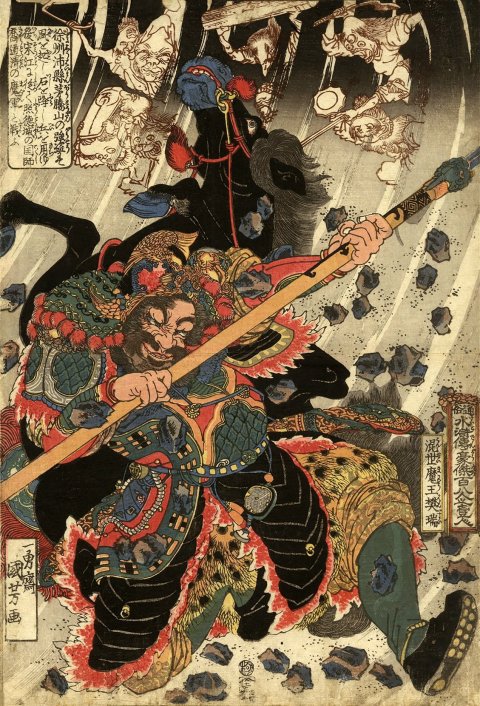
A later edition of the above print with the demons completely
redrawn |
||||
|
|
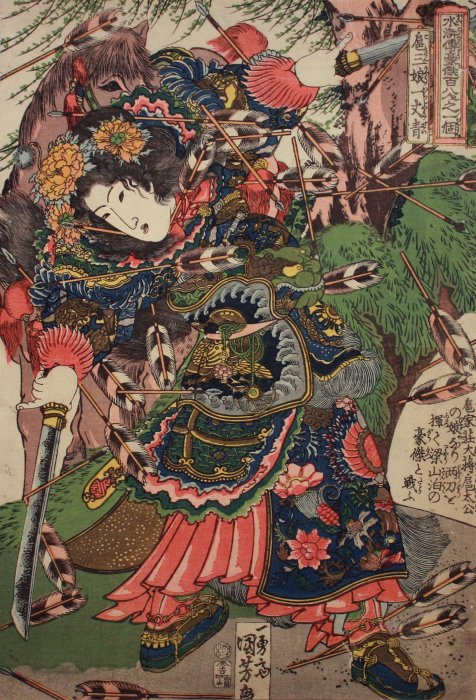
Japanese name: Kosanryô Ichijôsei (扈三娘一丈青) Chinese name: Hu San Scene: Kosanryô Ichijôsei, a sword in
either hand, cuts flying arrows, her horse behind her; she was the daughter
of the general Kotaikô Robinson: S2.37 Klompmakers: 25 |
||||
|
|
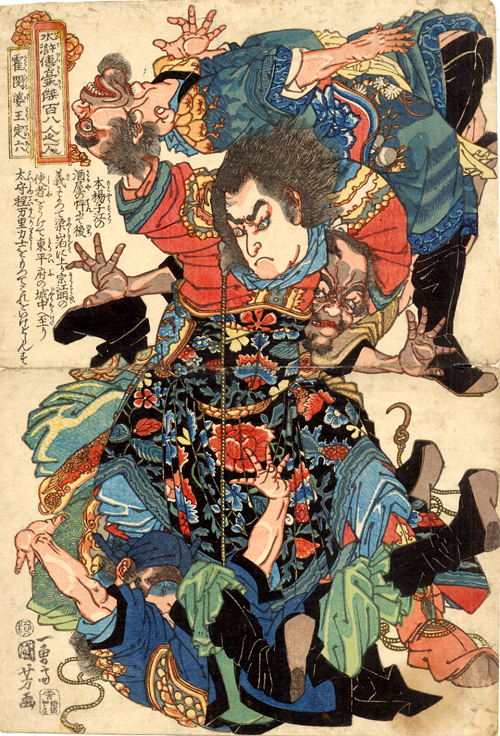
Japanese name: Kwakubimba (or Kassenba) Ôteiroku (霍閃婆王定六) Chinese name: Wang Dingliu Scene: Kwakubimba Ôteiroku overcoming
three foes, one of whom he lifts above his head Robinson: S2.38 Klompmakers: 48 |
||||
|
|
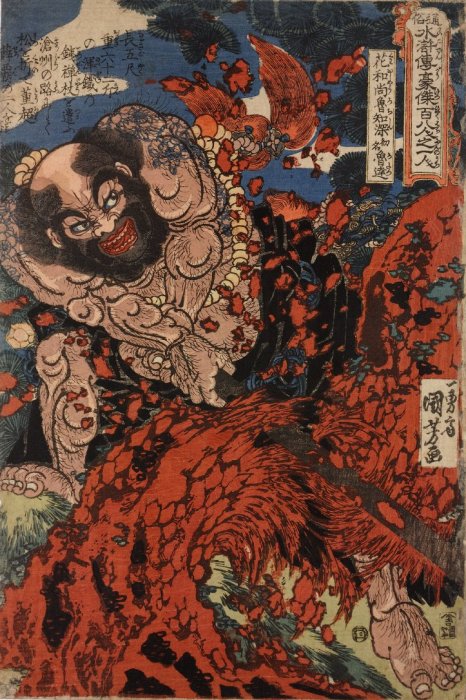
Japanese name: Kaoshô Rochishin (花和尚魯智深魯達) Chinese name: Lu Da or Lu Zhishen Scene: Kaoshô Rochishin (formerly
called “Rotatsu”) is a monk turned brigand. He is smashing through a pine trunk with
his great iron club to intimidate guards escorting Lin Chong into exile. Robinson: S2.39 Klompmakers: 6 |
||||
|
|
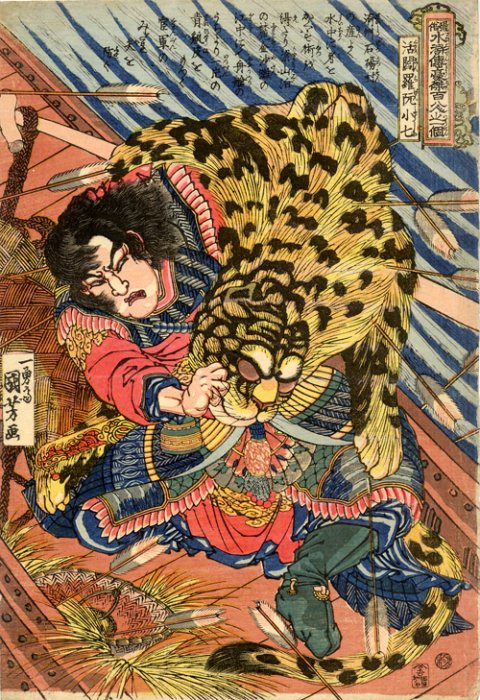
Japanese name: Kwatsuenra (or Katsuenra) Genshôshichi (活閻羅阮小七) Chinese name: Ruan Xiaoqi Scene: Kwatsuyenra Genshôshichi, in a
boat, sheltering from flying arrows under a tiger skin Robinson: S2.40 Klompmakers: 14 |
||||
|
|
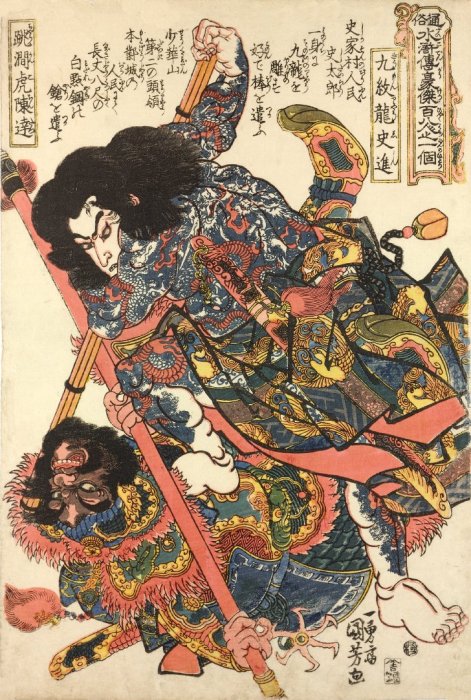
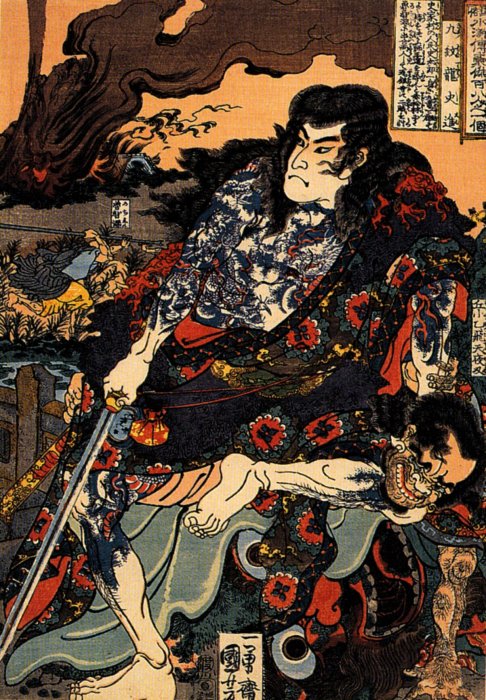
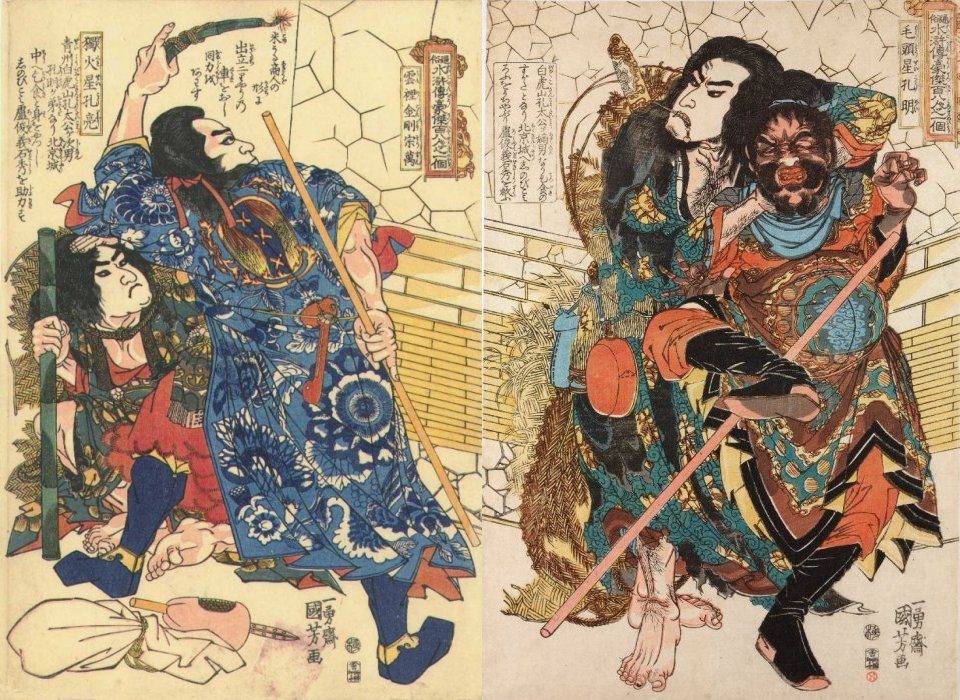
Japanese name: Kyumonryô Shishin (九紋龍支) and Chôkanko Chintatsu (水滸伝 史進) Chinese name: Shi Jin and Chen Da Scene: Kyumonryô Shishin (九紋龍史進), bare-chested
and tattooed, armed with a pole, overthrows an armored foe, Chôkanko Chintatsu (跳澗虎陳達) Robinson: S2.41 Klompmakers: 1 |
||||
|
|
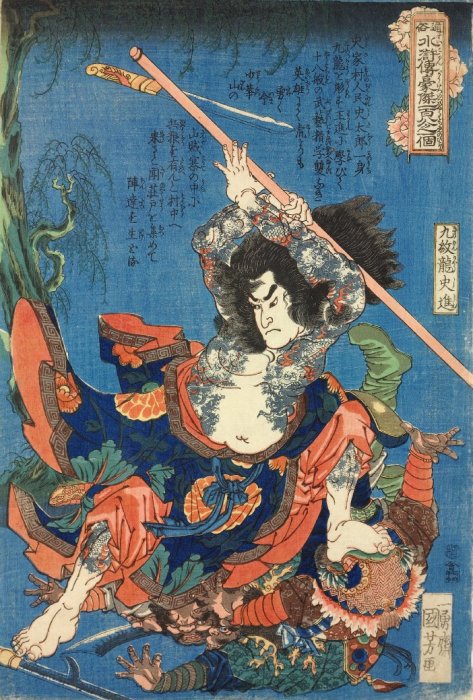
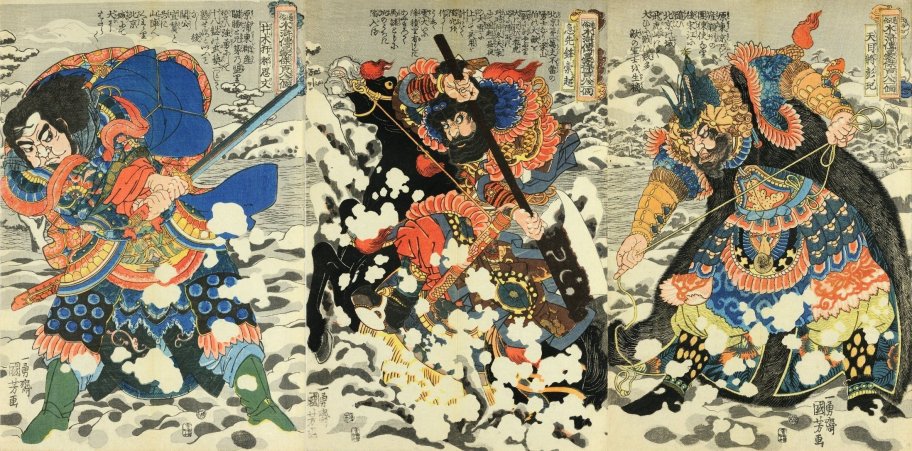
Japanese name: Kyumonryô Shishin (九紋龍史進) Chinese name: Shi Jin Scene: Kyumonryô Shishin seated on a
vanquished adversary , parrying a flying sword with his pole Robinson: S2.42 Klompmakers: 3b NOTE: This is a later
state than the complete first state triptych illustrated under S2.12 in Part
I |
||||
|
|
Japanese name: Kyumonryô Shishin (九紋龍史進) Chinese name: Shi Jin Scene: Kyumonryô Shishin, chest and
right arm bared and holding a drawn sword, seated on a vanquished foe, Kyûshô-otsu Hitenyasha with Rochishin in the background in pursuit of the enemy, and
the burning Robinson: S2.43 Klompmakers: 5 NOTE: This print
was published by Iba-ya Sensaburô
about 1845. |
||||
|
|
|||||
|
|
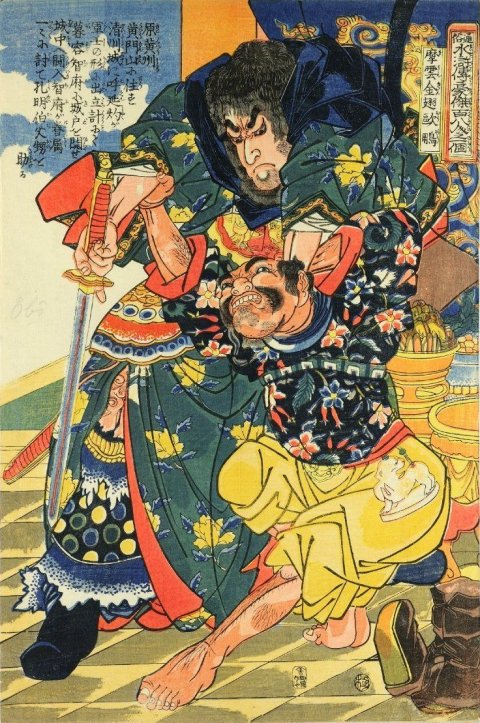
Japanese name: Ma'unkinshi Ôho (摩雲金翅歐鵬) Chinese name: Ou Peng Scene: Ma'unkinshi Ôho with a drawn sword seizes an adversary by
the scruff of the neck in the Robinson: S2.45 Klompmakers: 34 I am grateful to Nathan Oliver for this image. |
||||
|
|
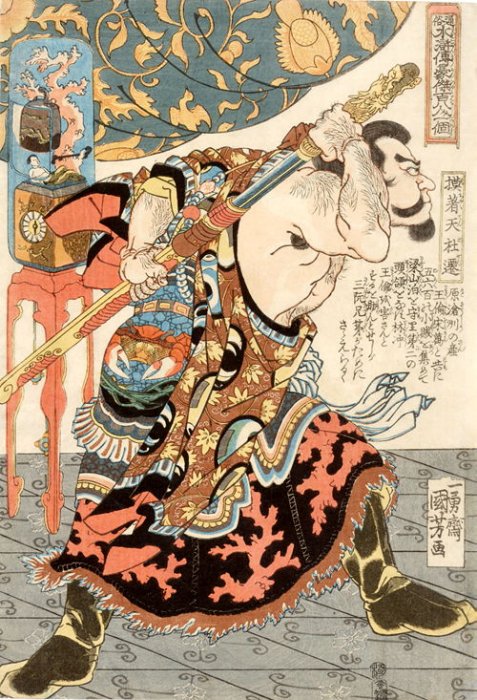
Japanese name: Mochakuten Tosen (摸著天杜遷) Chinese name: Du Qian Scene:, right arm
and shoulder bare, draws his sword from behind his back Robinson: S2.46 Klompmakers: 13c NOTE: See S2.23 in
Part I for the complete triptych |
||||
|
|
|||||
|
|
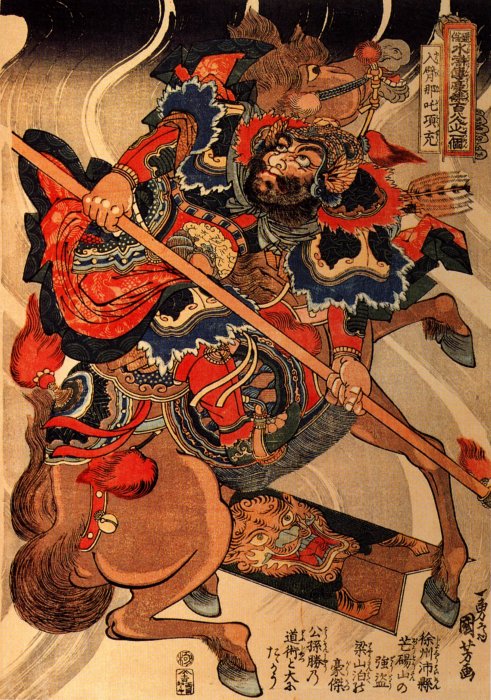
Japanese name: Nyûbinata (or Happinata) Kôjû (八臂哪吒項充) Chinese name: Xiang Chong Scene: Nyûbinata Kôjû armored, with spear,
on a prancing horse; background of stormy wind Robinson: S2.48 Klompmakers: 38 |
||||
|
|
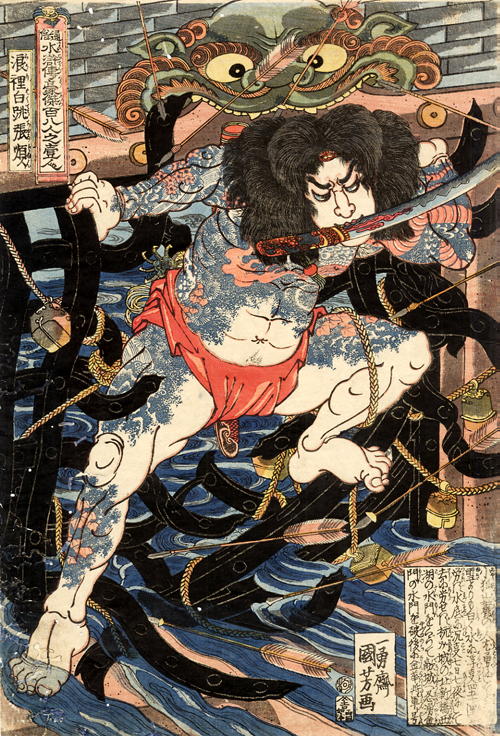
Japanese name: Rôrihakuchô Chôjun (浪裡白跳張順) Chinese name: Zhang Shun Scene: Rôrihakuchô Chôjun, wearing a loincloth
and tattooed, with a sword between his teeth, forces apart the bars of a
water-gate. Robinson: S2.49 Klompmakers: 56 NOTE: A later
edition of this print was published about 1845 by Iba-ya
Sensaburô. |
||||
|
“Robinson” refers to listing in Kuniyoshi: The Warrior-Prints by Basil William Robinson (Cornell University Press, Ithaca, NY, 1982) and its privately published supplement. “Klompmakers” refers to listing in Of Brigands and Bravery, Kuniyoshi's Heroes of the Suikoden by Inge Klompmakers (Hotei Publishing, Leiden, The Netherlands, 1998).
|