Thirty-six Famous Battles
(Meiyo sanjûrokkassen,
名誉三十六合戦)
Publishers: Ise-ya Ichibei and Hayashi-ya Shôgorô
c. 1848
|
Some of the prints in this series are
titles Meiyo sanjûrokkassen
(名誉三十六合戦), and some are titled Eimei sanjûrokkassen
(英名三十六合戦).
There are also two editions.
The first edition bears the rectangular seal of the publisher Ise-ya Ichibei, and the second
edition beats the fan-shapes seal of the publisher Hayashi-ya Shôgorô. Each print is about 14 by 10 inches (36 by
25 centimeters), a size known as ôban.
|
|
|
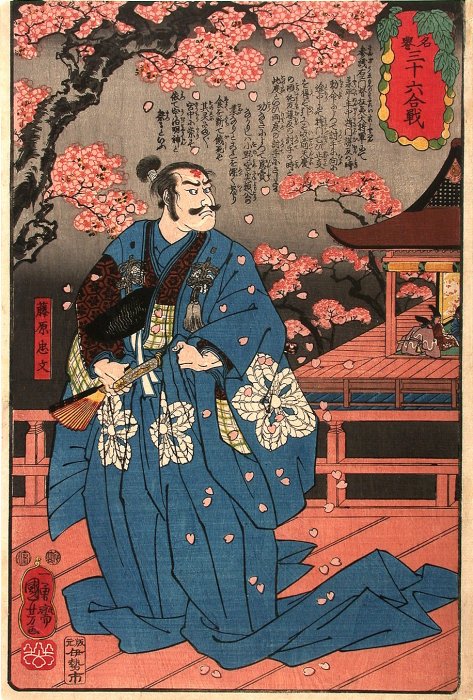
Scene: Fujiwara no Tadabumi (藤原忠文), insulted and
struck on the head, leaving the palace amidst falling cherry blossoms Robinson: S61.1 |
|
|
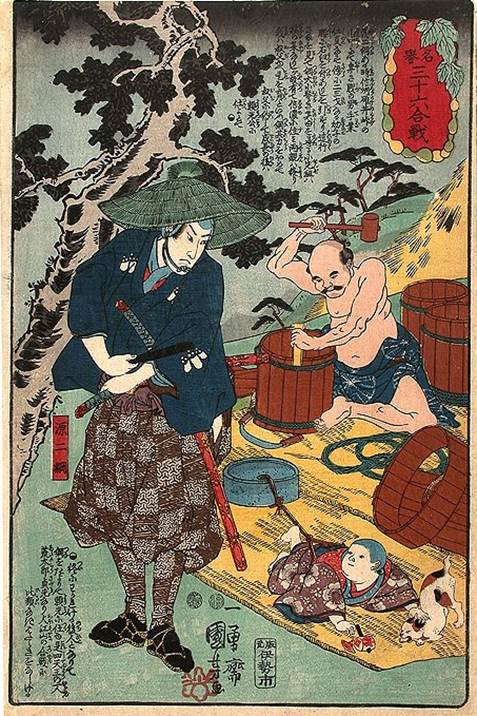
Scene: Genji Tsuna (源二綱) in traveling dress
is impressed by the strength of the child Usui no Sadamitsu
who is dragging a heavy piece of iron used by his father in the manufacture
of barrels Robinson: S61.2 |
|
|
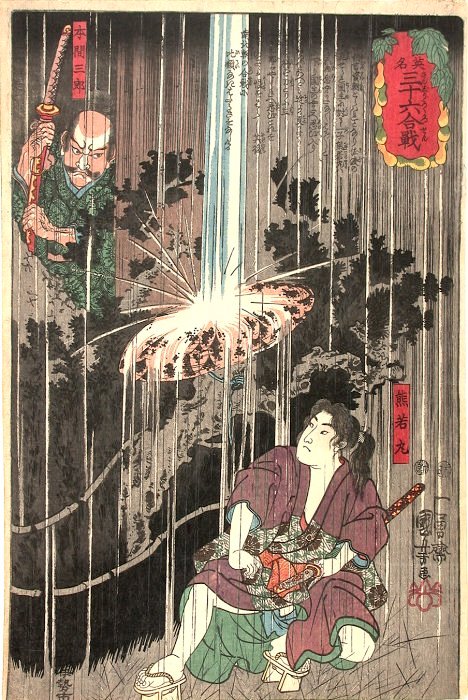
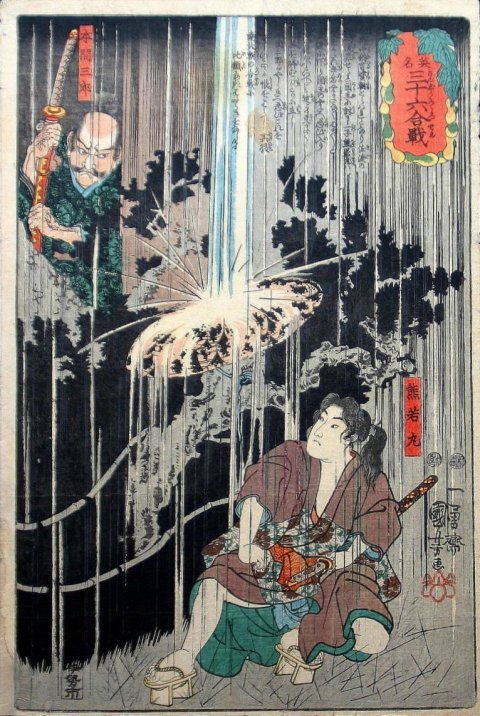
Scene: Kumawaka Maru (熊若丸) encounters his
father’s murderer, Homma Saburô (本間三郎), in a
downpour of rain, a stream of which falls on his hat Robinson: S61.3 |
|
|
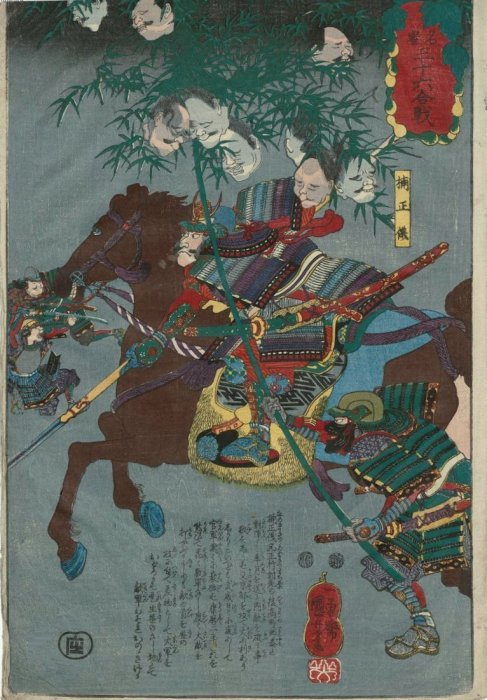
Another state of the above design |
|
|
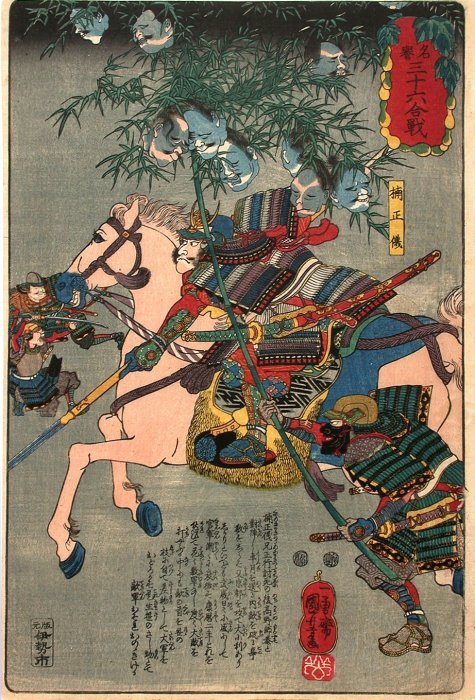
Scene: Kusunoki
Masanori (楠正儀) and a
retainer charging, the latter with a branch of bamboo from which severed
heads are suspended Robinson: S61.4 |
|
|
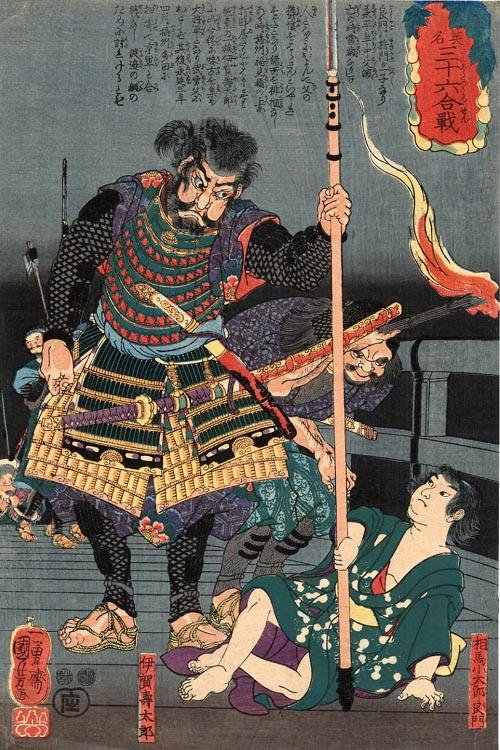
The original publisher, Ise-ya Ichibei, sold the woodblocks to another publisher,
Hayashi-ya Shôgorô, who
printed a second edition. Hayashi-ya Shôgorô’s seal has replaced
Ise-ya Ichibei’s seal in
the left lower corner. |
|
|
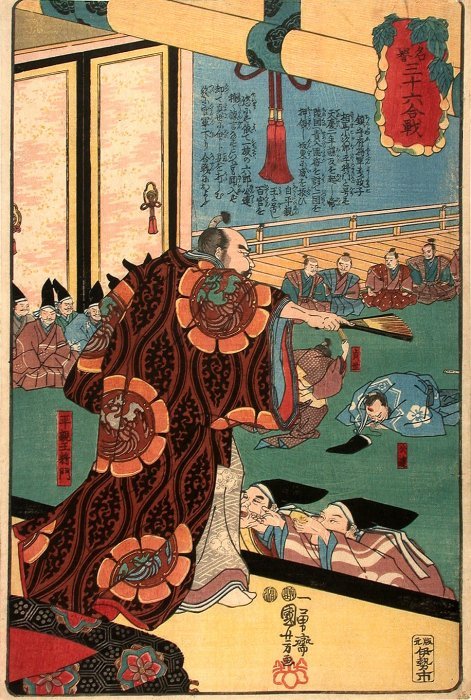
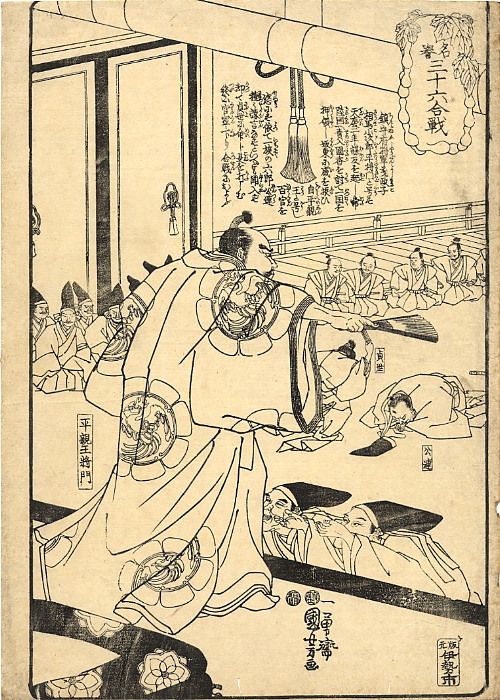
Scene: Heishinnô Masakado (平親王将門) with
outstretched fan on a dais berating his brother Rokurô
Kintsura (公連), whose cap
has been struck off by Musashi Gorô Sadayo (貞世) Robinson: S61.5 |
|
|
This is a key block print of the above design. It is an impression pulled from the first
woodblock made by a carver from the artist’s original drawing. The artist would then indicate the desired
colors on a key block print, and a woodblock for each color was cut using a
key block print as a guide.
Registration marks (kento) are characteristically found on Japanese key block
prints, although missing from this example.
Kento are cut in each
woodblock, so that the paper can be properly aligned on each woodblock during
printing. In addition to
being a guide for carving the color woodblocks, the key block was also used
to apply black ink (usually) in the printing process. |
|
|
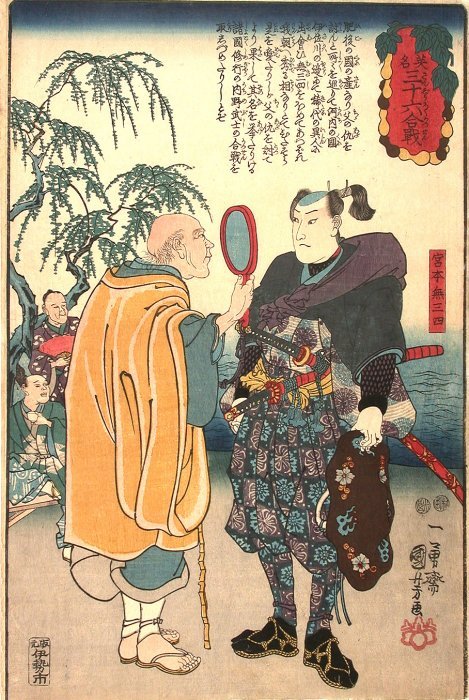
Scene: Miyamoto
Musashi (宮本無三四) on the banks
of the Isagawa in Kawachi Province meets a remarkable man who shows him a
magnifying glass Robinson: S61.6 |
|
|
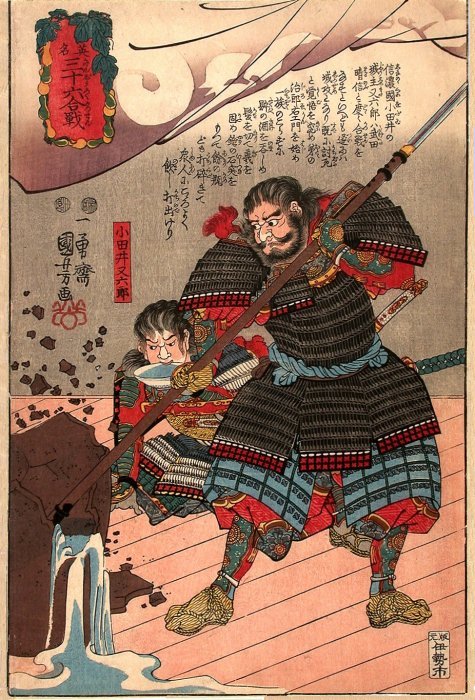
Scene: Odai Matarokurô (小田井又六郎) breaking
water storage jar during his war with Takeda Shingen Robinson: S61.7 |
|
|
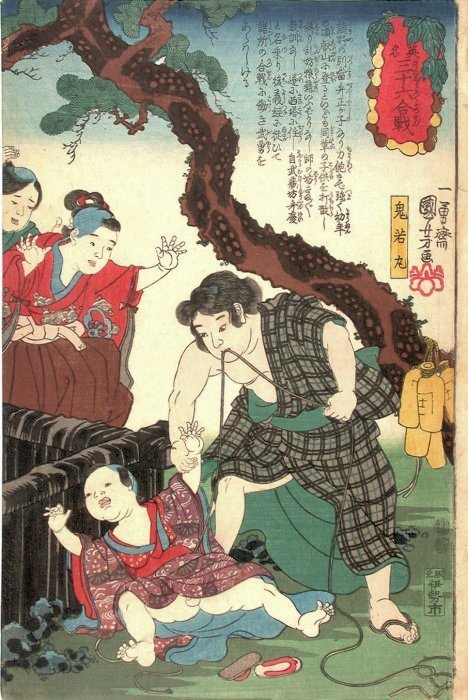
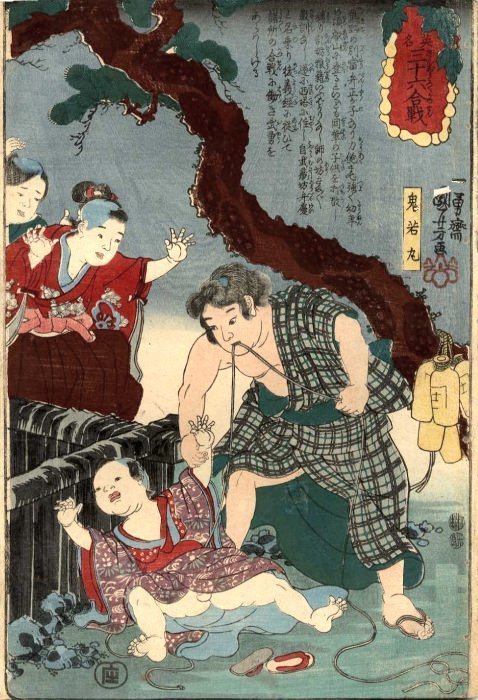
Scene: Unruly
conduct of Oniwaka Maru (鬼若丸) at Hieizan, where he fought and bullied the other children Robinson: S61.8 |
|
|
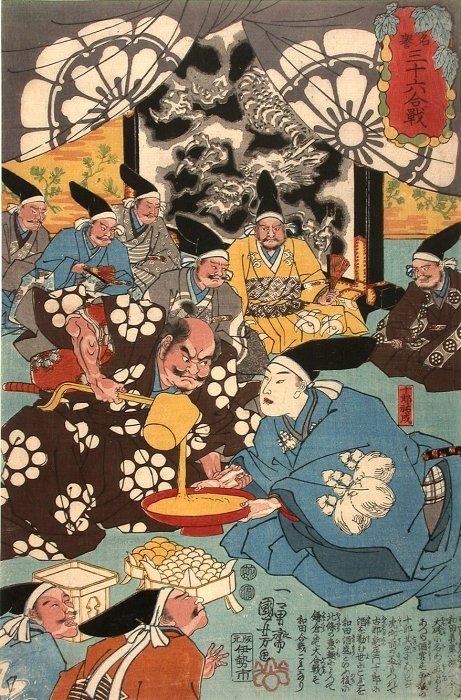
This is another example of the second edition of this series
published by Hayashi-ya Shôgorô. Note Hayashi-ya Shôgorô’s seal in the left lower corner and the clumsy
removal of Ise-ya Ichibei’s
seal from the right lower corner. |
|
|
Scene: Soga Jurô Sukenari (十郎祐成) at
Yoshimori’s feast being poured a very large cup of sake by Furugori Shinzaemon Robinson: S61.9 |
|
|
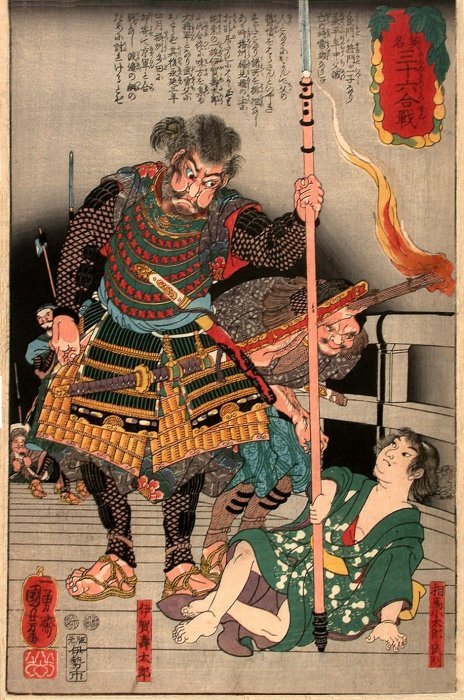
Scene: Sôma Kotarô Yoshikado
(相馬小太郎良門), the son of
Masakado, encounters Iga Jutarô
(伊賀寿太郎) and his gang
on the Fukumi Bridge Robinson: S61.10 |
|
|
This is another example of the second edition of this series
published by Hayashi-ya Shôgorô,
whose seal appears in the left lower corner. |
|
|
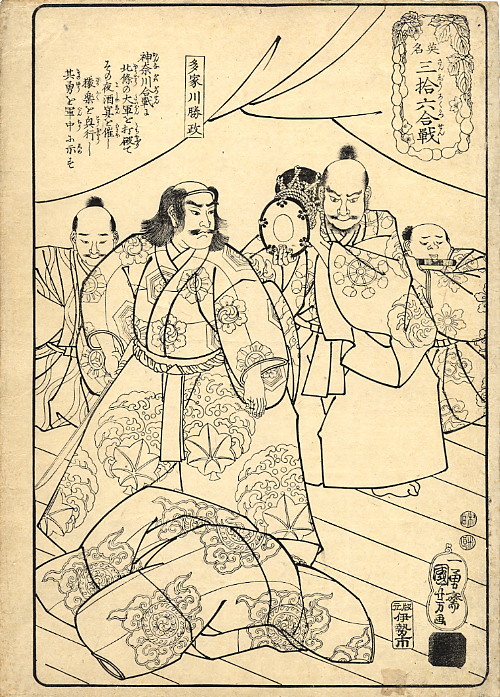
Scene: Takagawa Katsumasa (多家川勝政), after
defeating the Hôjô at the Battle of Shinagawa
performing the monkey dance in a drunken celebration Robinson: S61.11 NOTE: This is a key
block print. |
|
|
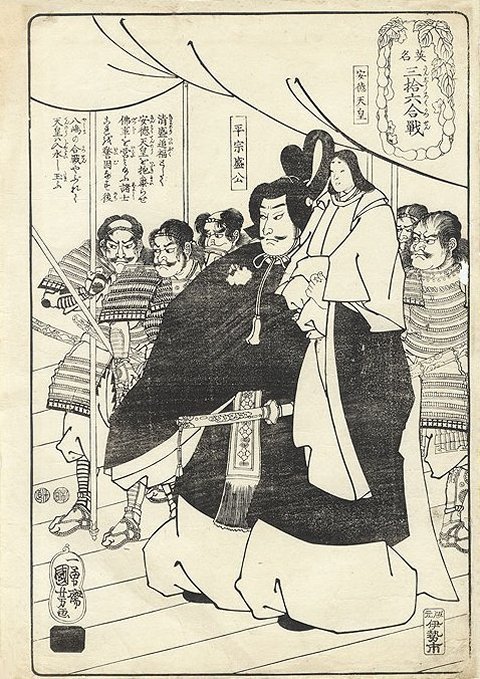
Scene: Lord Taira
Munemori (平宗盛公) carrying the
child emperor Antoku (Antoku
Tennô, 安徳天皇) Robinson: Not listed NOTE: This is a key
block print. |
|
“Robinson” refers to listing in Kuniyoshi: The Warrior-Prints by Basil William Robinson (Cornell University Press, Ithaca, NY, 1982) and its privately published supplement. CLICK HERE TO RETURN TO MAIN PAGE
|