Paintings of the 108 Heroes of the Popular Suikoden
|
There
are ten extant ink and color paintings, generally considered to be by
Kuniyoshi, that are in the same style as Kuniyoshi’s print series The
108 Heroes of the Popular Suikoden, with the same title cartouche. All the paintings are unsigned, and each
portrays a Suikoden hero who is not
represented in the 74 published prints. It is not clear whether these are
preliminary studies for additional prints that were never published, or
completed works of art. |
|
|
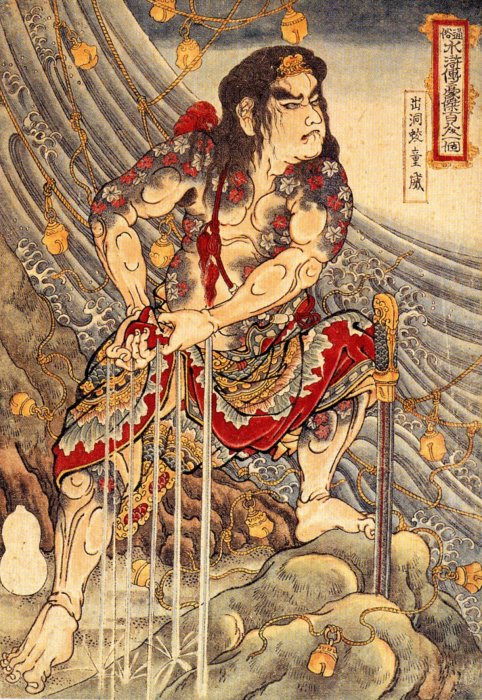
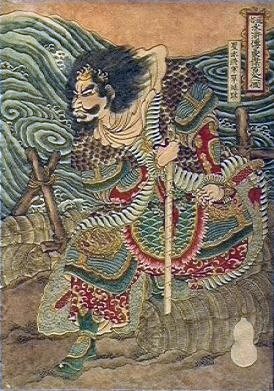
Japanese name: Shutsudôkô Dôi (出洞蛟 童威) Chinese name: Tong Wei Scene: Shutsudôkô Dôi wringing out his
cloths after escaping through water-gate with the warning bells behind him |
|
|
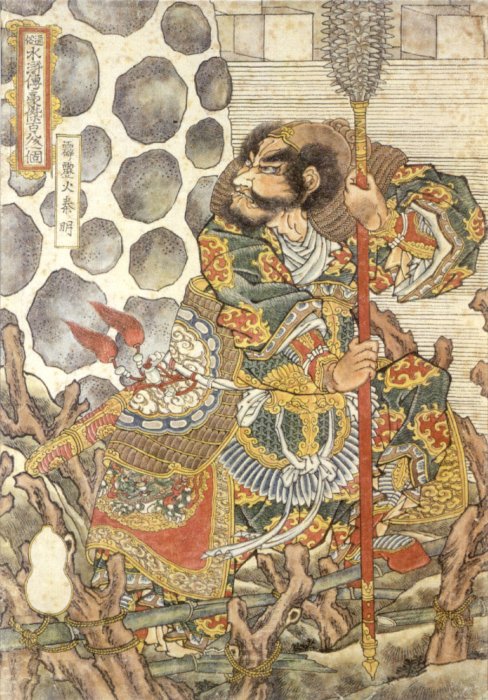
Japanese name: Hekirekika Shinmei (霹靂火 秦明) Chinese name: Qin Ming Scene: Hekirekika Shinmei standing beside a wall with his
favorite weapon, a toothed mace |
|
|
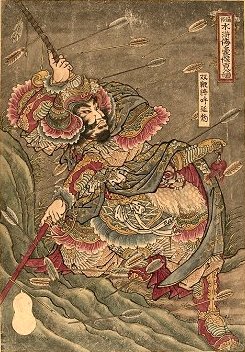
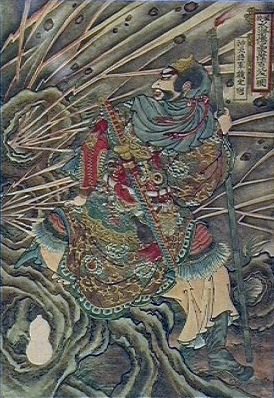
Japanese name: Sôben Koenshaku (呼延 呼延灼) Chinese name: Huyan Zhou Scene: Sôben Koenshaku wielding a pair of steel rods in battle |
|
|
Japanese name: Sensuishô (or Seisuishô) Tanteikei (聖水將 單廷珪) Chinese name: Shan Tinggui Scene: Sensuishô Tanteikei carrying a
spear along side a torrent of water he diverted to flood the enemy |
|
|
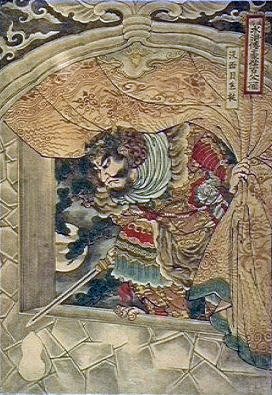
Japanese name: Botsumenmoku Shôtei (沒面目 焦挺) Chinese name: Jiao Ting Scene: Botsumenmoku Shôtei with drawn
sword climbing through a window |
|
|
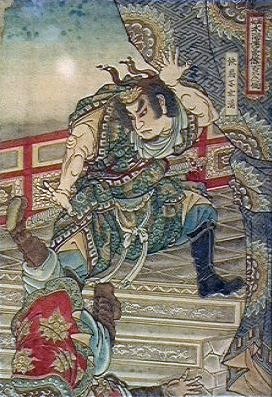
Japanese name: Tetsusenshi Sôsei (鐵扇子 宋清) Chinese name: Song Qing Scene: Tetsusenshi Sôsei throwing an
opponent down some stairs |
|
|
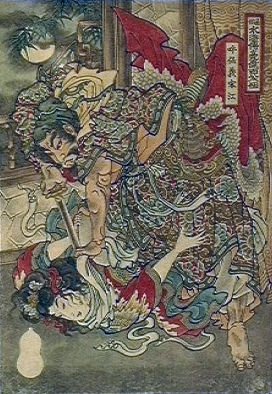
Japanese name: Kohôgi Sôkô (呼保義 宋江) Chinese name: Song Jiang Scene: Kohôgi Sôkô killing his
adulterous wife Yan Poxi in a struggle for a letter |
|
|
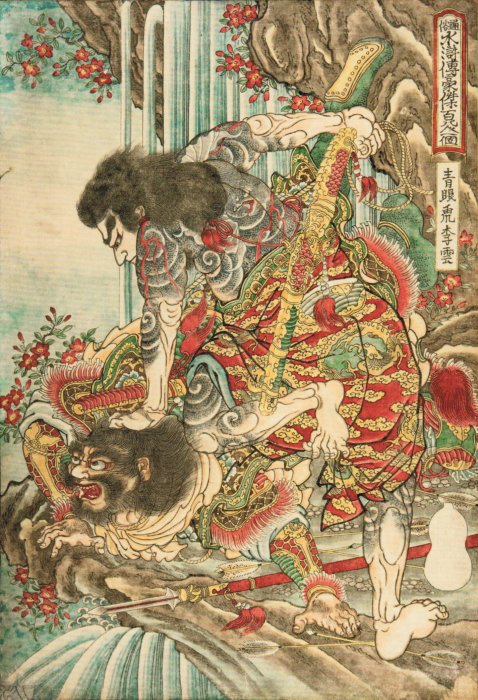
Japanese names: Seigankô Riun (青眼虎 李雲) and Kokusenpû Riki (黒旋風李逵) Chinese names: Li Yun and Li
Qui Scene: Seigankô Riun arresting Kokusenpû Riki by a waterfall |
|
|
Japanese name: Shinkashô Giteikoku (神火將 魏定國) Chinese name: Wei Dingguo Scene: Shinkashô Giteikoku attacking
Guan Sheng with his fire weapons |
|
|
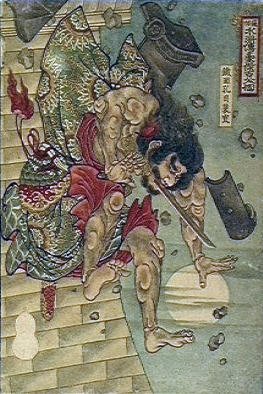
Japanese name: Tetsumenkômoku Haisen (鐵面孔目 裴宣) Chinese name: Scene: Tetsumenkômoku Haisen escaping over
a roof with falling roof tiles |
|
“Robinson” refers to listing of the series in Kuniyoshi by Basil William Robinson (Victoria and Albert Museum, London, 1961). CLICK
HERE TO RETURN TO MAIN PAGE
|