Set of Kintarô
(Kintarô zukushi, 金太郎尽)
Publisher: Tsujioka-ya Bunsuke
c. 1840
|
The
name Kintarô literally means Golden Boy. He was the son of Princess Yaegiri. Kintarô lived
alone in the woods where he talked to the animals. He was so strong that he could bend trees
like twigs and vanquished various monsters.
When he grew up, Kintarô joined with the
hero Raikô (Minamoto no Yorimitsu)
and became a famous warrior himself. Kintarô is also known as Kaidômaru
and as an adult was called Sakata no Kintoki.
The prints in this series are each about 14 by 10 inches (36 by 25
centimeters), a size known as ôban. I am grateful to Robert Pryor for his
contributions to this series. |
|
|
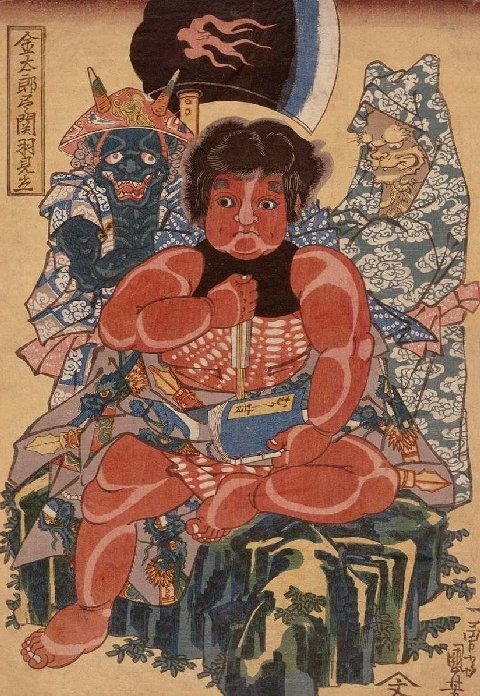
Subtitle: Imitation of Kwanu (Kwanu mitate, 金太郎尽 関羽見立) Scene: Kintarô poses on a rock as the Chinese general Kanu
accompanied by two oni (demons) and
holding a book of fairy tales (Mukashi mukashi) Robinson: S12.1 |
|
|
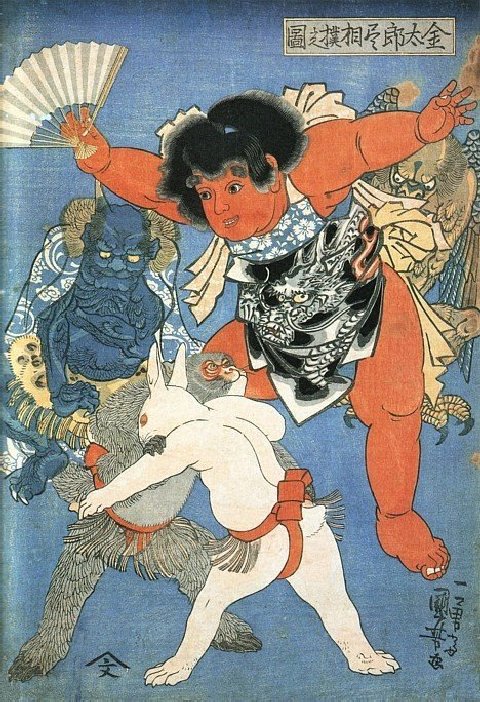
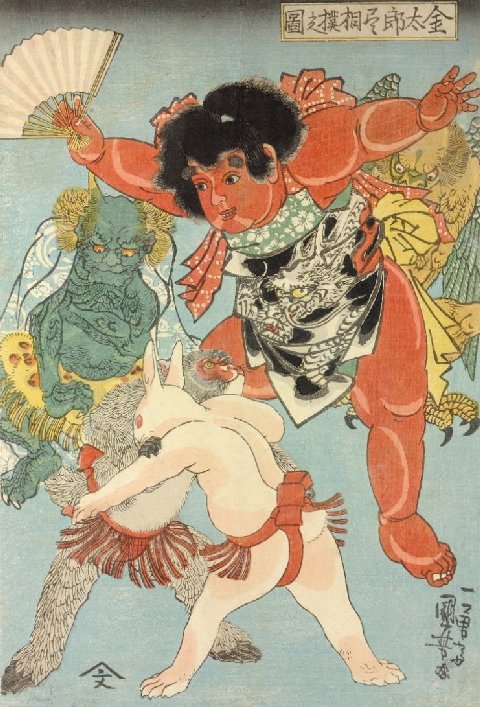
Subtitle: Picture of Sumô
(Sumô no zu, 相撲之圖) Scene: Kintarô, as a child in Robinson: S12.2 NOTE: Tengu are forest-dwelling creatures
that are either human-like with wings and long noses or bird-like. |
|
|
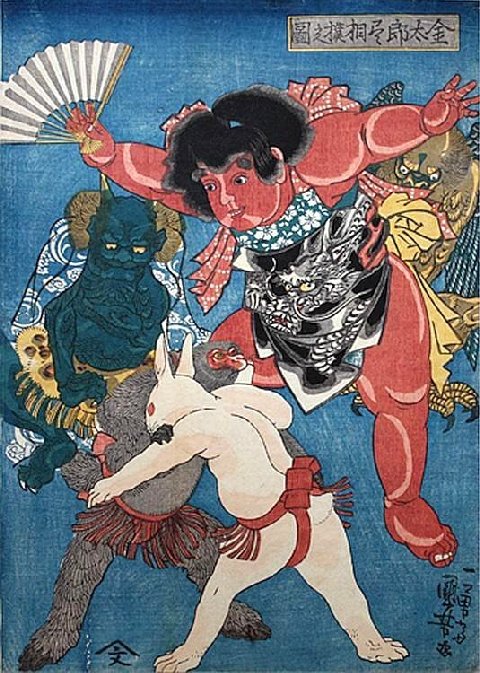
An alternate state of the above design with the rabbit’s sumô
belt being entirely red. |
|
|
Yet another state |
|
|
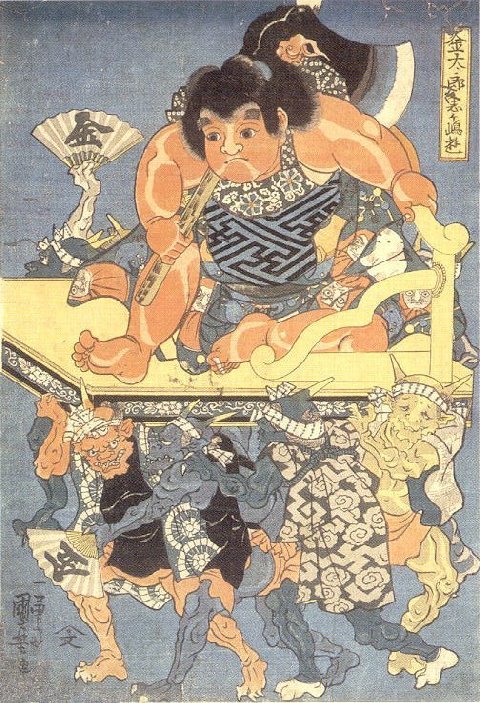
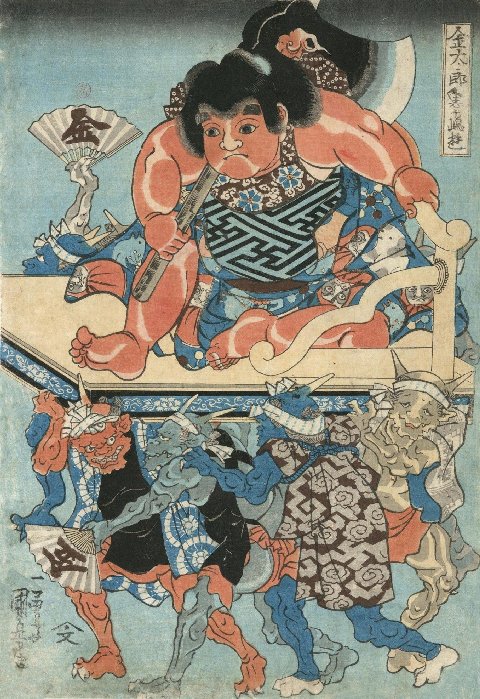
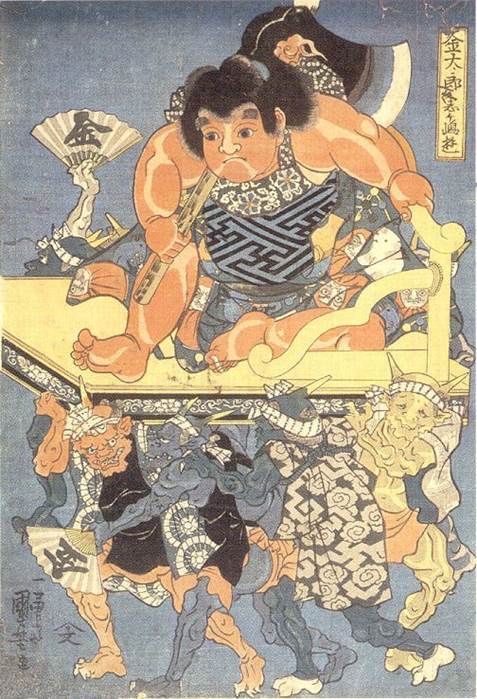
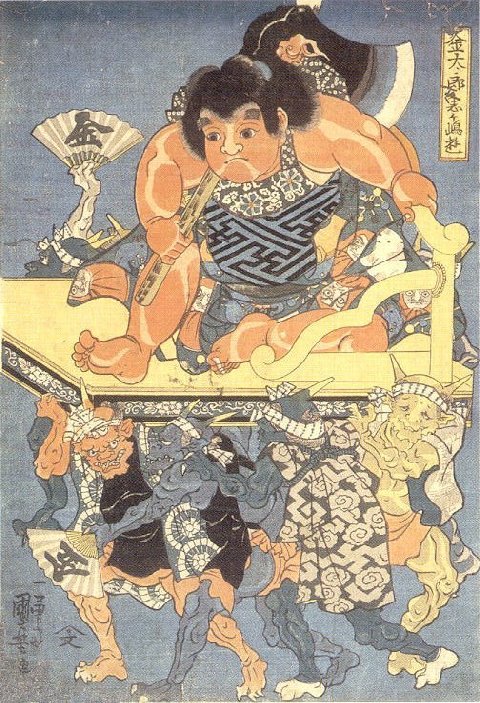
Subtitle: Kintarô and the Demons at Ogres’ Scene: Kintarô holding an axe is sitting in a portable shrine
which is carried on the shoulders of demons wearing festival clothing Robinson: Not listed |
|
|
Another state of the above design |
|
|
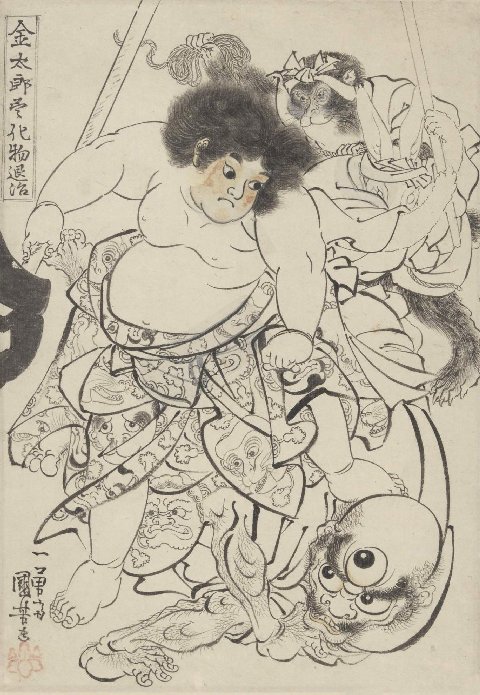
Subtitle: Monster
Extermination (Bakemono taiji, 化物退治) Scene: Kintarô fighting a three-eyed goblin Robinson: Not listed NOTE: This is a hanshita-e
(final drawing). |
|
The following prints are by Kuniyoshi’s student Yoshitsuya. They
were published by Ebi-ya Rinnosuke
c. 1849. |
|
|
|
Subtitle: New year (Shôgatsu, 正月) Scene: Kintarô throwing beans to banish demons at the start of the new year |
|
|
Subtitle: March (Sangatsu, 三月) Scene: Kintarô refereeing a sumô match between a rooster and a tengu |
|
|
Subtitle: May (Gogatsu,
五月) Scene: Kintarô riding a carp |
|
|
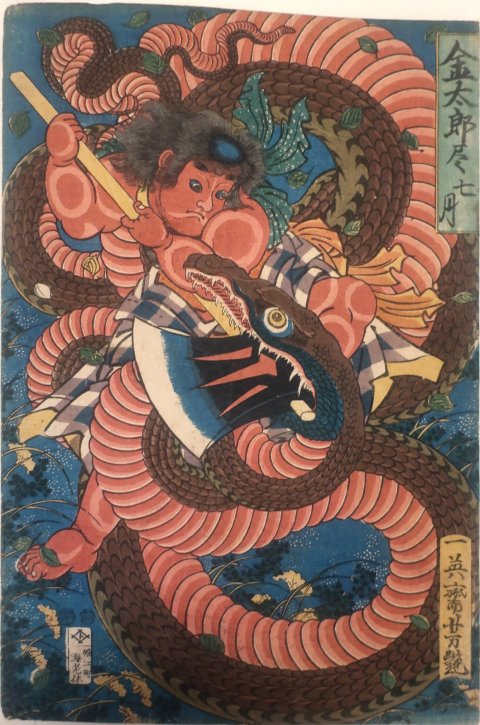
Subtitle: July (Shichigatsu, 七月) Scene: Kintarô fighting a giant serpent |
|
|
Subtitle: September (Kugatsu, 九月) Scene: Kintarô riding a bull while playing a flute |


|
“Robinson” refers to listing in Kuniyoshi: The Warrior-Prints by Basil William Robinson (Cornell University Press, Ithaca, NY, 1982) and its privately published supplement. CLICK HERE TO RETURN TO MAIN
PAGE
|