Heroes for the Five Elements
(Buyû go-gyô, 武勇五行)
Publisher: Minato-ya Kohei
1840
|
The Chinese
readings of the names of the five elements (godai) are wood (ki), fire (hi), earth (tsuchi), metal (kane), and water (mizu). The Japanese
readings of these same characters are moku, ka,
do, kon (or kin), and sui,
respectively. They do not represent
the modern scientific concept of elements as fundamental substances out of
which all things are composed. Rather,
they represent categories and concepts to which all things can be likened and
by which analyzed in a spiritual or philosophical manner. The five elements can be combined with the
dualistic yin-yang system to produce ten stems (jikken). In
this series of prints, historic and legendary heroes are likened to the ten stems. Robinson had seen only
six prints in this series, and it is unlikely that any more exist. These prints
are each about 14 by 5 inches (36 by 13 centimeters), a size known as chûtanzakuban. |
|
|
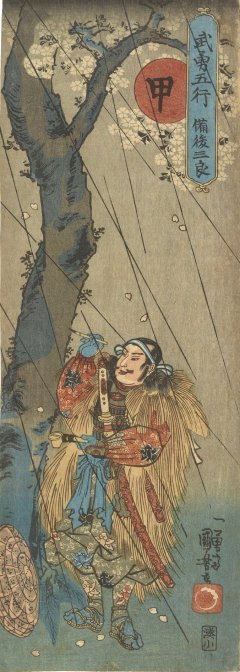
Element: wood (ki) Stem: kô (甲) Scene: Bingo Saburô (備後三良) writing a
message of encouragement to the captive Emperor Go-Daigô
on the trunk of a cherry tree Robinson: S16.1 |
|
|
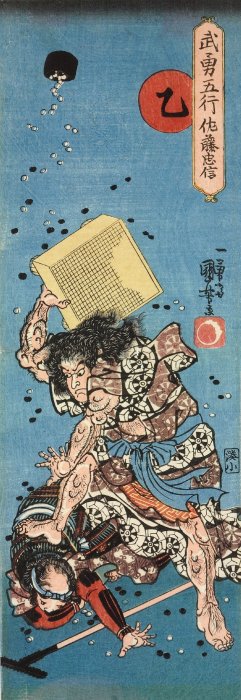
Element: wood (ki) Stem: otsu (乙) Scene: Satô Tadanobu (佐藤忠信) using a go board as a weapon to resist arrest Robinson: S16.2 |
|
|
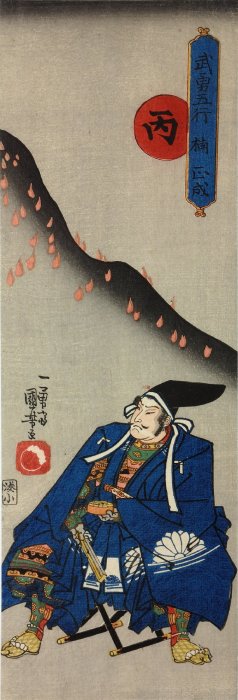
Element: fire (hi) Stem: hei (丙) Scene: Kusunoki
Masashige (楠 正成) seated on a
stool watching fox fires on a distant hill Robinson: S16.3 NOTE: In Japanese
legend, various supernatural powers are ascribed to foxes, including the
ability to transform themselves into people and into flames. The flames are called fox fires (kitsune bi). |
|
|
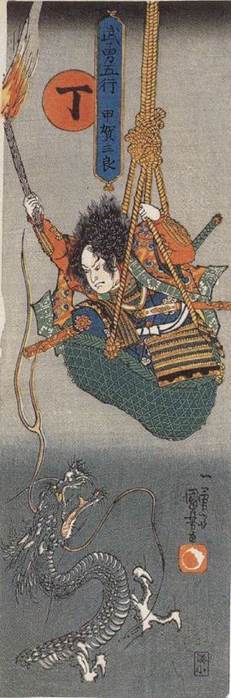
Element: fire (hi) Stem: tei (丁) Scene: Koga Saburô (甲賀三良) suspended in
a basket watching a dragon below Robinson: S16.4 |
|
|
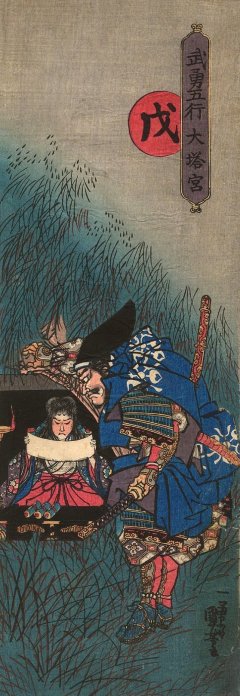
Element: earth (tsuchi)
Stem: bô (戊) Scene: Ôto-no-miya (Prince Morinaga Shinnô, 大塔宮) is visited by
the murder Fuchibe Yoshihiro while reading the
lotus sutra in his cave Robinson: S16.5 |
|
|
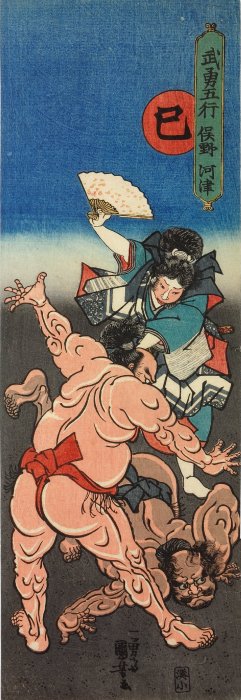
Element: earth (tsuchi)
Stem: ki (巳) Scene: Matano Gorô Kagehisa and Kawadzu Saburô Sukeyasu (俣野 河津) wrestling
with Ebina Gempachi Hirotsuna
umpiring Robinson: S16.6 |
|
“Robinson” refers to listing in Kuniyoshi: The Warrior-Prints by Basil William Robinson (Cornell University Press, Ithaca, NY, 1982) and its privately published supplement. CLICK HERE TO RETURN TO MAIN
PAGE
|