Comic and Miscellaneous
Triptychs and Diptychs,
Part I
|
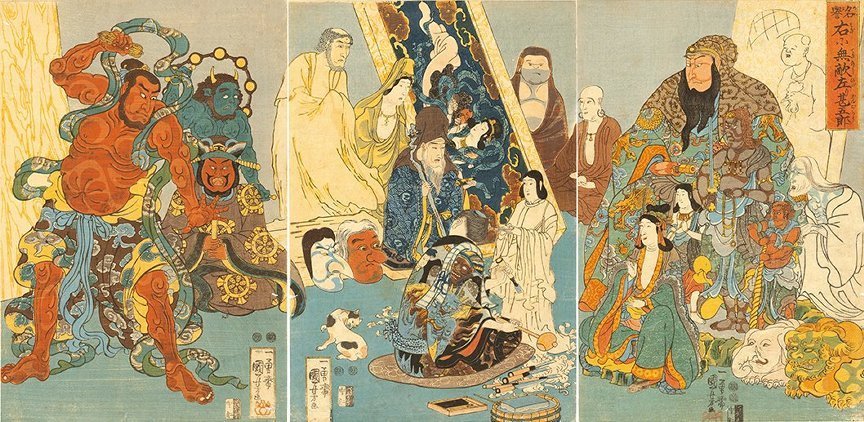
Title: The Famous
and Unrivalled Hidari Jingorô
(Meiyo migi ni teki nashi Hidari Jingorô, 名誉右に無敵左り甚五郎) Description: The
left-handed sculptor surrounded by his many creations Date: 1847-1850
(censors Mera and Murata) Publisher: Ebisu-ya Shôshichi |
|
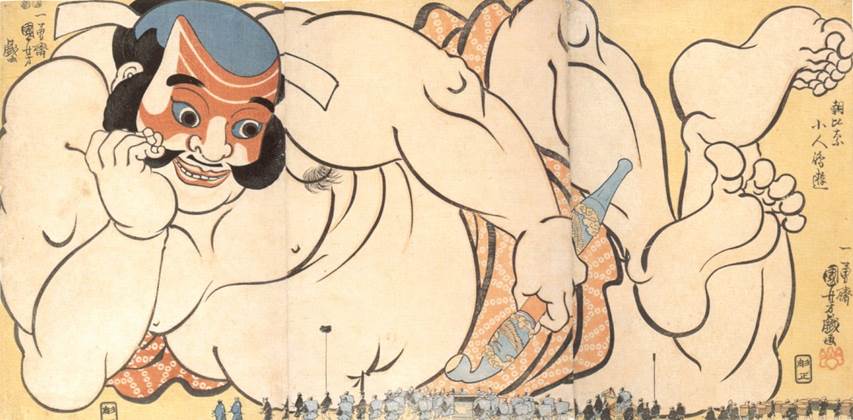
Title: Asahina’s
Travel to the Island of Dwarfs (Asahina
kobito jima asobi, 朝比奈小人嶋遊) Description: Ashima is
reclining and watching a daimyo’s parade passing by Date: 1846-1848 Publisher: Horimasa |
|
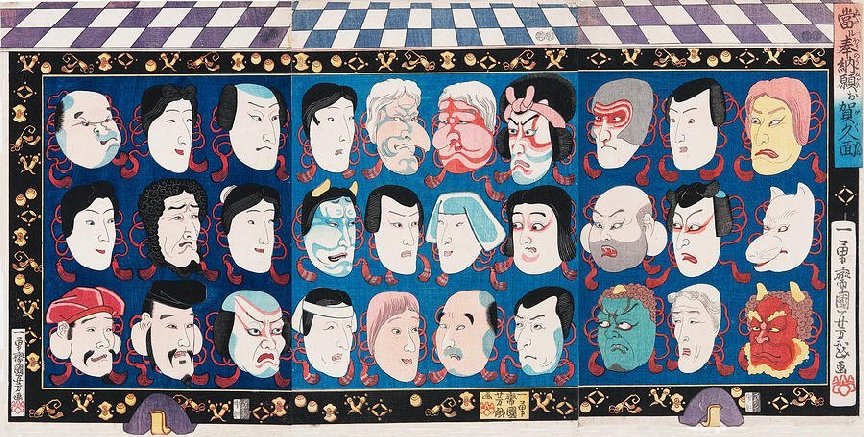
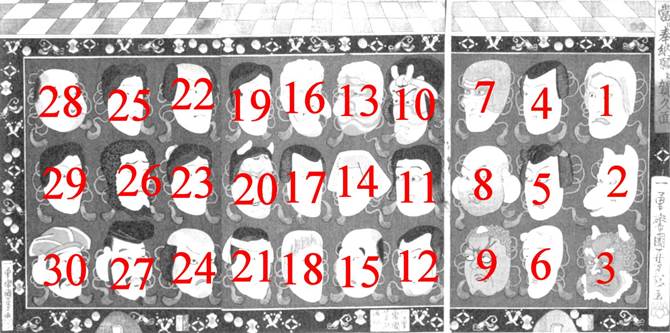
Title: The Votive
Tablet with Masks of Kabuki Actors Taken at Face Value (Ataru hônô negai
o gakumen,
當ㇽ奉納願お賀久面) Description: Thirty masks
with disguised portraits of the following actors represented in a framed
votive painting being offered at a Shinto shrine:
1. Nakamura Utaemon
IV 2. Matsumoto Kôshirô
VI 7. Bandô Hikosaburô IV Date: 1847-1848
(censors Hama and Kinugasa) Publisher: Ebisu-ya Shôshichi |
|
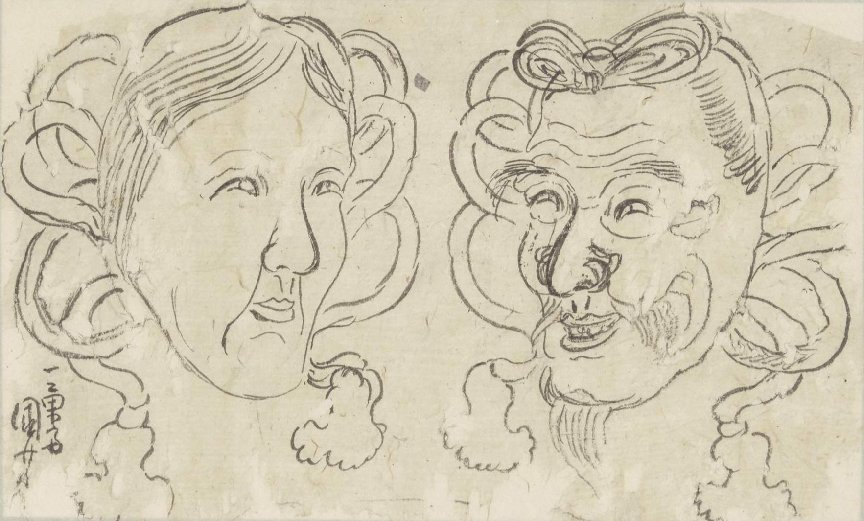
I am grateful to Robert Pryor for this drawing. |
|
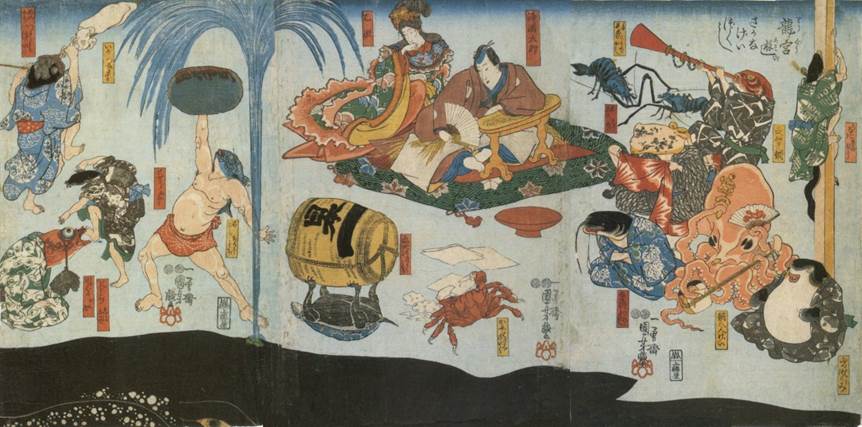
Title: Fish Showing
Performances in the Dragon’s Palace (Ryûgû asobi sakana gei zukushi) Description: Urashima Tarô and Princess Otohime, seated on a big cushion in the
centre of the triptych, are drinking sake while watching the performances of
various fish and sea dwellers from the dragon king palace. A whale appearing
on the lower half of the triptych sends up gigantic spouts of water from his
blowhole situated at the top of its head.
Following animals are performing their special talents (from right to
left): Date: 1847-1848 Publisher: Kazusa-ya Iwazô |
|
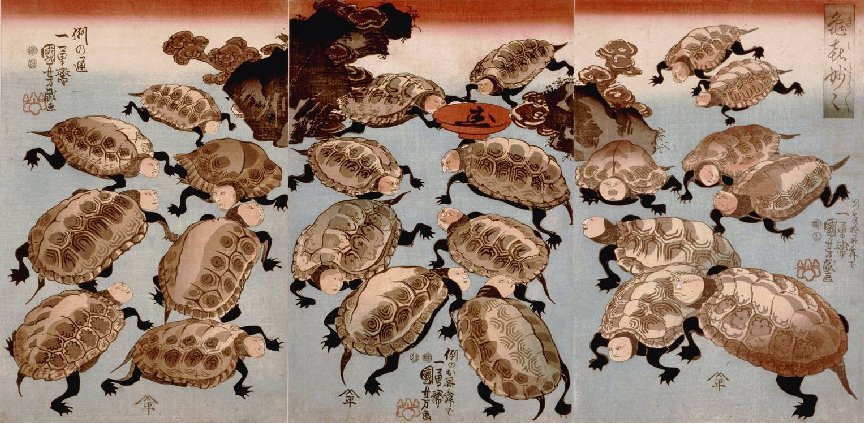
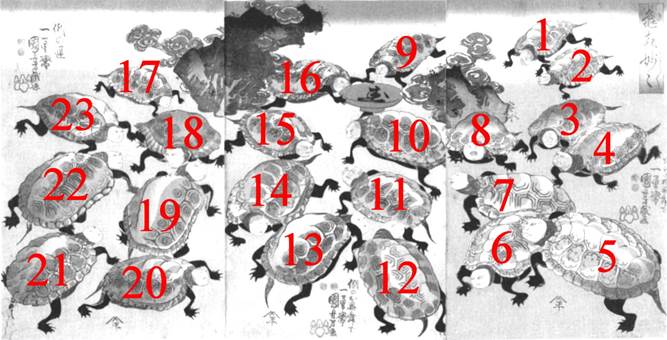
Title: Strange and
Wondrous Immortal Turtles (Kiki myômyô, 亀喜妙々) Description: Turtles heading for a sake cup in between to rocks. The red sake cup bears the character kotobuki.
The image title Kiki myômyô (亀喜妙々) is a pun that could be
read as "strange, strange" or as “dangerous, dangerous”. Kuniyoshi ironically refers to the ban on
actor portraits since the turtle’s Sino-Japanese reading KI is
identical with that of the character for "dangerous" (abunai).
Not only the distinctive facial features, but also the patterns and
characters concealed on the tortoise shell reveal the identities of the
following actors:
1.
Ôtani Hiroemon (tani) 10. Matsumoto Kôshirô
IV (matsu ,moto) Date: 1847-1850
(censors Mera and Murata) Publisher: Nomura Tokubei |
|
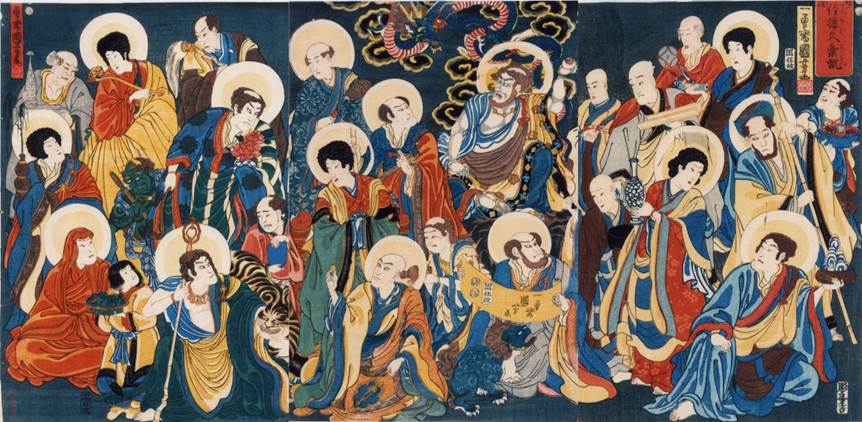
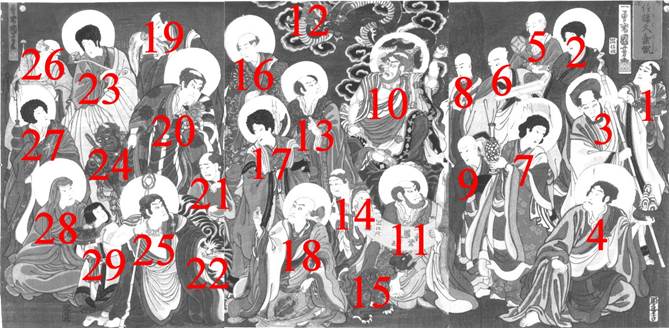
Title: Theatrical
Parody of the Sixteen Ahrats (Mitate jûroku rakan, 美達住楼久楽翫) Description: The title of the triptych Mitate
jûroku rakan (Theatrical
Parody of the Sixteen Ahrats) is a pun on words
alluding to the beautiful men who are staying in the brothels forever. The
triptych illustrates 29 densely packed figures consisting of Buddha’s
disciples (arhat, rakan), apprentices (dôji) and various foreign looking animals
personifying famous actors. The most celebrated actors are depicted with a
nimbus indicating their status as Buddha’s disciples. Usually there are 16
disciples but in this depiction only 15 appear. The famous kabuki star
Ichikawa Kuzô II is missing his nimbus which was
probably unintended. The majority of the portrayed actors are displayed as
Asians with curly, brown hair and a beard. Hairstyle, garment and figure of
the impersonators of female roles (onnagata) are illustrated in
distinctively western style. Kuniyoshi who was keen on all things foreign
depicted Buddha’s disciples as the following actors:
1.
Date: 1849-1851
(censors Fuku and Muramatsu) Publisher: Sumiyoshi-ya Masagorô |
|
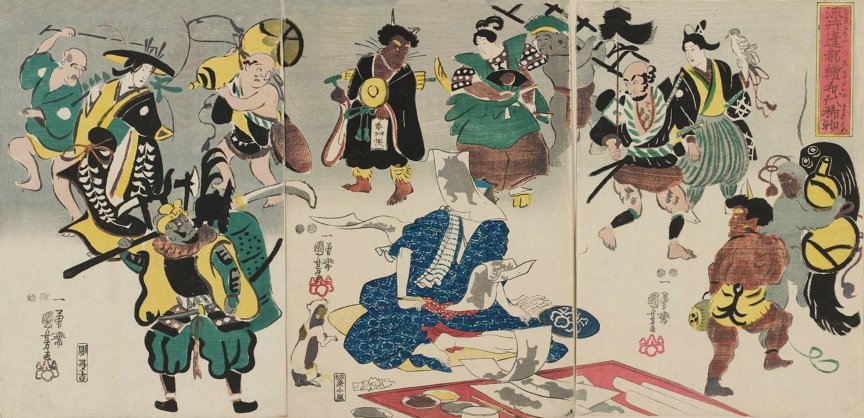
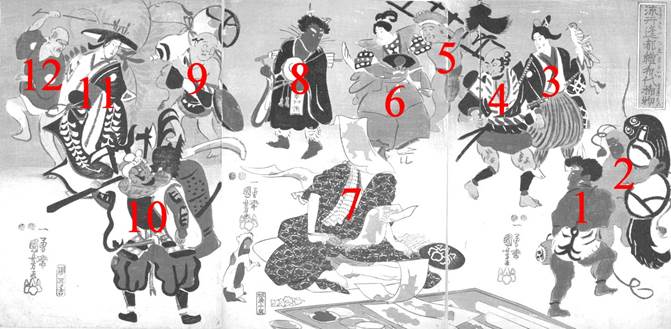
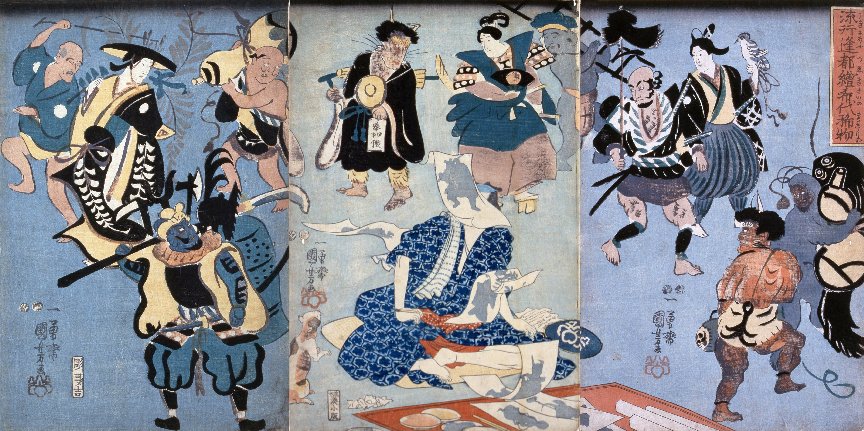
Title: Popular Ôtsu-e for the Times: A Long-Awaited
Rarity (Toki ni au Ôtsu-e kitai no maremono, 梳行逢都繪代稀物) Description: The artist
Ukiyo Matabei surrounded by Ôtsu-e
characters that have come to life to protect him. Ukiyo Matabei’s
face is hidden by a sheet of paper from which the Ôtsu-e
have escaped but the paulownia crest (yoshikiri)
on the fan in the artist’s hand and the presence of a cat reveals that Matabei is the feline lover Kuniyoshi himself. The Ôtsu-e figures dancing around the artist are
disguised portraits of the following actors:
1.
6.
Iwai Kumesaburô Date: 1847-1848
(censors Hama and Kinugasa) Publisher: Minato-ya Kohei |
|
I am grateful to Robert Pryor for this state
with a blue background. |
|
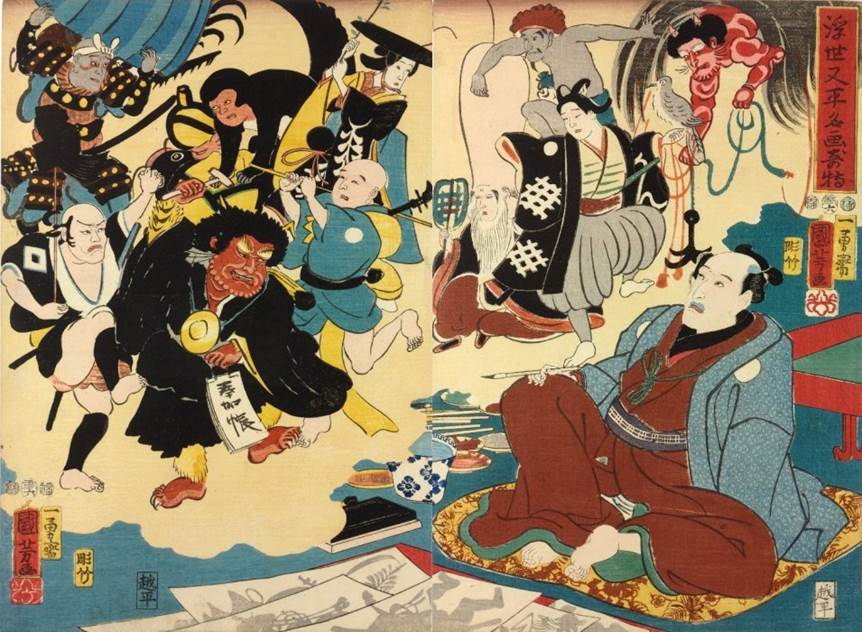
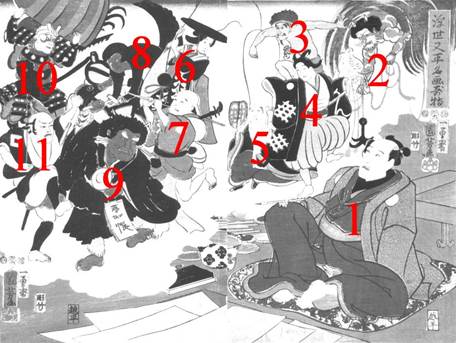
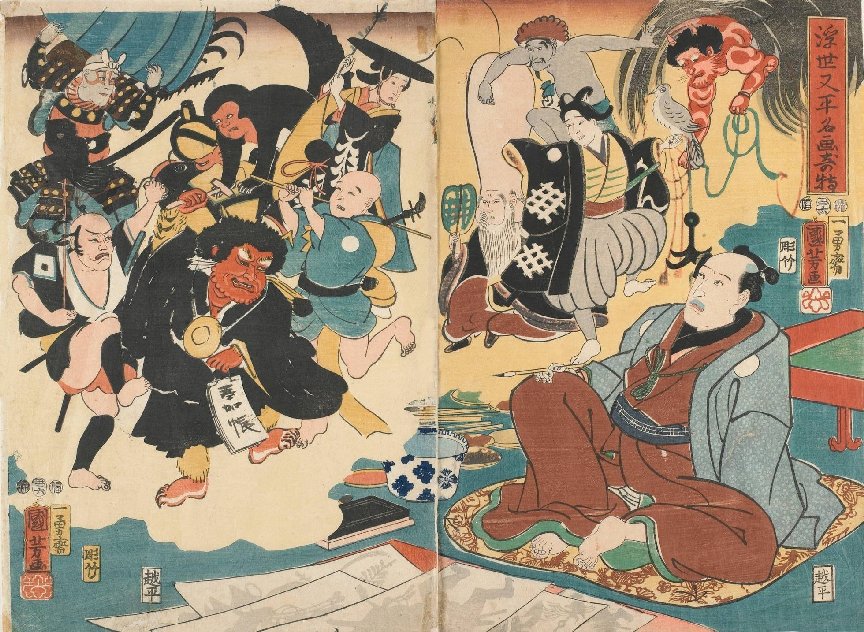
Title: Miracle of Masterpieces
by Ukiyo Matabei (Ukiyo Matabei meiga
no kidoku, 浮世又平名画の奇特) Description: The artist
Ukiyo Matabei making paintings that come to life
and parade around him. The paintings
resemble the following actors:
1.
Publisher: Koshimura-ya Heisuke |
|
I am grateful to Robert Pryor for this image in
which the seals of the publisher (Koshimura-ya Heisuke, 越平) and the carver (Hori Take, 彫竹) are colored differently. |
|
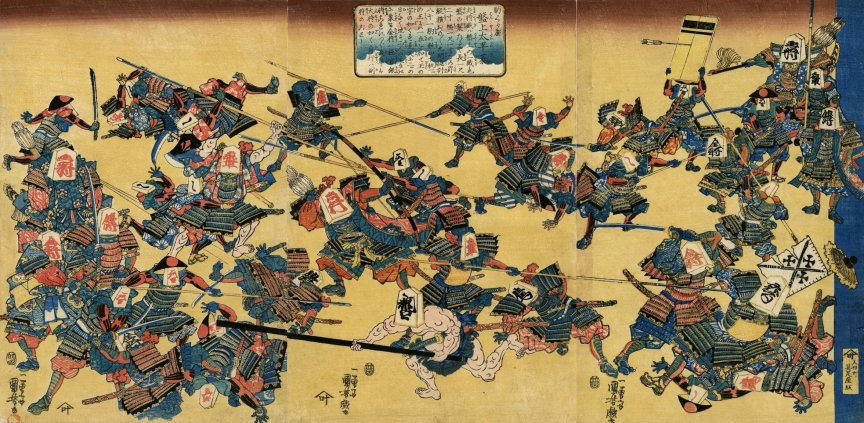
Title: Battle of the
Shogi Pieces: Prosperity and Peace
across the Board (Koma kurabe banjô taiheiki, 駒くらべ盤上太平棋) Description: Pieces from Shogi (a game like chess) are fighting Date: 7th
month of 1843 Publisher: Gusoku-ya Kahei |
|
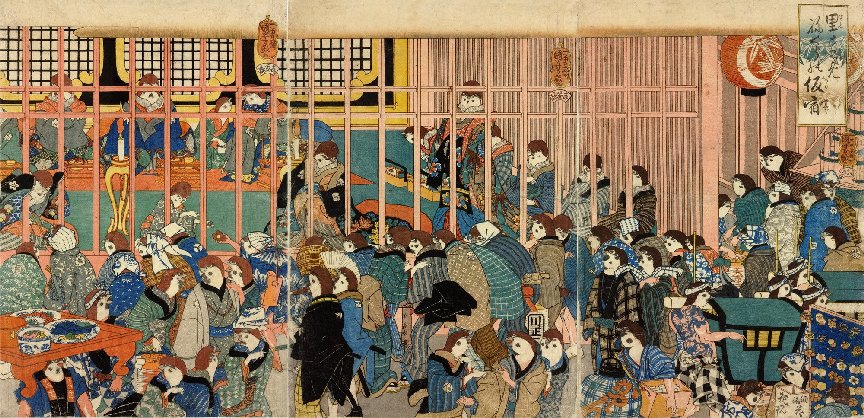
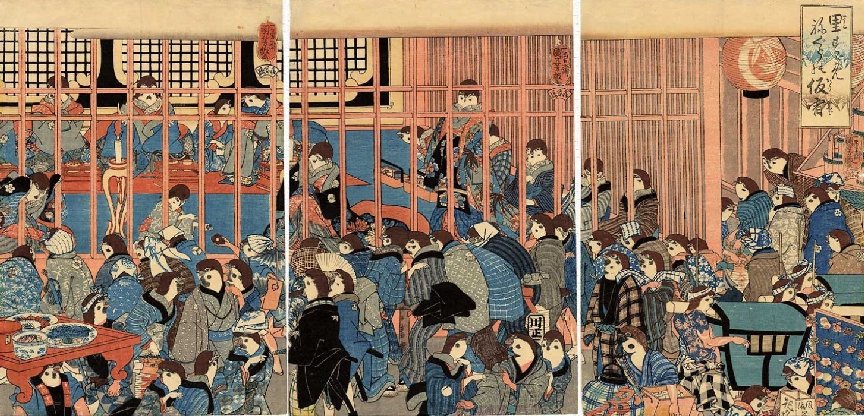
Title: The Yoshiwara
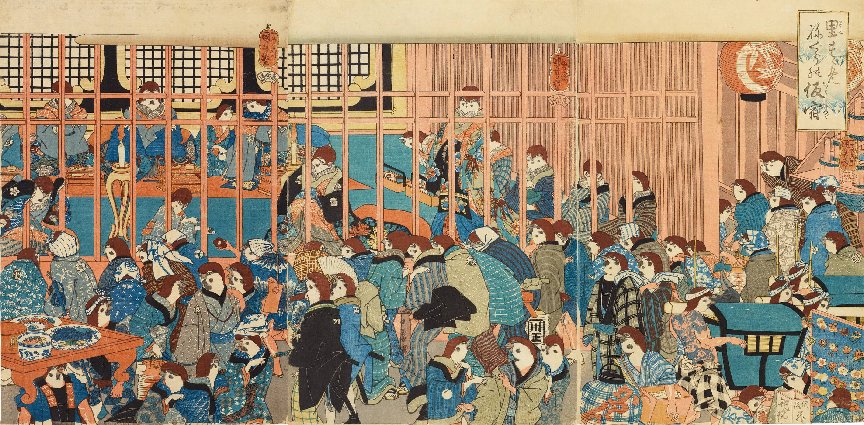
Sparrows’ Temporary Nest (Sato suzume negura no kariyado, 里すゞめねぐらの仮宿) Description: A crowd of
personified male and female sparrows looking through the latticework is
depicted on the street in the foreground. Sparrows as courtesans adorned in
extravagant robes are sitting in a room projected toward the street
surrounded by latticework while awaiting their prospective customers. A few
sparrows in the foreground are carrying baskets and little tables. Date: 5th
month of 1846 Publisher: Kita-ya Magobei’s fan-shaped seal is
under Kuniyoshi’s signature on all three sheets, and Kawaguchi-ya Shôzô’s seal (川正) is on a paper
lantern on the center sheet. NOTE: In 1845, a fire destroyed the brothels of the Yoshiwara,
forcing the courtesans to move to a temporary location, which this triptych
illustrates. Since prints showing courtesans were banned by
the “Tenpô reforms”, the courtesans were replaced with sparrows. The kimono of the young sparrow purchasing something
through the grille is decorated with Kuniyoshi’s kiri
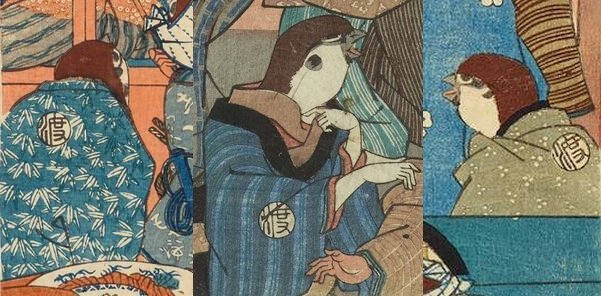
mon, as is that of the girl looking at kanzashi hair decorations, bottom right. The seal of the censor Watanabe Shôemon (a stylized 渡 within a circle) appears on the
haori (coat) of one sparrow in each sheet:
I am grateful to Robert Pryor for these images and information. |
|
In this state, Watanabe Shôemon’s mon (crest) was removed from the center sheet. |
|
Another state with blue as the only color in the
title cartouche |
|
|