Twenty-four Paragons of Filial Piety of Our Country
(Honchô nijûshi-kô, 本朝廿四考)
Publisher: Murata-ya Tetsu
1842-1843
|
This
series of prints portrays a warlike lot of children from Japanese history and
legend–several free their parents from captivity or avenge their parents’
deaths. The prints in this series are
each about 10 by 7 inches (25 by 18 centimeters), a size known as chûban. |
|
|
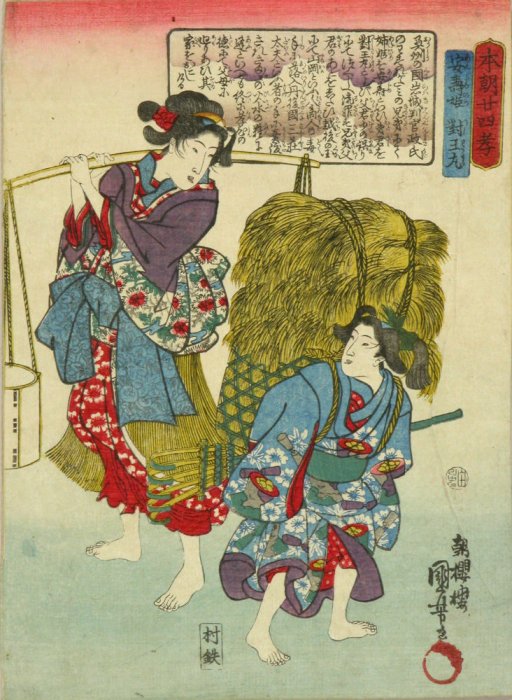
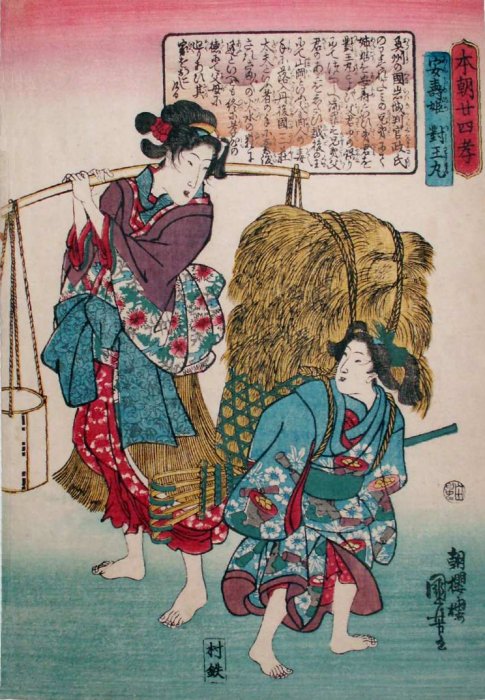
Title: Anju-hime and Tsushiô Maru (安壽姫 封王丸) Scene: Anju-hime carrying two buckets on a pole over her shoulder
accompanied by her brother, Tsushiô Maru who is
carrying a rake and a basket of reeds Robinson: S23.1 |
|
|
This state, which lacks the Toshidama
seal in the right lower corner, was probably printed after 1844. In 1844, Kunisada, a competitor of
Kuniyoshi, proclaimed himself the head of the Utagawa school, and adopted the
name Toyokuni, which was the name of the previous
leader of the school. Kuniyoshi
responded by severing his relationship with the school and stopped using the Toshidama seal, which was the schoolʼs
heraldic device. |
|
|
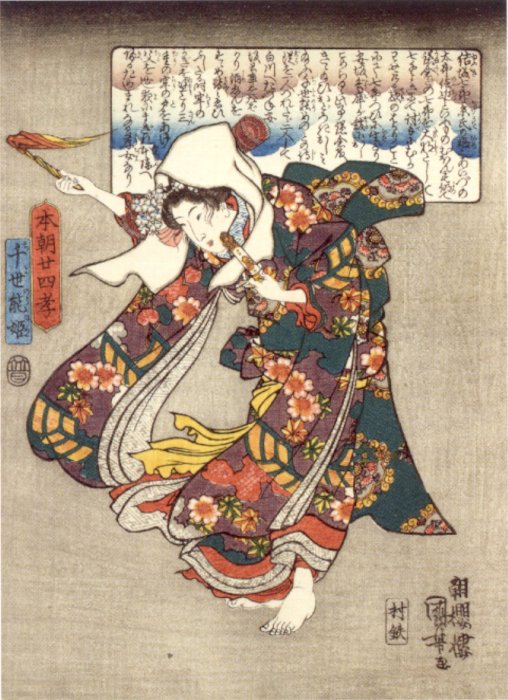
Title: Chiyonô-hime (チ世能姫) Scene: Chiyonô-hime in a wind holding a torch and a dirk about
to rescue her father from imprisonment after the rebellion of Aidzu no Tarô Nobuchika against Yoritomo Robinson: S23.2 |
|
|
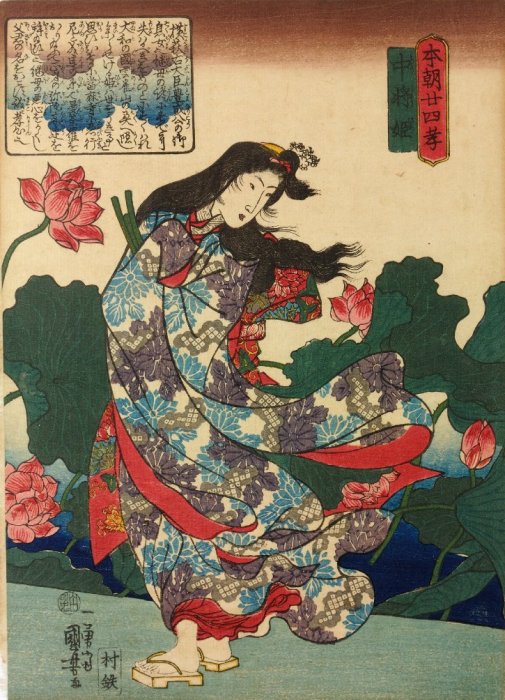
Title: Chûjô-hime (中将姫) Scene: Chûjô-hime walking by a lotus pond on a windy day Robinson: S23.3 |
|
|
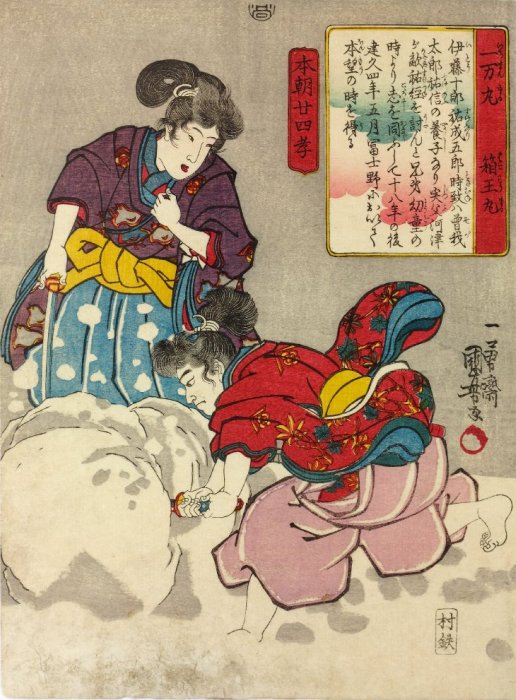
Title: Ichiman-maru (一万丸) and
Hako-o-maru (箱王丸) Scene: The young
Soga brothers practice swordsmanship on a heap of snow in order to avenge
their father Robinson: S23.4 |
|
|
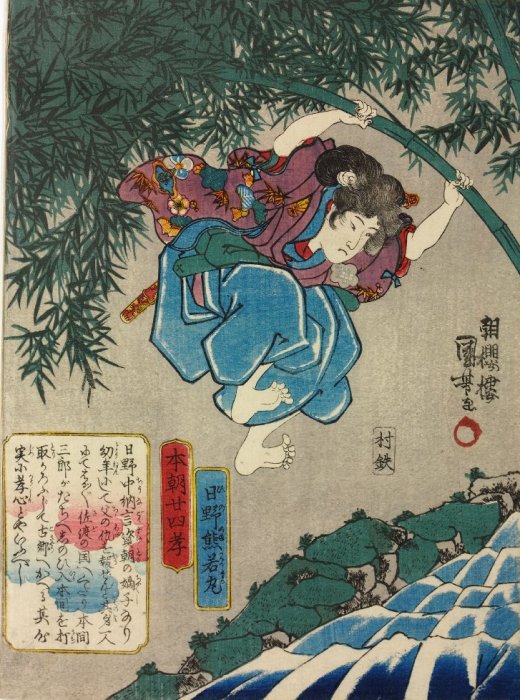
Title: Hino Kumawaka-maru (日野熊若丸) Scene: Hino Kumawaka Maru training to avenge his father by swinging
across a stream on a bamboo Robinson: S23.5 |
|
|
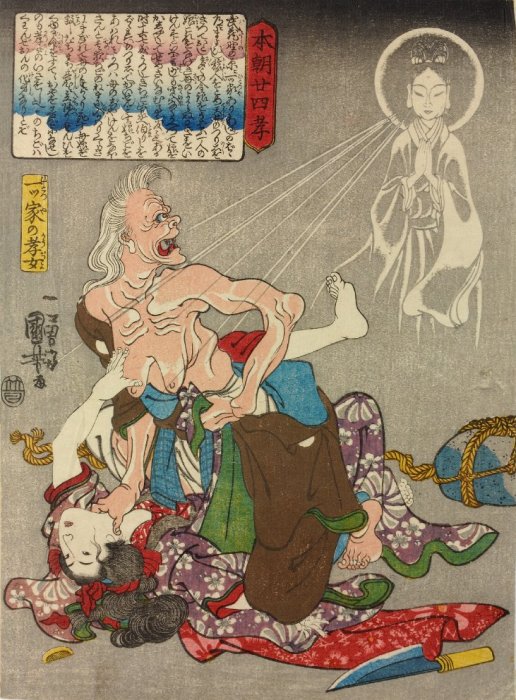
Title: The Dutiful
Girl of the Hitotsuya (Hitotsuya no Kojo, 一ツ家の孝女) Scene: The dutiful
girl of Hitotsuya saved from the hag of the lonely
house by an apparition of the goddess Kannon Robinson: S23.6 |
|
|
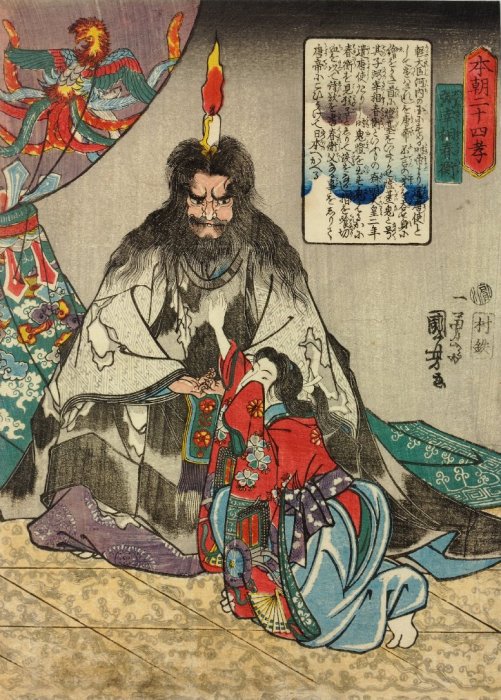
Title: Hitsu-no-Saishô Haruhira (弼宰相春衡) Scene: Hitsu-no-Saishô Haruhira recognizes his Father who was forced to act as a
lighthouse with a candle on his head Robinson: S23.7 |
|
|
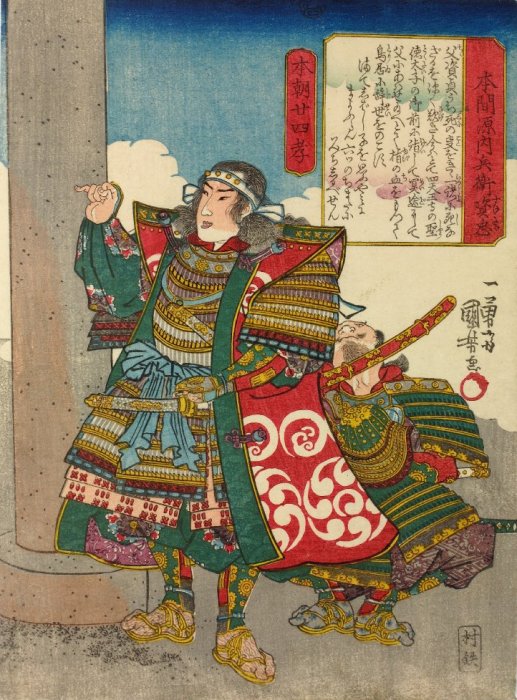
Title: Homma Gennai-hyôe Suketada (本間源内兵衛資忠) Scene: Homma Gennai-hyôe Suketada writing
his farewell poem on a torii at Shitennôji with his own blood after the death of his
father Sukesada Robinson: S23.8 |
|
|
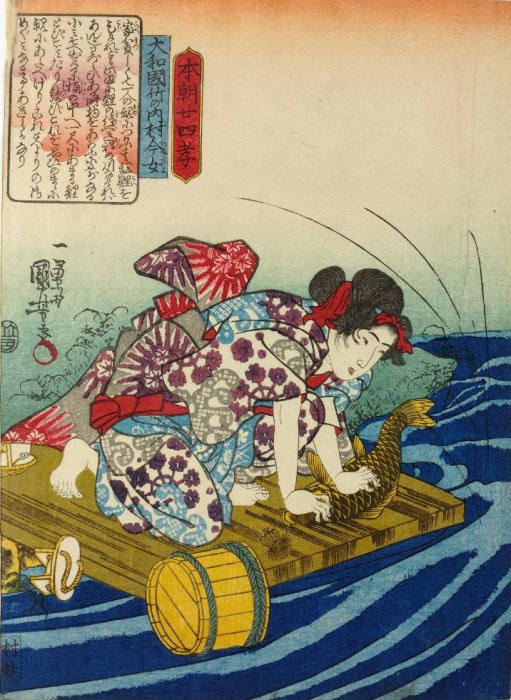
Title: Ima-jo of
Take-no-uchi Village in Yamato (Yamato-kuni
Take-no-uchi mura no
Ima-jo, 大和国竹の内村今女) Scene: The poor girl
Ima-jo catching a carp to feed her parents Robinson: S23.9 |
|
|
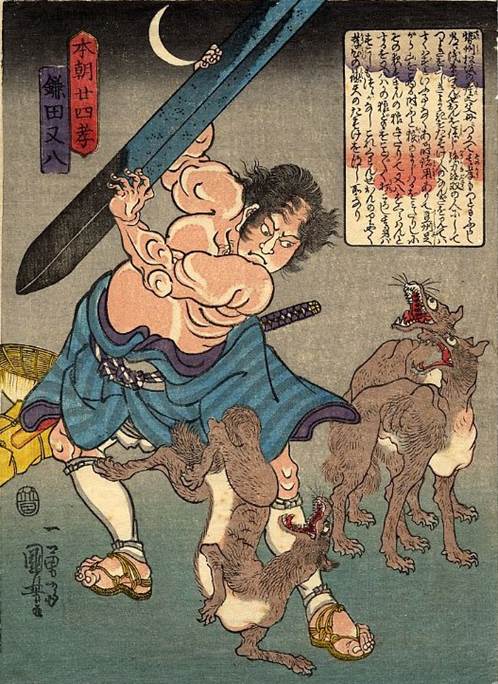
Title: Kamada Matahachi (鎌田又八) Scene: Kamada Matahachi of Matsuzaka
fighting off wolves with a huge iron bar in the Robinson: S23.10 |
|
|
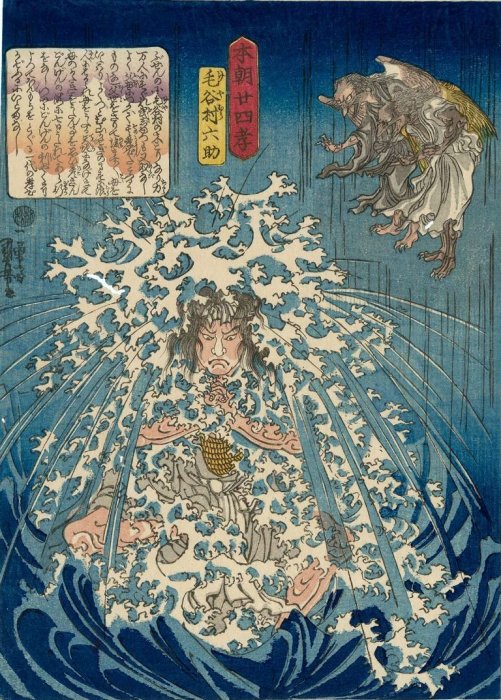
Title: Keyamura Rokusuke (毛谷村六助) Scene: Keyamura Rokusuke spending
seven days under the Hikosan Gongen
Waterfall Robinson: S23.11 |
|
|
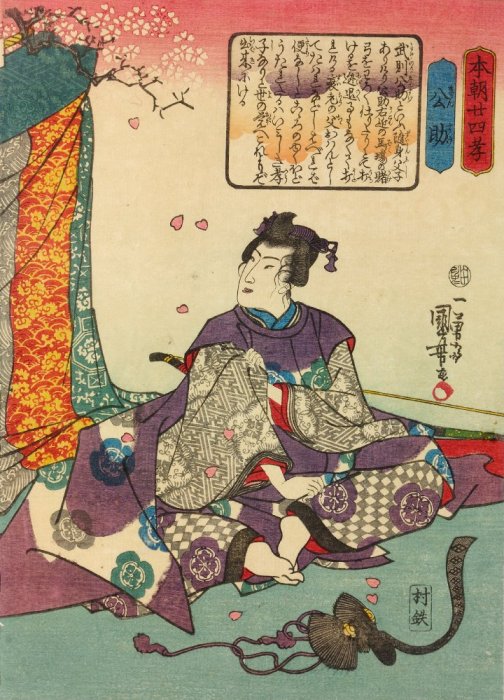
Title: Kinsuke (公助) Scene: Takenori Kinsuke seated with
his bow behind him and the hat of a palace guard before him Robinson: S23.12 |
|
|
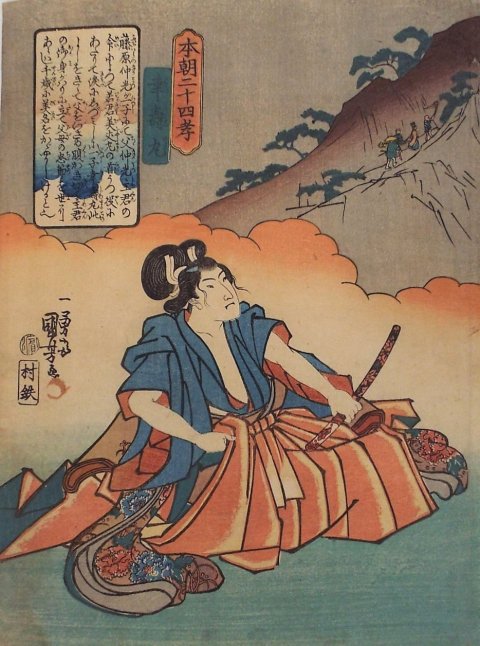
Title: Kôju Maru (幸壽丸) Scene: Kôju Maru seated grasping a dirk and about to perform seppuku with travelers on a mountain
behind him Robinson: S23.13 NOTE: The term “hara-kiri”, although more common in
English than “seppuku”, is
considered in |
|
|
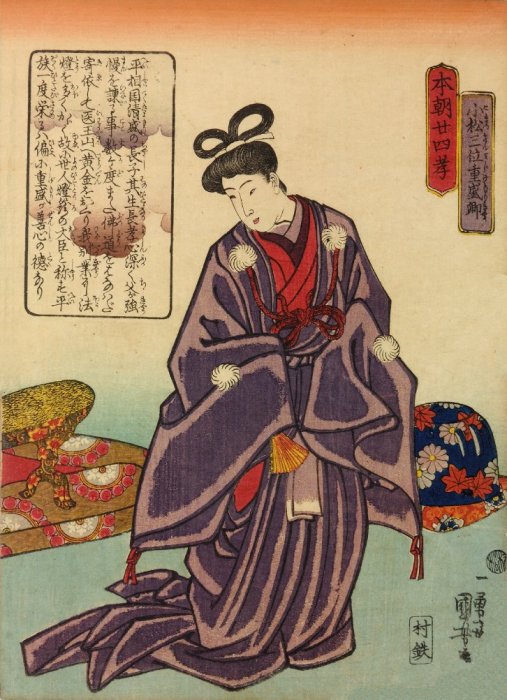
Title: Komatsu Sammi
Shigemori-kyô (小松三位重盛卿) Scene: Komatsu Sammi
Shigemori-kyô as a youth Robinson: S23.14 |
|
|
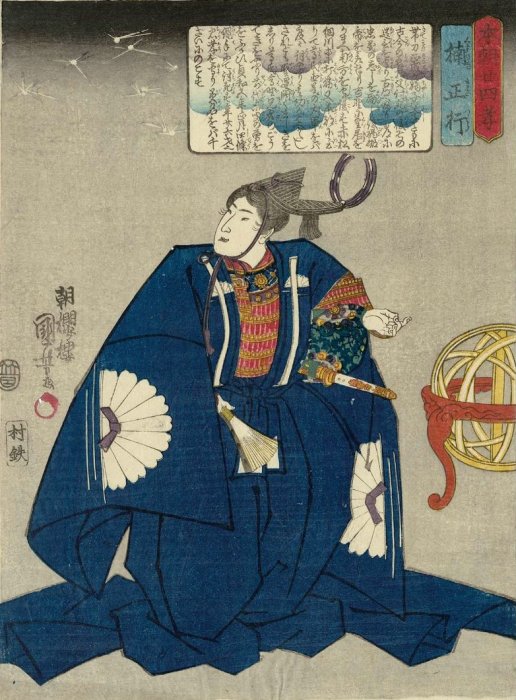
Title: Kuzunoki Masatsura (楠木正行) Scene: Kusunoki Masatsura in court robes over armor beside an armillary
sphere on a starry night Robinson: S23.15 |
|
|
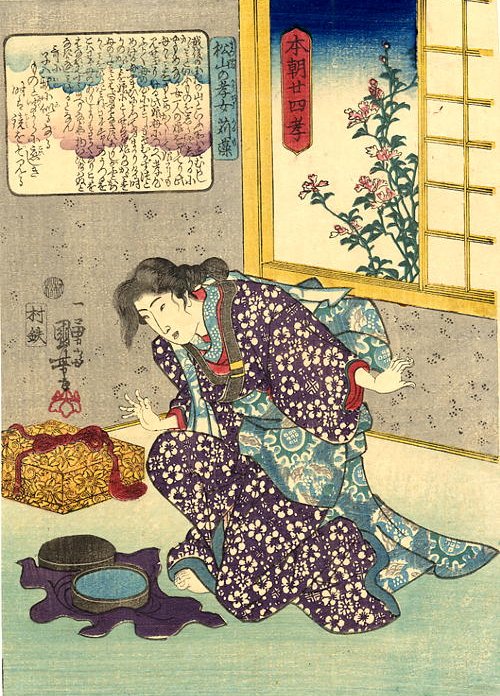
Title: Karumo, the Dutiful Daughter of Matsuyama (Matsuyama no Kojo Karumo,
松山の孝女刈摸) Scene: Karumo looking in astonishment in a mirror on the floor
in which she mistakes her own reflection for that of her dead mother Robinson: S23.16 |
|
|
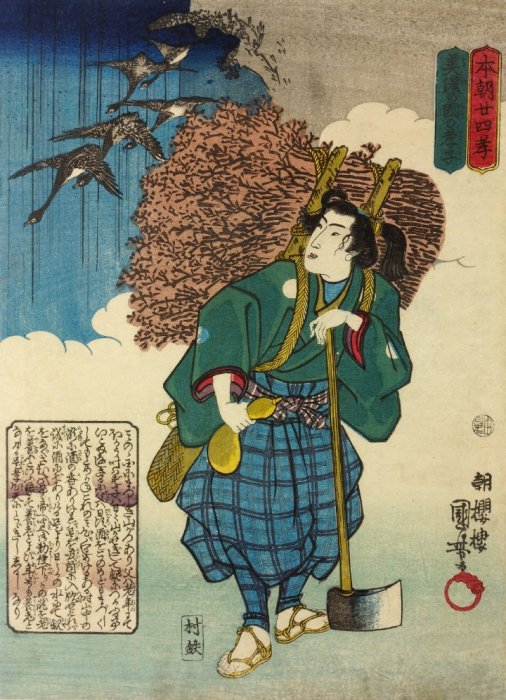
Title: The Dutiful
Son of Mino (Mino no kuni no koshi, 美濃の国の孝子) Scene: The dutiful
youth from Robinson: S23.17 |
|
|
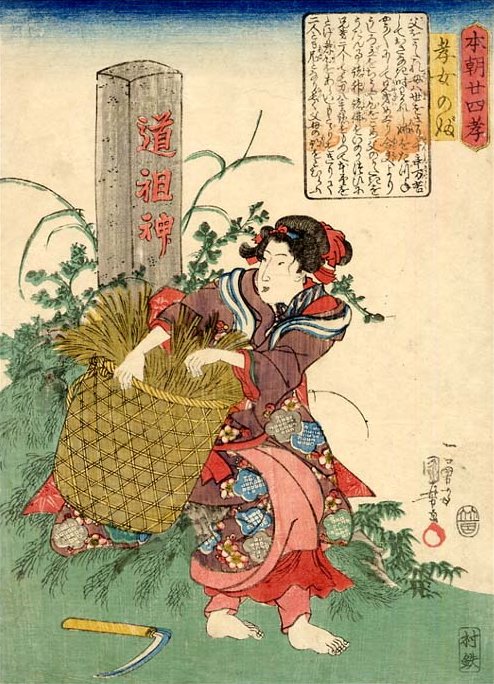
Title: The Dutiful
Daughter Nobu (Kojo Nobu, 孝女のぶ) Scene: Nobu with her
sickle on the ground carrying a basket of rushes for her aged mother Robinson: S23.18 |
|
|
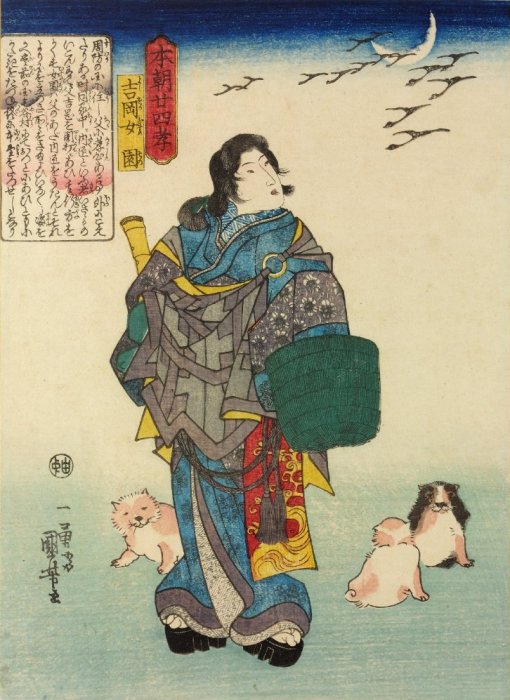
Title: Sono, The Daughter of Yoshioka (Yoshioka musume Sono,
吉岡女園) Scene: Sono dressed as a nun and carrying a shakuhachi (traditional Japanese bamboo flute) with three puppies
at her feet Robinson: S23.19 |
|
|
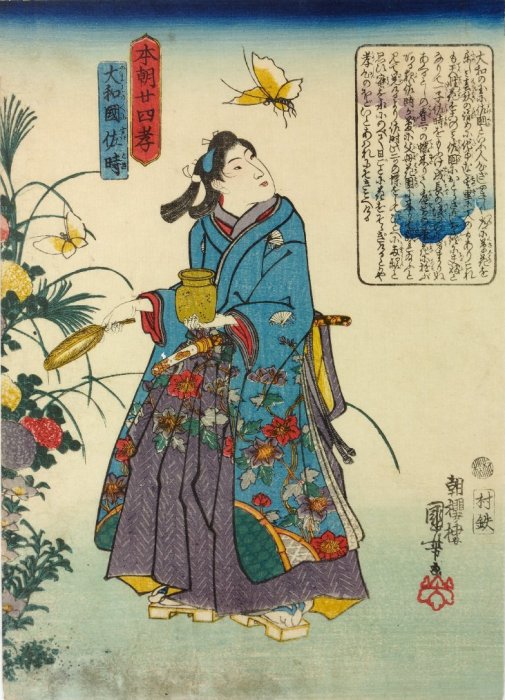
Title: Suketoki of Yamato (Yamato-kuni Suketoki, 大和国佐時) Scene: Suketoki visiting with his dead parents who returned to
him in the form of butterflies Robinson: S23.20 |
|
|
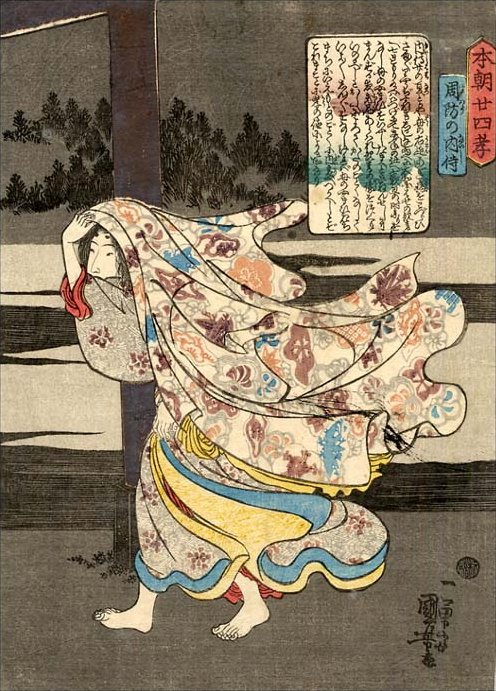
Title: Suô no Naishi (周防の内侍) Scene: The poetess, Suô no Naishi, walking on a
windy night Robinson: S23.21 |
|
|
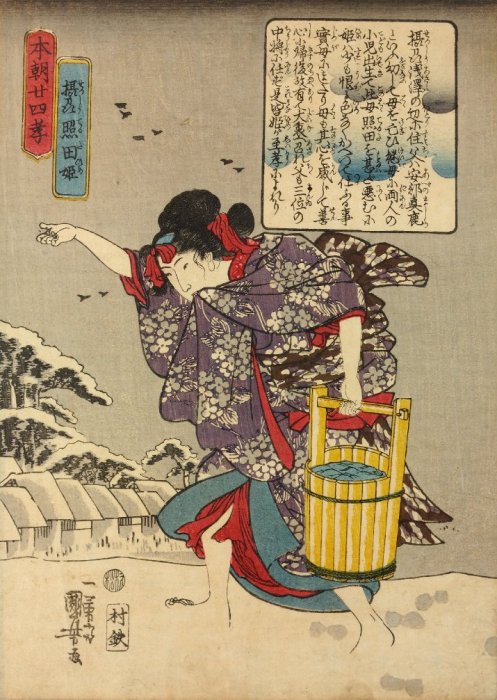
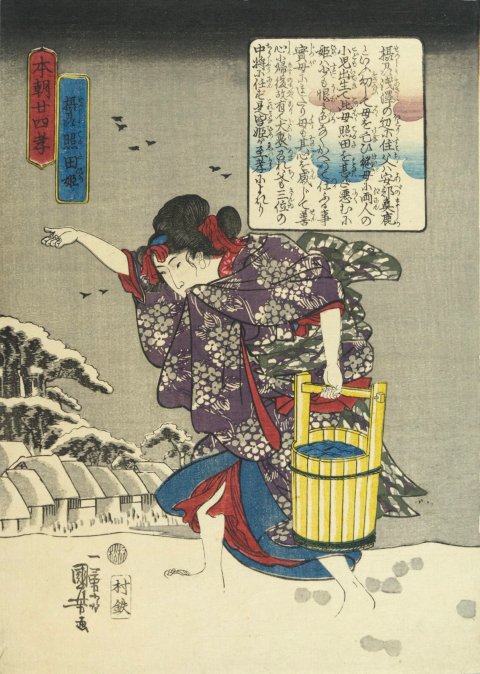
Title: Sesshû Teruta-hime (摂州照田姫) Scene: Teruta-hime carrying a water bucket through the snow Robinson: S23.22 |
|
|
I am grateful to Phil Phillips for this alternate state of the
above design with pink clouds in the text box. |
|
|
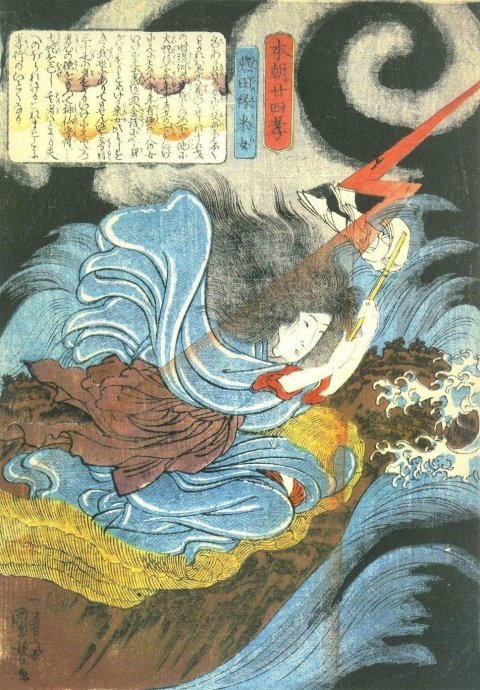
Title: Atsuta no en Uneme (熱田縁釆女) Scene: Uneme of Atsuta, holding a gohei,
exorcising the monstrous serpent of the Robinson: S23.23 |
|
|
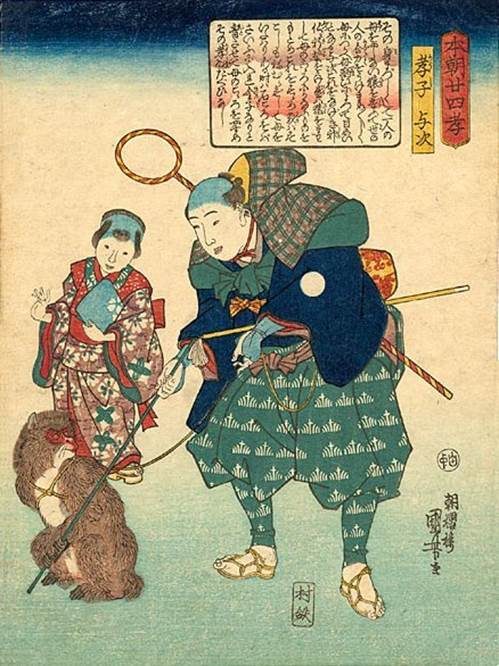
Title: The Dutiful
Child Yoji (Koshi Yoji, 孝子与次) Scene: Yoji working
as a monkey-trainer to earn money to aid his sick mother Robinson: S23.24 |
|
|
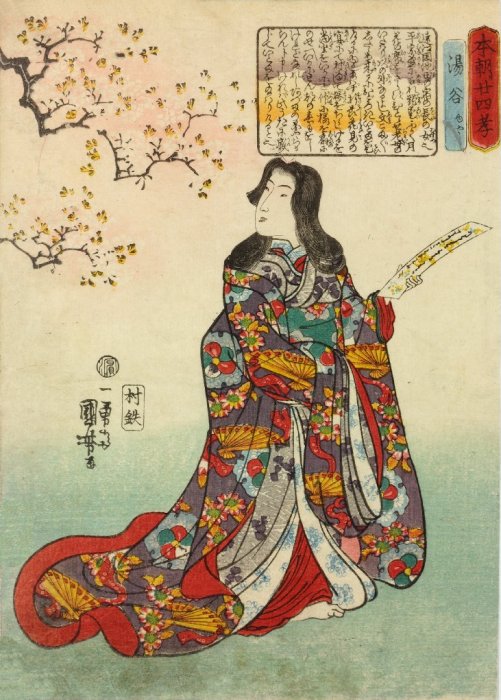
Title: Yuya (湯谷) Scene: Yuya holding a poem-card by a blossoming cherry tree Robinson: S23.25 |
|
|
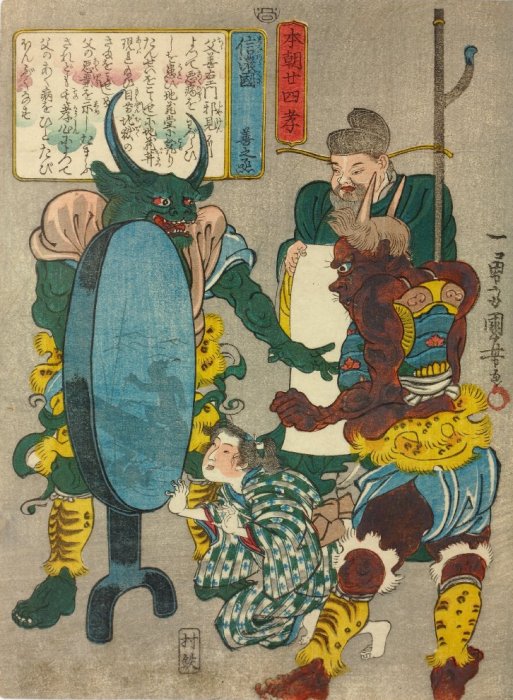
Title: Zennojô of Shinano (Shinano kuni no Zennojô, 信濃国善之丞) Scene: Zennojô with two demons and one of the judges of hell
seeing a vision in a large mirror Robinson: S23.26 |
|
“Robinson” refers to listing in Kuniyoshi: The Warrior-Prints by Basil William Robinson (Cornell University Press, Ithaca, NY, 1982) and its privately published supplement. CLICK HERE TO RETURN TO MAIN
PAGE
|